


Corrosive Symbols: A Guide to GHS Hazard Labels
Corrosive symbols are the hazard pictograms that warn a substance can burn skin, damage eyes or eat through metal on contact. Under the Globally Harmonized System (GHS), the corrosion pictogram is a black icon of liquid dripping onto a hand and a metal bar, set inside a red-bordered white diamond. For facility and safety managers, understanding this symbol is the first step towards labelling containers, signing storage areas and protecting staff correctly.
This guide explains what the pictogram shows, what it means, where it applies and how to put it to work across a factory, mine or retail site.
What Do Corrosive Symbols Look Like?
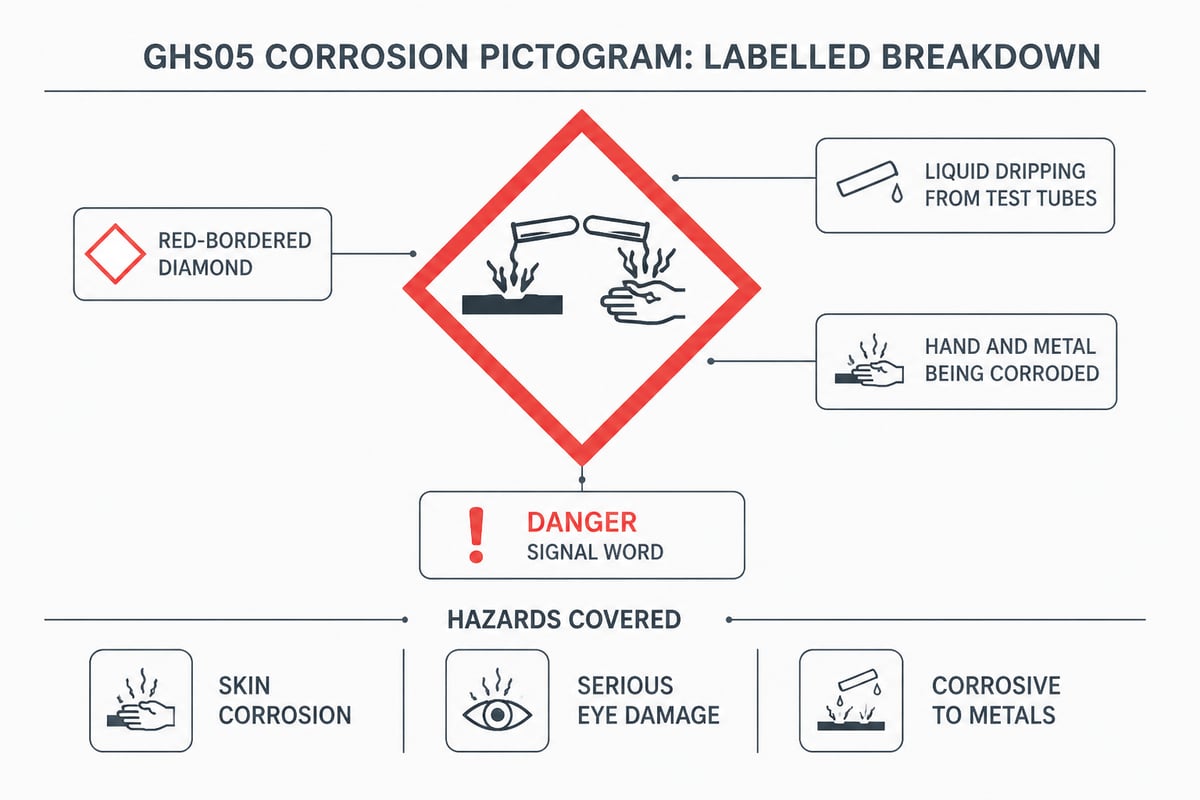
The GHS corrosion pictogram (officially GHS05) is a red-bordered square set on its point, with a white background and a black symbol. The symbol shows two test pieces being attacked by liquid: one drop falls on a hand, and another falls on a metal surface, both showing damage.
Three features identify it quickly:
- The diamond shape. A square rotated 45 degrees, always with a red border.
- The two images. A hand and a bar, each marked by dripping liquid.
- The black-on-white palette. The symbol itself is black, never coloured, on a white field.
Different symbols can look similar from a distance, so it helps to know what separates them. The exclamation mark pictogram (GHS07) covers irritants and mild toxicity. The health hazard pictogram (GHS08) shows a human silhouette with a starburst on the chest and covers long-term effects such as carcinogenicity. Only the corrosion pictogram shows liquid damaging a hand and metal.
What Do Corrosive Symbols Mean?
A corrosive symbol means the product can cause irreversible damage to living tissue or materials through chemical action. GHS applies it to three kinds of hazard:
- Skin corrosion. Destruction of skin tissue, from visible dead tissue through to full-thickness burns, after a short exposure.
- Serious eye damage. Tissue damage in the eye, or severe physical decay of vision, that does not fully heal within 21 days.
- Corrosive to metals. Substances that materially damage or destroy metals.
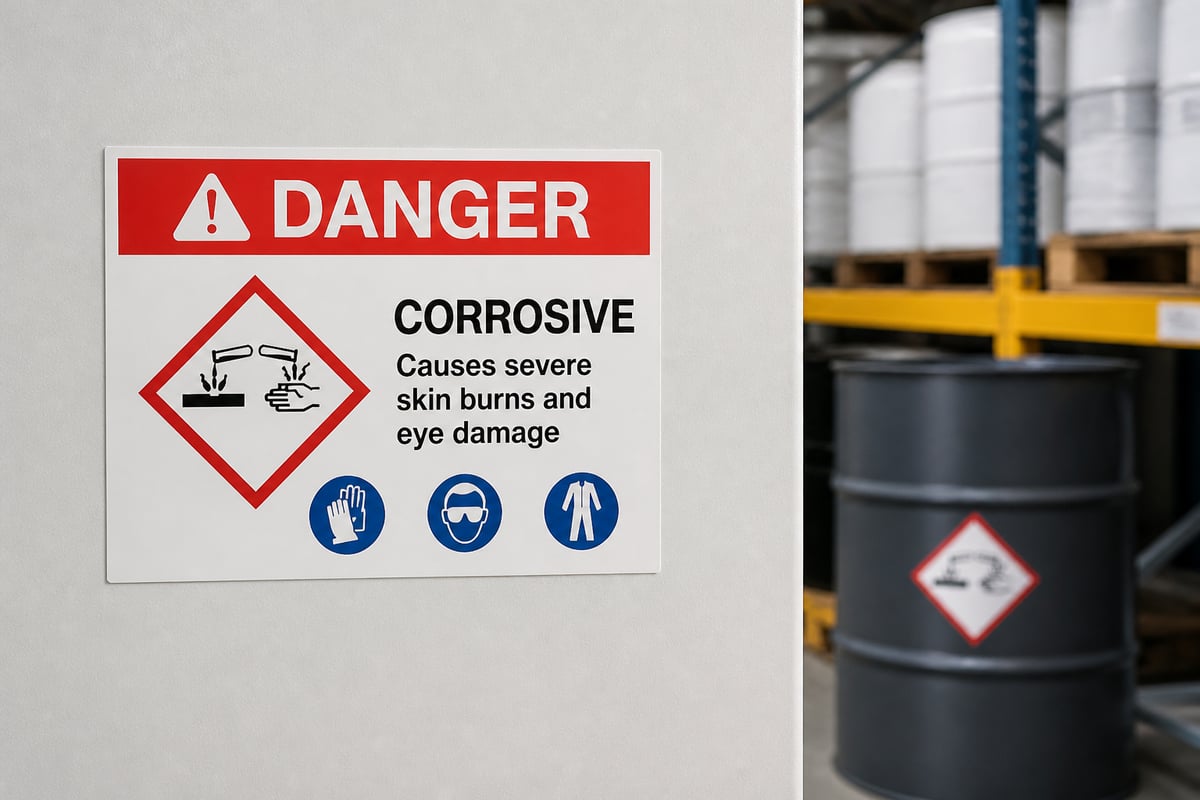
The pictogram is usually accompanied by the signal word "Danger" and hazard statements such as "Causes severe skin burns and eye damage". The German Federal Institute for Occupational Safety and Health (BAuA) provides an overview of hazard pictograms and signal words that explains how GHS05 relates to these hazard classes.
Corrosive does not mean acidic only. Strong alkalis such as caustic soda and sodium hypochlorite solutions are just as capable of causing severe burns. Many managers associate the symbol with battery acid alone, yet cleaning concentrates, drain openers and descalers carry it too.
Where Do Corrosive Symbols Come From? GHS and South African Rules
Corrosive symbols originate from the GHS, a United Nations framework that standardises how chemical hazards are classified and communicated worldwide. The current edition is Revision 11, published in 2025, as listed by UNECE.
South Africa applies GHS-aligned classification and labelling alongside the requirements of the Occupational Health and Safety Act and its Hazardous Chemical Substances Regulations. Employers must be able to show that chemicals are identified, that staff are informed about them and that suitable controls are in place.
Other jurisdictions apply GHS slightly differently, and the differences matter when you import products or work with international parent companies:
| Region | System | Notes for the corrosion pictogram |
|---|---|---|
| South Africa | SANS 10234 (GHS-aligned) | Used on supplier labels and safety data sheets |
| European Union | CLP Regulation | Same GHS05 symbol and "Danger" signal word |
| United States | OSHA HazCom | Pictogram rules set out in OSHA's label-element requirements |
| Canada | WHMIS 2015 | Explained in this CCOHS guide to the corrosion pictogram |
Because the core symbol is shared, a drum labelled in Europe or North America will normally show the same corrosive symbols you already know. The wording on the label may differ, so check it against the safety data sheet (SDS) before deciding how to store or handle it.
How Do Corrosive Symbols Differ from Transport Labels?
A GHS pictogram describes the hazards of a chemical in the workplace, whereas a transport label tells carriers and emergency responders what a consignment contains while it is moving. The two systems overlap but are not interchangeable.
The transport equivalent for corrosives is the Class 8 label from the UN Recommendations on the Transport of Dangerous Goods. It is a diamond with the top half white and the bottom half black, showing the same liquid-on-hand-and-bar image. You will see it on delivery vehicles and outer packaging.
In practice:
- Receiving goods. A drum may arrive with both a Class 8 transport label and a GHS pictogram. Keep both visible.
- Decanting. Once product leaves its original container, the transport label no longer applies. The new container needs a GHS-style workplace label.
- Signs on walls. Area signage follows workplace safety sign conventions, not transport conventions.
Which Chemicals Carry the Corrosive Symbol?
Any substance classified as skin corrosive, seriously damaging to eyes or corrosive to metals carries the pictogram, and many routine workplace chemicals qualify. Typical examples across South African industry include:
- Mining and metals processing: sulphuric acid, hydrochloric acid, nitric acid, sodium hydroxide
- Manufacturing and water treatment: caustic soda, sodium hypochlorite, ferric chloride
- Food processing and retail: concentrated sanitisers, oven cleaners, descalers
- Workshops and fleet maintenance: battery electrolyte, brake cleaners, rust removers
- Swimming pools and facilities management: pool acid, chlorine liquids, drain cleaners
Concentration matters. A diluted solution may be classified differently from its concentrate, so always read the classification section of the SDS rather than assuming the same symbol applies at every strength.
What Else Must Appear on a Corrosive Label?
A compliant label carries more than the pictogram. The standard GHS elements are:
- Product identifier. The name matching the SDS.
- Pictogram(s). The corrosion symbol, plus any others that apply.
- Signal word. "Danger" for corrosives in the most severe categories.
- Hazard statements. For example, "Causes severe skin burns and eye damage".
- Precautionary statements. Instructions for prevention, response, storage and disposal.
- Supplier details. Name, address and telephone number.
When a product has several hazards, more than one pictogram may be required, though GHS has precedence rules to avoid redundancy. A common case: where the corrosion symbol is shown for skin damage, the exclamation mark for skin irritation is generally omitted. Presentation matters as well. Pictograms must be large enough to be read, with the border, background and symbol colours intact.
Where Should Corrosive Warning Signs Be Posted?
Corrosive warning signs belong wherever a person could meet the hazard before they can read a container label. Container labels protect the person holding the product, whereas area signs protect everyone approaching the space.
Sensible locations include:
- Doors to chemical stores, dosing rooms and battery charging areas
- Bunded tank farms and acid dosing stations
- Decanting points and mixing areas
- Laboratories and quality-control rooms
- Cleaning cupboards in retail back-of-house areas
Mount signs where they can be seen clearly, free of obstruction and with adequate lighting. For dark stores or areas that may lose power, photoluminescent signs stay visible in an emergency. Suppliers can make a warning of corrosive hazard sign for each entrance and use the wider warning signs range for related hazards in the same area.
Which Signs and Equipment Should Accompany Corrosive Symbols?
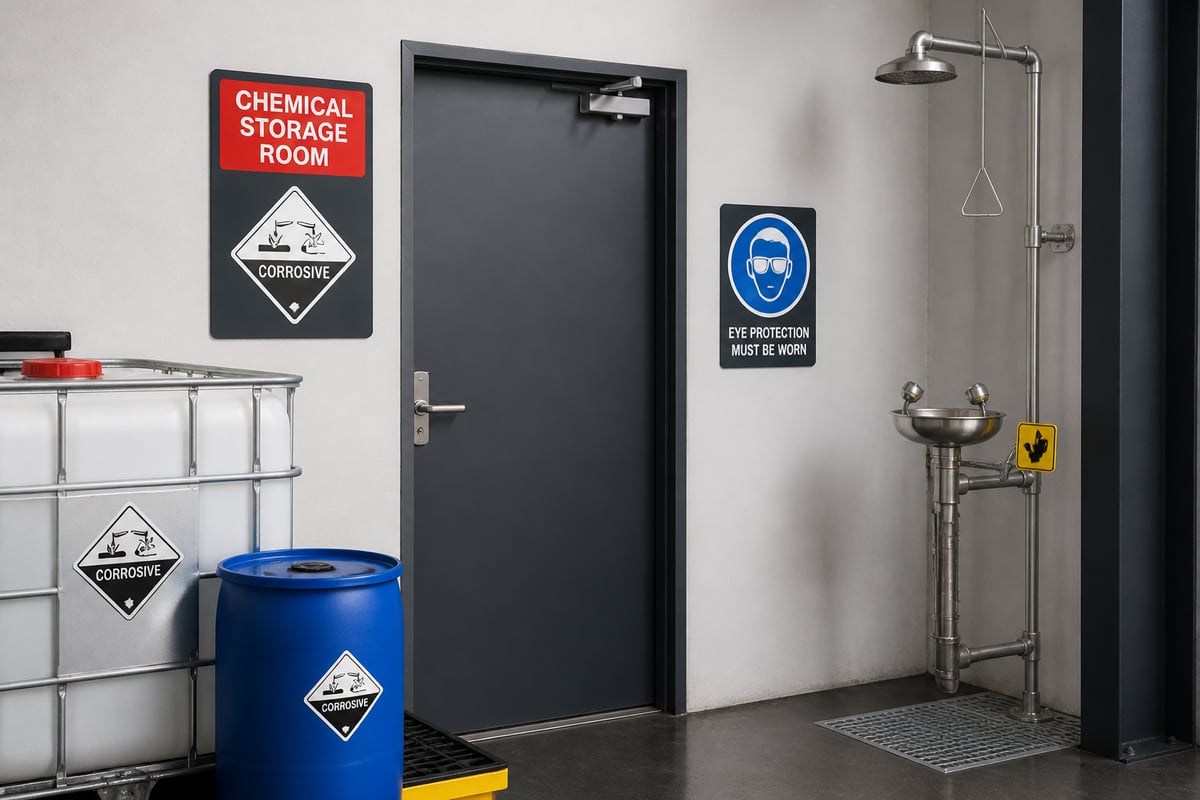
Corrosive symbols should be paired with mandatory PPE signs and emergency equipment, so that people see both the hazard and the required response. A warning alone tells staff what the danger is but not what to do about it.
Typical pairings:
- Mandatory signs for gloves, face shields, chemical aprons and eye protection, available as mandatory signs
- Prohibitory signs such as no smoking, no eating or drinking, and no unauthorised entry
- Safety information signs marking the location of an emergency shower or eyewash station
- Face and eye protection where splash risk exists, such as a face shield
Place the eyewash and shower close to the hazard and keep the path clear. First aid guidance for corrosive burns relies on immediate, prolonged flushing with water, so any delay caused by a locked door or a blocked route increases the severity of injury.
How Should Corrosive Products Be Stored and Handled?
Corrosive products should be stored in labelled, compatible containers, in a dedicated area, with spill control and emergency equipment close by. The pictogram is a prompt to follow the SDS, which sets out the specific requirements for each product.
Core practices:
- Segregate incompatibles. Keep acids apart from alkalis, and both away from oxidisers, organic solvents and reactive metals. Mixing can produce heat, toxic gas or violent reactions.
- Use suitable containers. Choose materials that resist the product. Metal shelving can be attacked by acid vapours.
- Store low. Keep large or heavy containers near the floor to reduce the height of any fall and spill.
- Contain spills. Use bunds or spill trays sized to hold the volume of the largest container.
- Label every container. Decanted or diluted product needs its own workplace label, never an unlabelled bottle.
- Keep the SDS accessible. Staff should know where it is and how to read the corrosive classification.
How Do You Train Staff to Recognise Corrosive Symbols?
Training works best when staff can link the pictogram to a specific product, a specific location and a specific response. Short, practical sessions beat long classroom presentations.
A workable approach for supervisors:
- Show the symbol on real containers. Walk the site and point out where corrosive symbols appear on drums, bottles and tanks.
- Explain the three hazards. Skin, eyes and metals, with one workplace example of each.
- Practise the response. Have staff locate the eyewash and shower, and run through the first steps for splashes.
- Check PPE fit and condition. Gloves, aprons and visors must suit the product and be in good repair.
- Review the labels and SDS. Confirm that staff can find the signal word, hazard statements and first aid instructions.
- Repeat on a schedule. Refresh when new products arrive or after an incident or near miss.
Keep a record of who attended and what was covered. That record supports your compliance position if an inspector asks how you inform employees about hazardous chemicals.
What Mistakes Make Corrosive Labelling Fail?
Most labelling failures are routine housekeeping problems, not knowledge gaps. These are the ones to audit for:
- Faded or damaged labels. Chemical splashes strip print, so inspect labels regularly and replace them.
- Unlabelled secondary containers. Spray bottles and buckets filled from a drum are a common source of burns.
- Outdated signage. Older hazard signs using orange-and-black symbols may no longer match current GHS pictograms.
- Signs placed too high or behind stock. A sign nobody can see is not a control.
- Missing language support. Where staff speak different home languages, pair symbols with plain text in the languages used on site, as pictograms are only part of the message.
- No link to the SDS. A label that cannot be matched to a current data sheet leaves gaps in your records.
A quarterly walk-through with a simple checklist catches most of these before they cause an incident.
How Do You Choose Durable Corrosive Signs?
Choose sign materials that survive the environment they will hang in, because corrosive areas are hard on signage. Acid vapours, washdown water and constant handling degrade cheap stickers quickly.
Consider:
- Material. ABS plastic resists moisture and many chemicals and suits indoor wet areas. Cromadek steel offers rigidity and weather resistance for outdoor and heavy-duty use.
- Visibility. High-contrast printing and photoluminescent options help where lighting is poor.
- Size. Match the sign to the viewing distance, such as a gate sign read from a vehicle versus a door sign read at arm's length.
- Compliance. Confirm that signs follow SANS and SABS requirements for colour, shape and symbol.
SafetySignsForSale makes safety signs to order in ABS plastic or Cromadek steel, all SABS approved, which suits both a damp chemical store and an exposed tank farm. For exact sizes, wording and lead times, check the product pages or contact the team directly rather than assuming a standard specification.
Start by walking your site with an SDS folder and listing every area where a corrosive product is stored, decanted or used, then check each one for a visible symbol, a mandatory PPE sign and clear access to an eyewash or shower. SafetySignsForSale has over 25 years of experience in signage and delivers nationwide, with made-to-order safety signs in ABS plastic or Cromadek steel for factories, mines and retailers. If you would like your signage and emergency equipment priced against your audit list, you can request a quote from the team.