


White Crossing: What It Means and How It Works
A white crossing is a pedestrian crossing marked with white stripes painted across a road, commonly called a zebra crossing, where people on foot have priority over vehicles. The white bars show drivers where to stop or slow down, and show pedestrians the safest place to cross. For facility and safety managers, the same principle applies on factory roads, mine haul routes, loading yards and retail car parks: clear white markings, supported by the right signage, reduce the likelihood of a vehicle meeting a pedestrian at an unmarked point.
This article explains what a white crossing is, how the priority rules work, how the markings are laid out, and how to apply the idea in a South African workplace.
What a White Crossing Is
A white crossing is a stretch of road marked with broad white bars that runs parallel to the direction of traffic, giving pedestrians a defined place to cross. The pattern gives the zebra crossing its name, because the alternating bars resemble the stripes of the animal.
The defining feature is the white paint. Unlike a signalised crossing, which relies on traffic lights to control movement, a white crossing depends on the driver seeing the markings, recognising them and giving way. That reliance on visibility is why condition matters. Faded or dirty paint, poor lighting and obscured signs all weaken the crossing's ability to do its job.
The term is used in several ways, so it helps to separate them:
- Zebra crossing: the standard white-striped crossing with no traffic signals.
- Marked pedestrian walkway: a painted route inside a private site, such as a warehouse floor or a mine surface area.
- Approach markings: the white zigzag lines and give-way lines that sit before the crossing itself.
How a White Crossing Works
A white crossing works by combining a visible road marking with a clear priority rule: drivers must give way to pedestrians who are on the crossing and should give way to those waiting to cross. The UK Highway Code states that drivers must give way to pedestrians on a zebra crossing and should give way to pedestrians waiting to cross one. Many road systems follow a similar principle, and it is a sound model for private sites that set their own traffic rules.
The mechanism has three parts that work together:
- Visibility. Wide white bars contrast with dark tarmac or concrete, so drivers see the crossing from a distance.
- Priority. The rule tells drivers that the person on the crossing goes first.
- Predictability. Pedestrians cross at the same point every time, so drivers learn where to expect them.
Predictability is the quiet strength of the system. A pedestrian who crosses anywhere is hard to anticipate. A pedestrian who crosses at a known point is far easier for a driver to plan around.
Approach Markings and Warning Signs
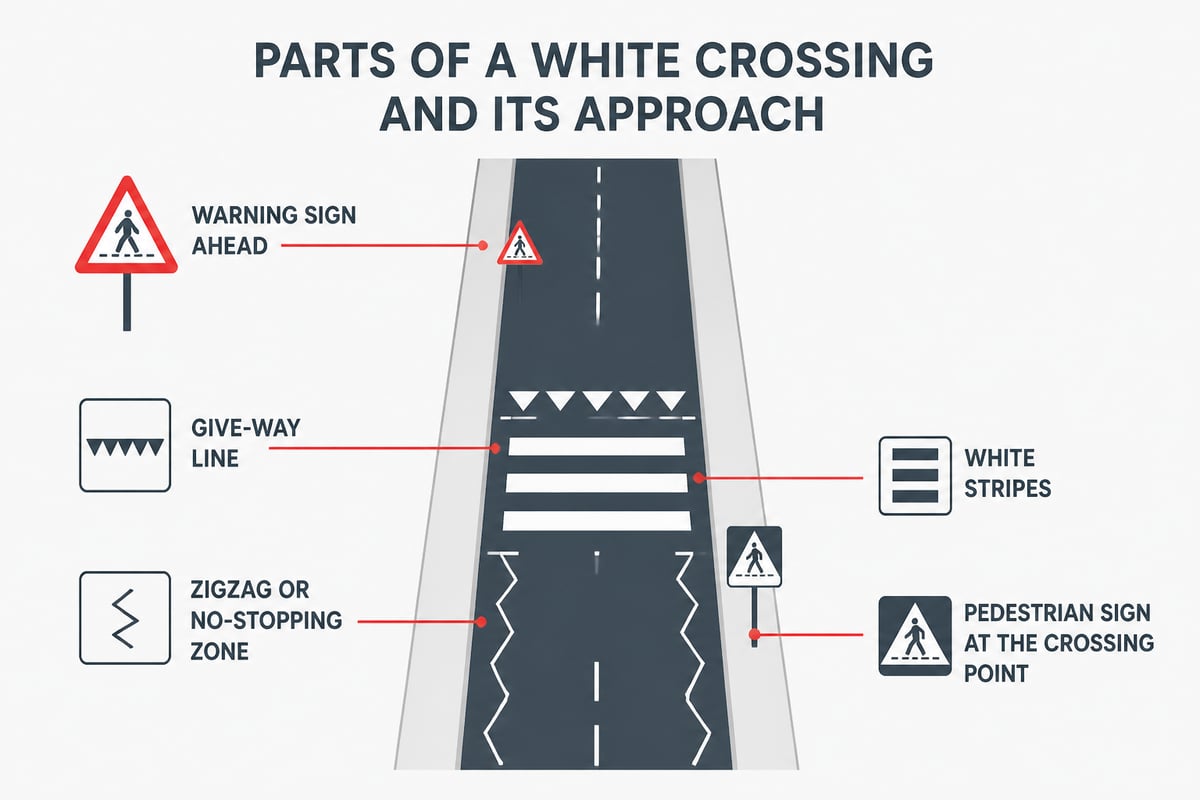
A crossing is rarely effective as paint alone. Approach markings and signs warn drivers before they reach the stripes, giving them time to slow down. On public roads, these include zigzag lines on either side of the crossing, where stopping and overtaking are restricted. On private sites, the equivalent is a warning sign placed ahead of the crossing, together with a stop line or speed hump where traffic is heavy.
For a practical summary of how drivers should approach these crossings, including giving way and allowing extra stopping distance on wet or icy roads, the driver-focused crossing rules are a useful reference.
Layout and Marking Standards
A white crossing is laid out with parallel white bars, a clear approach and enough width for the volume of people using it. Exact dimensions are set by the road authority or by your site's own traffic management plan, so confirm them against your applicable requirements rather than copying a figure from another country.
Some general layout principles hold across most systems:
- Contrast. White paint needs a clean, dark surface. Oil stains, dust and tyre marks reduce its effectiveness.
- Width. The crossing should be wide enough for the peak number of pedestrians, such as a shift change at a factory gate.
- Alignment. Bars should run parallel to the flow of vehicles, and the crossing should connect directly to pedestrian pavements or walkways.
- Lighting. At night or in poorly lit areas, the markings need adequate illumination to remain visible.
Maintenance is part of the standard. A repaint schedule tied to traffic volume keeps the markings readable, and a periodic inspection catches fading before it becomes a hazard.
Where White Crossings Are Used
White crossings appear wherever pedestrians and vehicles share space and a defined crossing point improves safety. In a South African business context, the most common settings include:
- Factory and warehouse yards, where forklifts and delivery trucks move across the paths of workers walking between buildings.
- Mine sites, where light vehicles and haul trucks operate near change houses, offices and walkways.
- Retail car parks, where shoppers walk from parked cars to store entrances, often with trolleys or children.
- Loading bays and distribution centres, where drivers reverse and manoeuvre in confined areas.
- Campus-style sites, such as hospitals, schools and industrial parks, where several buildings sit across internal roads.
Hypothetical Example: A Factory Yard
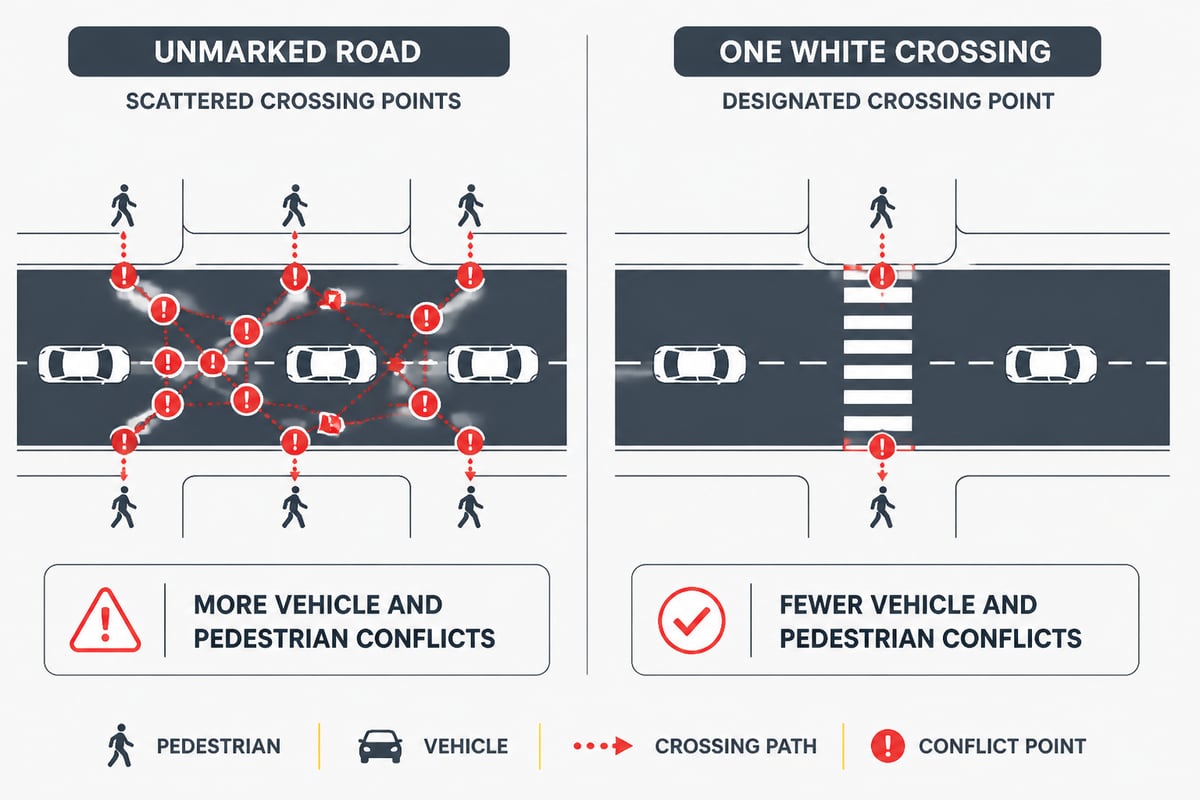
Hypothetical example: a manufacturing site has a car park on one side of an internal road and the main production entrance on the other. Workers cross the road at several unmarked points, and delivery vehicles travel through at moderate speed. Marking a single white crossing at the entrance, adding a warning sign ahead of it and fitting a stop or speed-control measure on both approaches gives vehicles a point at which to slow and pedestrians one place to cross. The aim is to concentrate crossings at a single, well-signed point.
Why a White Crossing Matters
A white crossing matters because it directs pedestrian movement to the safest available point and gives drivers a clear cue to slow down. Without one, people choose their own route across the road, and drivers have no warning of where to expect them.
For safety managers, the case rests on several practical benefits:
- Fewer conflict points. Funnelling pedestrians to one crossing reduces the number of places where a vehicle might meet a person.
- Clear accountability. A marked crossing with a signed priority rule makes site rules easier to communicate, train and enforce.
- Better compliance records. Documented signage and markings support audits and incident investigations.
- Reduced stopping pressure. Drivers who see a crossing early have more time to react.
Guidance on pedestrian behaviour supports the same approach. The NHTSA pedestrian safety guidance advises people to use crossings or intersections where possible, to choose well-lit places when no crossing is available, and to wait for a clear stop before stepping out.
Signage That Supports a White Crossing
Signs reinforce the paint by telling drivers and pedestrians what the markings mean and what is expected of them. A crossing with no signage relies entirely on drivers noticing stripes, which is risky at speed, in rain or at night.
The usual combination for a workplace crossing includes:
- A warning sign placed ahead of the crossing so drivers have time to slow down.
- A stop or give-way sign at the crossing where vehicles must yield.
- A speed limit sign that sets a safe approach speed.
- A pedestrian sign at the crossing itself so it can be seen from both directions.
The same thinking applies to other crossing hazards on a site. Where internal roads cross a railway line, for example, a railway crossing ahead sign warns drivers before they reach the track. For general hazard messages along the route, warning signs cover the wider range of site risks.
Choosing Sign Materials
Signs on internal roads face sun, dust, rain and the occasional knock from vehicles. SafetySignsForSale makes its safety signs to order from ABS plastic or Cromadek steel, and all of them are SABS approved. For sizes, mounting options and quantities, check the relevant product pages or contact the team directly.
For traffic and road safety messages such as stop, give way, speed limit and warning signs, SafetySignsForSale's Road Signs range is the natural starting point for a site crossing.
Planning a White Crossing on Your Site
Planning a white crossing starts with watching where people actually walk and where vehicles actually travel, then marking the crossing where the two routes naturally meet. Placing it where people already cross improves the chances that they will use it.
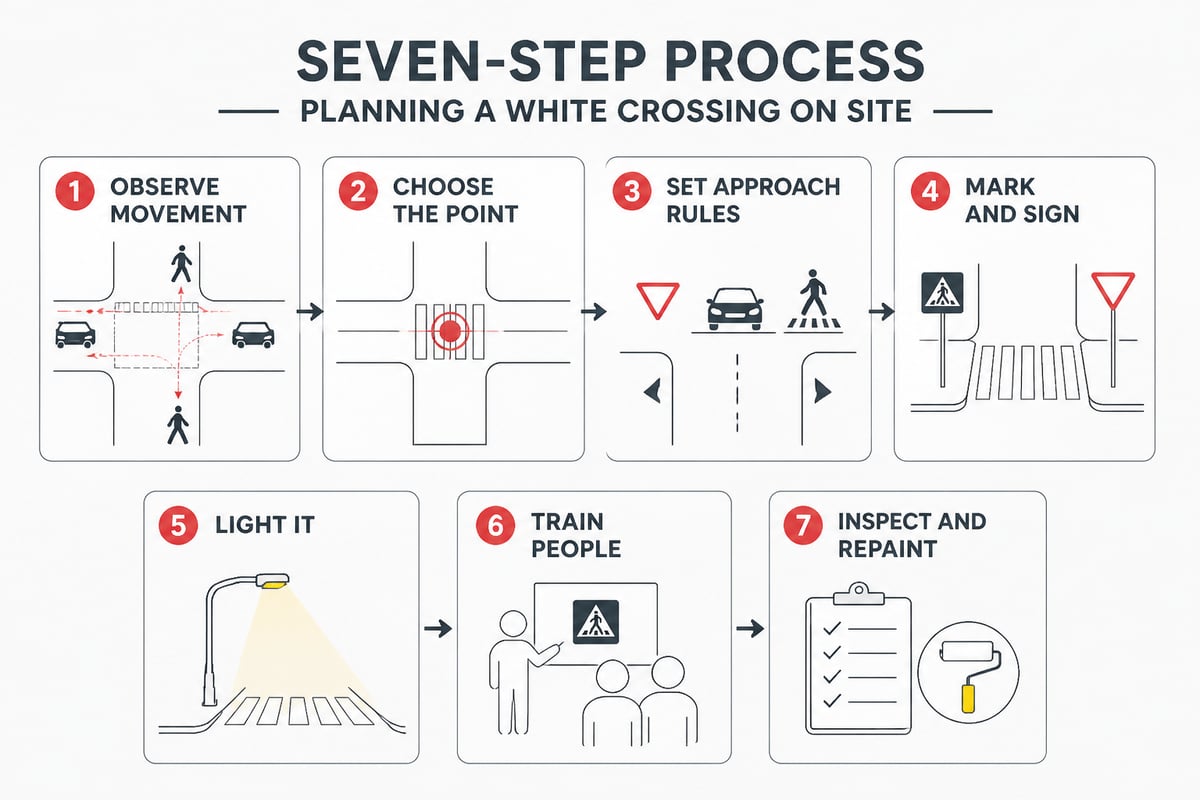
A simple sequence helps:
- Observe movement. Record where pedestrians and vehicles interact, especially at shift changes and delivery peaks.
- Choose the crossing point. Pick a spot with good sight lines and no obstructions such as parked vehicles or stacked goods.
- Set the approach rules. Decide on speed limits, stop lines and any physical speed-control measures.
- Mark and sign. Paint the white bars and install warning, stop and pedestrian signs on both approaches.
- Light it. Make sure the crossing is visible after dark.
- Train and communicate. Brief employees, drivers and visitors on the priority rule.
- Inspect and repaint. Check the markings regularly and refresh them before they fade.
Common Mistakes to Avoid
Most failures of a white crossing come from poor upkeep or poor placement rather than from the concept itself. Watch for these issues:
- Faded markings that no longer contrast with the road surface.
- Obstructed sight lines from parked vehicles, stacked pallets or overgrown vegetation.
- Too many crossings, which dilute the predictability that makes the system work.
- Signs placed too close to the crossing to give drivers time to react.
- No lighting, leaving the crossing nearly invisible at night.
- Unclear rules, where drivers and pedestrians are not told who has priority.
A well-maintained crossing, correctly signed, communicates its purpose without needing anyone to explain it.
Related Terms
Several terms sit close to a white crossing, and it helps to keep them distinct:
- Zebra crossing: the common name for a white-striped crossing without signals.
- Pelican, puffin and toucan crossings: signal-controlled crossings used on public roads.
- Give-way line: the line that shows where a vehicle must yield.
- Pedestrian walkway: a marked route for people on foot, often within a site.
- Traffic calming: physical measures such as speed humps that slow vehicles near a crossing.
- Road markings: the painted lines and symbols that guide road users.
For readers who want to check the underlying road rules, the official Highway Code index points to the rules on zebra crossings, pedestrian crossings and the responsibilities of each road user, and a readable guide to pedestrian crossing rules covers where to cross and the precautions to take before stepping into the road.
Frequently Asked Questions
What is a white crossing?
A white crossing is a pedestrian crossing marked with white stripes across the road, where pedestrians have priority over vehicles. It is also known as a zebra crossing.
Who has right of way at a white crossing?
Pedestrians do. Under the UK Highway Code, drivers must give way to pedestrians on a zebra crossing. On private sites, the same rule should be written into your traffic management policy and supported by signs.
Do I need signs as well as painted stripes?
Yes. Signs warn drivers in advance and state the rule clearly. Stripes alone depend on drivers noticing the paint, which is unreliable in poor light or at speed.
How often should the markings be repainted?
Repaint when the stripes begin to fade or lose contrast. Busy yards with heavy vehicles may need more frequent attention, so build an inspection into your regular site safety checks.
Can a white crossing be used inside a building?
Painted walkways serve the same purpose on warehouse and factory floors. They separate pedestrians from forklifts and other mobile equipment, and they work best when paired with floor signs and mandatory notices.
Start by walking your site at a shift change and noting where people and vehicles cross paths, then mark the busiest point as a white crossing with a warning sign on each approach. SafetySignsForSale has over 25 years of experience in signage and supplies SABS-approved signs with nationwide delivery across South Africa, including the Road Signs range for crossings, stop points and speed control. When you know what your site needs, you can request a quote and have the signs made to order for your crossing.