


Fire Extinguisher Sign Guide: Types and Requirements
A fire distinguisher sign, correctly called a fire extinguisher sign, is a red square or rectangular safety sign with a white extinguisher pictogram that shows where a portable extinguisher is kept and, on identification signs, which fire classes it can tackle. Facility managers use two kinds together: a location sign that makes the extinguisher easy to find, and an identification sign that explains the extinguisher type and how to use it. Getting both right affects how quickly staff respond in the first minute of a fire, and whether your premises pass an inspection.
This guide covers the sign types, the design rules, mounting positions, fire classes and the practical checks that keep your signage compliant.
What does a fire extinguisher sign actually show?
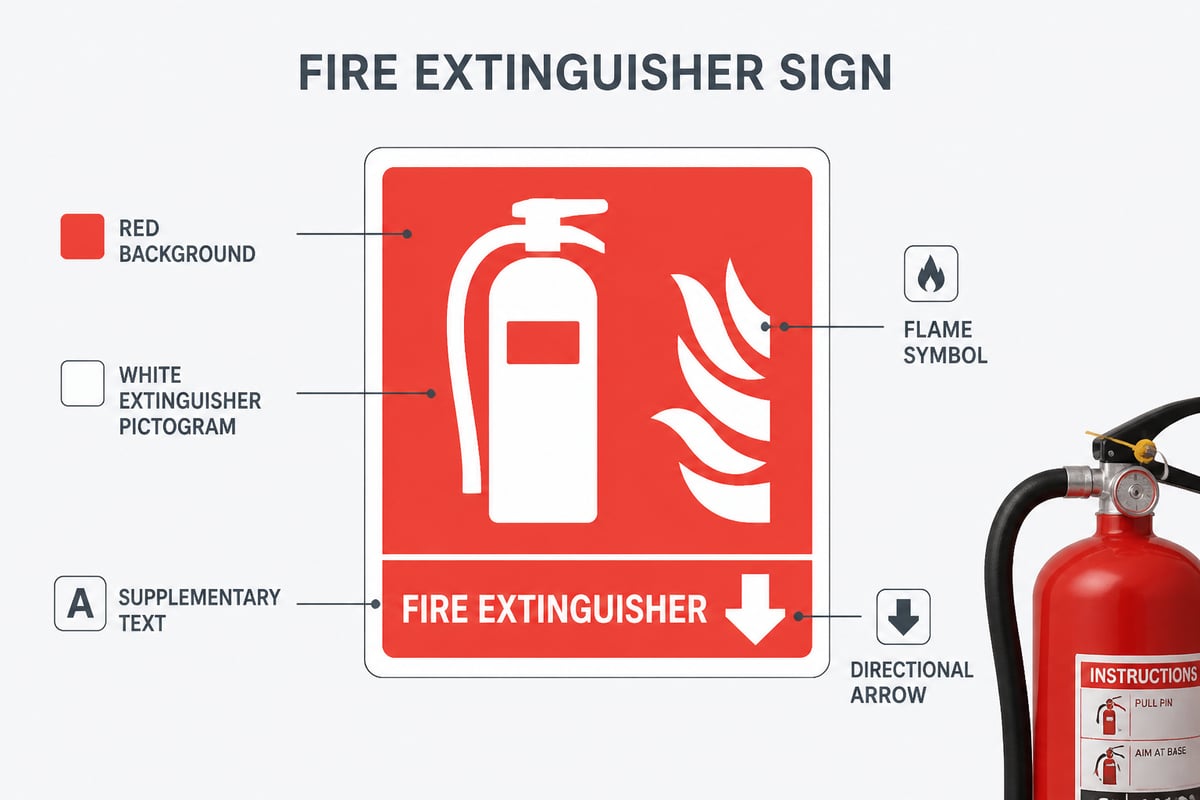
A fire extinguisher sign shows a white extinguisher pictogram on a red background, giving an immediate visual cue to the location of firefighting equipment. It belongs to the firefighting category of safety signs, which is separate from warning, mandatory and prohibition signs.
UK government guidance on safety signs, published by the Maritime and Coastguard Agency, describes firefighting signs as square or rectangular, with a white pictogram on red, and requires red to cover at least 50% of the sign area. The same guidance identifies the fire-extinguisher pictogram as one of four red-square firefighting signs.
Some signs add a directional arrow or text. The pictogram does the main work, because it must be understood by every employee, contractor and visitor regardless of language or literacy.
What types of fire extinguisher sign are there?
There are three main types: location signs, identification signs and directional signs, and most sites need all three. Each serves a different purpose, so one sign cannot replace the others.
- Location signs carry the extinguisher pictogram and mark the exact spot where the extinguisher hangs or stands. They must be visible from the approach route.
- Identification signs state the extinguisher type, for example water, foam, dry powder, CO₂ or wet chemical, and which fire classes it suits. Bedfordshire Fire and Rescue Service notes that extinguishers should be fixed to a wall or stand and clearly signposted, and that identification signs explain the extinguisher type and how and when to use it.
- Directional signs combine the pictogram with an arrow, guiding people to extinguishers that are out of direct line of sight, such as around corners, behind racking or in long corridors.
Photoluminescent versions glow in low light and are useful in plant rooms, warehouses, underground areas and anywhere power failure could leave staff in the dark. For mines and heavy industry, they add a layer of resilience that standard printed signs cannot provide.
Where should fire extinguishers be marked?
Fire extinguishers should be marked at the exact point where each unit is mounted, at a height that is visible from the normal approach route, and along escape routes where the extinguisher is not in direct view. The aim is that anyone in the building can find the nearest extinguisher without searching.
Practical placement rules for facility managers:
- Mount the sign directly above or beside the extinguisher, so the sign and the equipment are read as one point.
- Place signs at eye level or higher so parked vehicles, stock, pallets and open doors cannot hide them.
- Add directional signs wherever walls, racking or machinery block the line of sight.
- Keep the area clear of storage. A correctly signed extinguisher that is blocked by stock fails its purpose.
- Mark extinguishers near exits and high-risk areas, such as electrical rooms, kitchens, workshops and loading bays.
For large premises, walk each floor as a visitor would. If you cannot see an extinguisher sign within a few steps of any point, add another.
What are the types of fire and which extinguisher suits each?
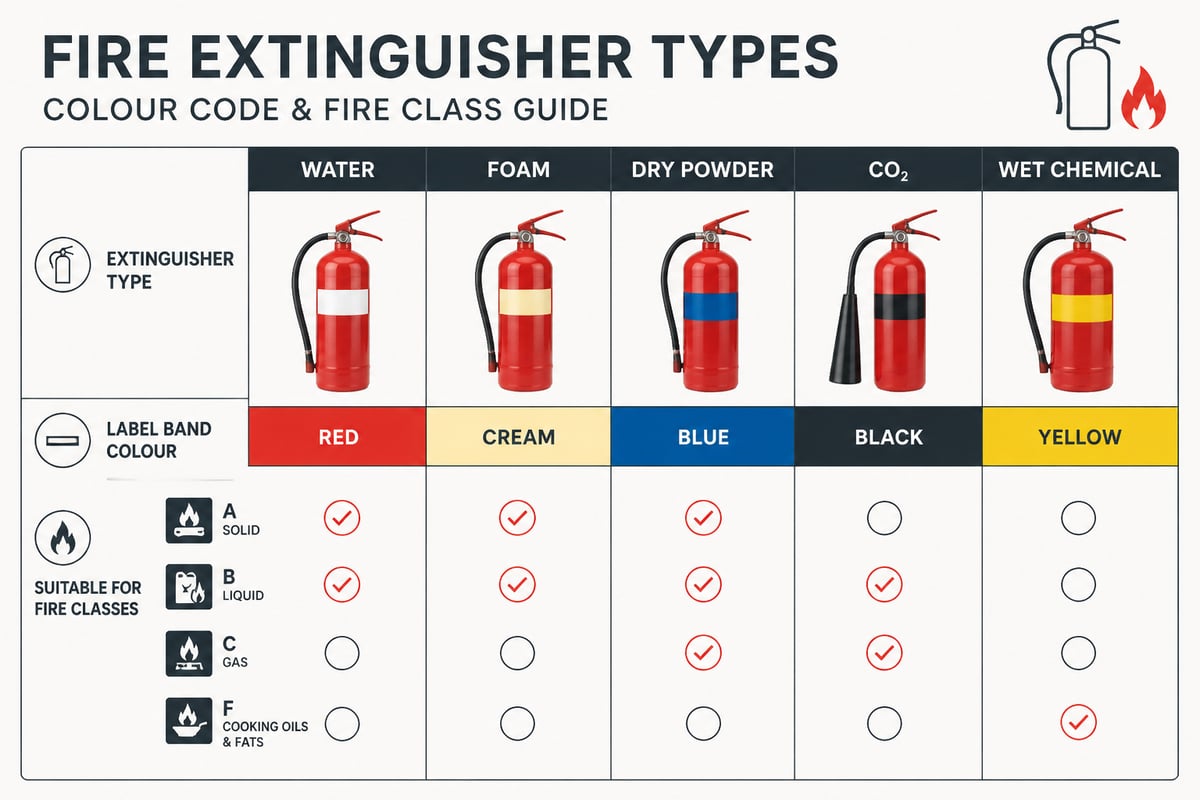
Fires are grouped into classes according to the fuel burning, and each class needs a matching extinguisher. Commonly used classes include A, B, C, D, electrical and F, though the number of formal classes varies by standard.
| Fire class | Fuel | Typical extinguisher |
|---|---|---|
| A | Wood, paper, textiles, plastics | Water, foam, dry powder |
| B | Flammable liquids such as petrol and solvents | Foam, CO₂, dry powder |
| C | Flammable gases | Dry powder |
| D | Combustible metals | Specialist dry powder |
| Electrical | Live electrical equipment | CO₂ |
| F | Cooking oils and fats | Wet chemical |
The UK small-premises fire guide advises a water-based extinguisher for combustible material fires and a CO₂ extinguisher for electrical equipment. It also recommends a Class F extinguisher and a fire blanket in kitchens and cooking areas where fat fryers or similar equipment pose a risk. Retailers with food courts and factories with canteens should apply that thinking directly.
Your identification signs should name these classes plainly, so a person standing in front of the extinguisher knows immediately whether it is the right tool.
What are the types of fire extinguisher and their colours?
The main extinguisher types are water, foam, dry powder, carbon dioxide and wet chemical, and each has a colour-coded band or label identifying the contents. In South Africa, the SANS 1475 standard governs extinguisher design and marking, so always confirm the band colour against the label and your supplier's documentation.
- Water: red body, used for Class A fires. Never for live electrics or fat fires.
- Foam: suited to Class A and B fires; check the label for band colour.
- Dry powder: a versatile option for A, B, C and electrical risks, though it reduces visibility when discharged in enclosed rooms.
- CO₂: the standard choice for electrical equipment and server rooms.
- Wet chemical: designed for Class F cooking oil and fat fires.
Because colour coding can differ between standards and manufacturers, treat the label as the source of truth. A sign should never contradict the extinguisher beside it. If you replace a CO₂ unit with dry powder, replace the identification sign in the same visit.
What is the golden rule of fire extinguishers?
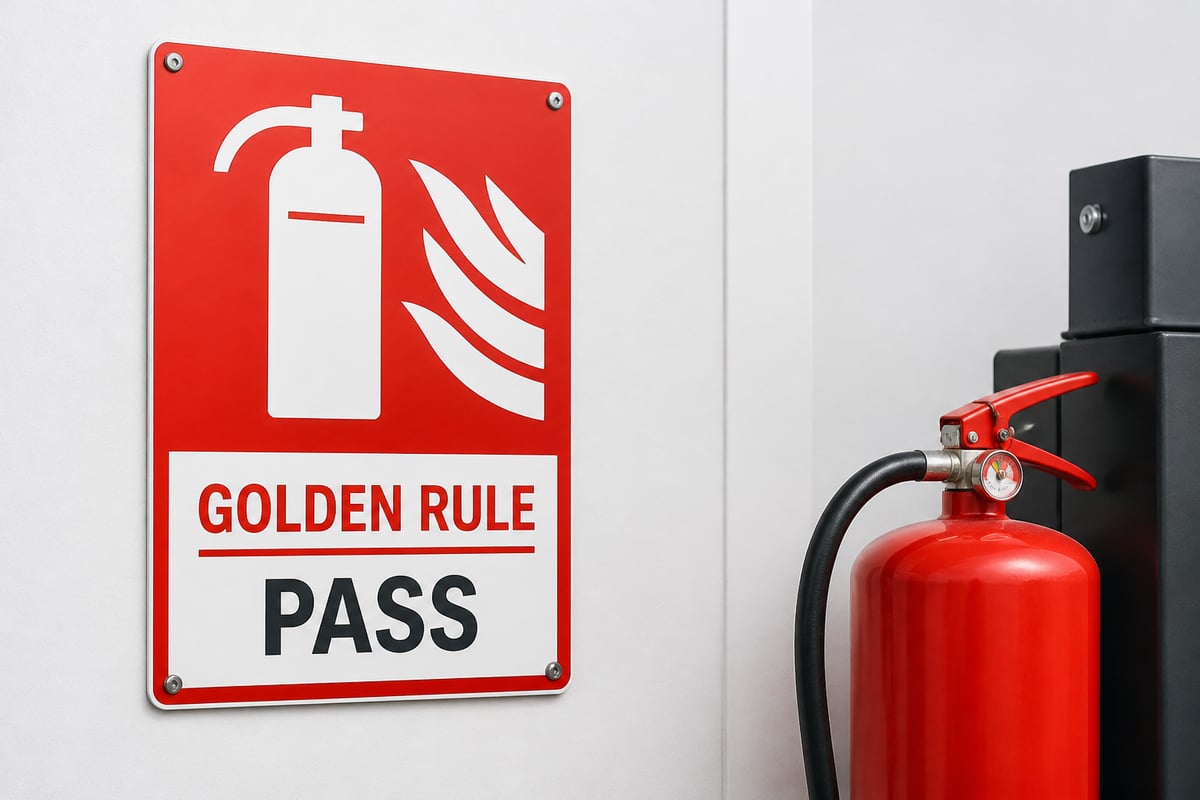
The golden rule is to only fight a fire if it is small, you have a clear escape route behind you and you have been trained to use the extinguisher; otherwise, raise the alarm and evacuate. Life safety always comes before property protection.
Many fire services teach the PASS sequence for operating a portable extinguisher: pull the pin, aim at the base of the fire, squeeze the handle and sweep from side to side. Instruction signs placed beside the extinguisher reinforce this under stress, when people tend to forget what they learned in training.
Staff should also know which fires an extinguisher must never be used on. Water on a fat fire or live electrics can make the situation worse, which is why identification signs matter as much as location signs.
What size and format should the sign be?
Choose a sign size that can be read from the normal viewing distance, with the pictogram clear at that range. A sign mounted in a small office can be compact, while one in a warehouse aisle or open plant area needs to be larger so it can be seen from across the floor.
Material matters as much as size. Signs in outdoor yards, mine sites and washdown areas face UV, moisture, chemicals and impact, so durable materials last longer than thin printed labels. ABS plastic suits general indoor and sheltered use, while Cromadek steel is a tougher option for harsh environments.
Format options typically include:
- Rigid panels with pre-drilled holes for screw fixing
- Self-adhesive vinyl for smooth, clean surfaces
- Photoluminescent panels for low-light and emergency use
- Projecting or double-sided signs for corridors, so the sign is visible from both directions
For multi-site organisations, standardise on one pictogram style and sign format across all locations. Consistency lets staff transferred between sites recognise equipment instantly.
How do you choose a compliant fire extinguisher sign supplier?
Choose a supplier whose signs are approved to the relevant standard, made from durable materials and available in the quantities your sites need. For South African facilities, SABS approval is the first check, because it confirms the sign meets recognised design and colour requirements.
SafetySignsForSale makes safety signs to order in ABS plastic or Cromadek steel, covering fire fighting, warning, mandatory, prohibitory, photoluminescent and general information categories. Its safety signs are SABS approved, and it delivers nationwide across South Africa, which suits procurement teams supplying several sites at once.
When you request bulk pricing, supply a clear schedule. A simple extinguisher register helps:
- List every extinguisher by location and floor.
- Record the type and fire classes covered.
- Note where directional signs are needed.
- Specify materials and sizes per area, such as photoluminescent for stairwells and Cromadek steel for external use.
A schedule like this reduces ordering errors and gives you a ready audit trail for inspections.
How do you keep fire extinguisher signage compliant over time?
Keep signage compliant by checking it during every routine extinguisher inspection and replacing anything faded, damaged, hidden or mismatched with the equipment. Signs degrade, and layouts change, so a compliant site last year may not be compliant now.
Build these checks into your monthly walk-through:
- Visibility: Is the sign visible from the approach route, or has new stock or machinery blocked it?
- Legibility: Are the colours faded, and is the pictogram still clear?
- Accuracy: Does the identification sign match the extinguisher type currently on the wall?
- Condition of equipment: Are the extinguisher, its pin and its service tag in order? Fitting extinguisher accessories and tags helps you record inspection dates clearly.
- Coverage: After any renovation, layout change or new process, are signs still adequate?
If you need to replace or add units, browse the range of fire extinguishers and order matching signs at the same time. For sites with fire hydrant installations, mark those points too, and consider the related fire hydrant valve range, so your whole firefighting layout is signed and consistent.
Keep dated inspection records. If an inspector asks how you maintain signage, a log showing regular checks is stronger evidence than a verbal assurance.
FAQ
Is a fire extinguisher sign a legal requirement?
In South African workplaces, occupational health and safety and fire regulations generally expect firefighting equipment to be identifiable and accessible, and signage is a common way of achieving this. Local municipal by-laws and your insurer may also set specific requirements, so confirm the details with your fire officer or compliance adviser.
Can I use one sign for several extinguishers?
No. Each extinguisher should have its own sign at its own location, so people can find the nearest unit quickly. A single sign covering a group of units is acceptable only where the extinguishers are mounted side by side and the sign clearly applies to all of them.
How often should extinguisher signs be replaced?
There is no fixed lifespan. Replace a sign when it fades, cracks, peels or becomes unreadable, or whenever the extinguisher type or position changes. Harsh environments such as outdoor yards and mines will wear signs faster than indoor offices.
Start by walking your premises with a floor plan and marking every extinguisher that lacks a visible location sign or a matching identification sign. That list becomes your order schedule. SafetySignsForSale has more than 25 years of experience in signage and supplies made-to-order safety signs to blue chip clients, with over 10,000 happy clients across South Africa. Send your schedule through and Request a Quote so your fire extinguisher signage is priced and ready for delivery.