


GHS Hazard Symbols: Full List With Meanings
There are nine GHS hazard symbols, called pictograms, and each one is a diamond with a red border and white background to signal a specific type of chemical danger: explosive, flammable, oxidising, gas under pressure, corrosive, acutely toxic, harmful or irritant, serious health hazard, or environmental hazard. The pictograms appear on chemical container labels and safety data sheets. This guide explains what each symbol means, how the pictograms combine on a label, and which pictogram labels and signs suit a South African facility.
1. The nine GHS hazard symbols at a glance
The Globally Harmonised System (GHS) is the international framework behind chemical labelling, and the UK's classification system is based on the GHS. Its pictograms are diamond-shaped, with a red border and white background, and there are nine of them in total. The shape and colour scheme are fixed, so a worker can recognise a chemical hazard symbol at a glance before reading any text.
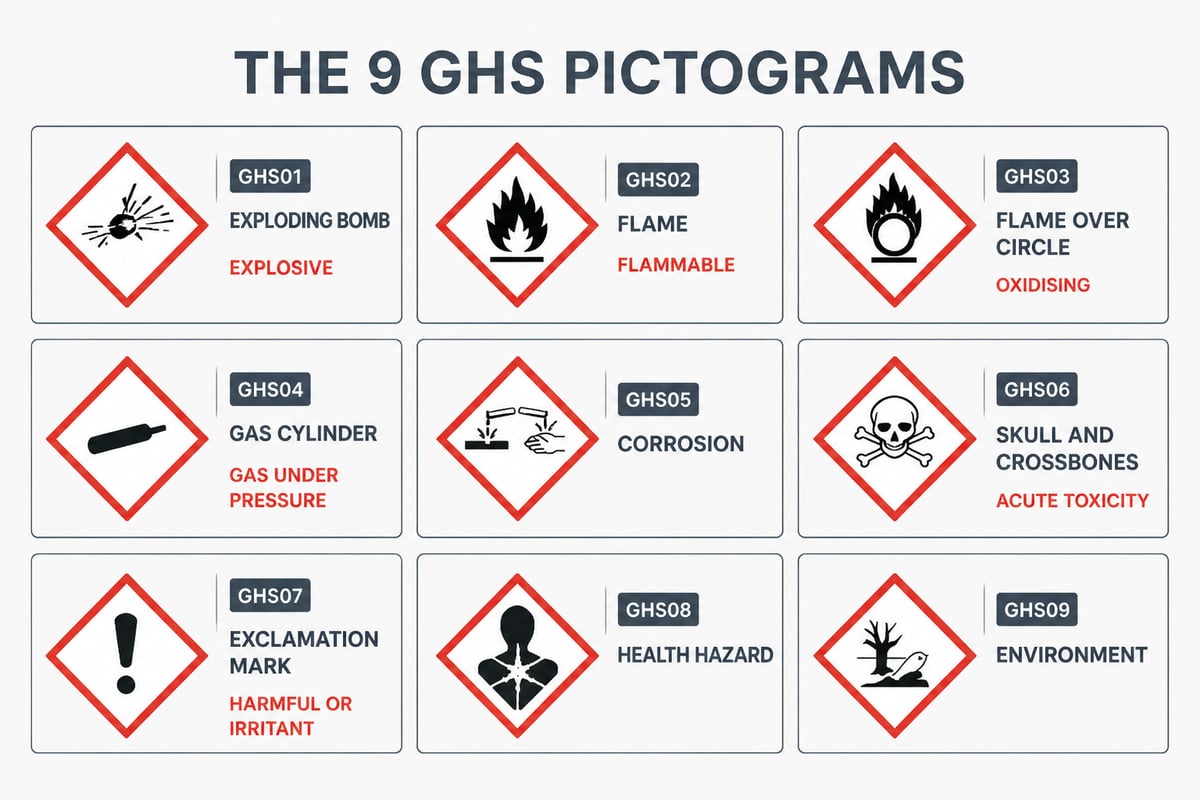
| Code | Symbol | Meaning |
|---|---|---|
| GHS01 | Exploding bomb | Explosives, self-reactive substances, organic peroxides |
| GHS02 | Flame | Flammable gases, liquids, solids, aerosols |
| GHS03 | Flame over circle | Oxidising gases, liquids, solids |
| GHS04 | Gas cylinder | Gases under pressure |
| GHS05 | Corrosion | Corrosive to metals, skin burns, serious eye damage |
| GHS06 | Skull and crossbones | Acute toxicity (fatal or toxic) |
| GHS07 | Exclamation mark | Harmful, irritant, skin sensitiser |
| GHS08 | Health hazard | Carcinogen, mutagen, respiratory sensitiser, organ toxicity |
| GHS09 | Environment | Hazardous to the aquatic environment |
2. GHS01 to GHS04: physical hazards
The first four symbols describe dangers from the physical behaviour of a substance rather than its effect on the body. Because these hazards act through fire, blast or pressure, they shape how a product is stored, segregated and handled long before anyone is exposed to it.
- GHS01, exploding bomb: explosives, self-reactive substances and organic peroxides that can detonate or react violently. Typical items include blasting agents on a mine and some pyrotechnic materials.
- GHS02, flame: flammable gases, liquids, solids and aerosols, plus substances that ignite spontaneously in air or release flammable gas on contact with water. Think solvents, paints, thinners and LPG.
- GHS03, flame over circle: oxidisers that feed a fire by supplying oxygen. Bleaching agents, pool chemicals and some fertilisers fall here.
- GHS04, gas cylinder: gases held under pressure, including compressed, liquefied and refrigerated gases. A cylinder can rupture if heated, and refrigerated liquefied gas can cause cryogenic burns.
Storage areas for these classes normally need area signage as well as container labels. SafetySignsForSale stocks a warning of explosion sign and a warning of fire hazard sign for the room or cage where such materials are kept. Oxidisers (GHS03) should be stored apart from flammables (GHS02), since a spill that mixes the two can ignite without any other source.
3. GHS05 to GHS09: health and environmental hazards
The remaining five symbols cover harm to people and to the environment. Several of them depend on the route of exposure, so the same product may be hazardous through skin contact, inhalation or swallowing, and the label tells you which.
- GHS05, corrosion: substances that corrode metals, cause severe skin burns or cause serious eye damage. Acids, caustic soda and battery electrolyte are common examples.
- GHS06, skull and crossbones: acute toxicity in the most severe categories, where a single exposure by swallowing, skin contact or inhalation can be fatal or toxic. Cyanides and some pesticides carry it.
- GHS07, exclamation mark: the lower-tier symbol. It marks substances that are harmful if swallowed, irritate skin or eyes, cause allergic skin reactions or irritate the respiratory tract.
- GHS08, health hazard: serious or long-term effects, including carcinogenicity, germ cell mutagenicity, reproductive toxicity, respiratory sensitisation and specific target organ toxicity.
- GHS09, environment: substances toxic to aquatic life, with acute or long-lasting effects. It matters for effluent, stormwater and spill planning, because a product that looks minor indoors can still do serious damage once it reaches a drain or watercourse.
A frequent confusion is GHS07 versus GHS08. GHS07 describes short-term, lower-severity harm. GHS08 describes serious chronic effects that may only show after repeated exposure.
4. Where the symbols must appear
Pictograms appear in two places, and the two serve different purposes. On the container, a hazard label combines pictograms with written warnings, including the signal word ("Danger" or "Warning"), hazard statements and precautionary statements. In the safety data sheet (SDS), the pictograms appear in the hazard identification section, so workers can see the classification before they open the product. The container label is what a worker sees mid-task, while the SDS carries the fuller detail on first aid, spill response and storage.
Transport adds a third layer. Packages in transit carry the square-on-point transport hazard diamonds, which are separate from the red-bordered GHS pictograms and may appear alongside them. South African facilities typically handle all three: supplier labels on incoming drums, SDS files at the point of use, and workplace signage for storage and process areas.
5. How many pictograms can one label carry?
A product can carry several symbols, because a single chemical's label may display one or more hazard pictograms. Precedence rules prevent duplication, so a label does not show every symbol that technically applies:
- If GHS06 (skull and crossbones) applies, GHS07 is normally omitted for the same product.
- If GHS05 (corrosion) applies for skin or eye damage, GHS07 is not used for skin or eye irritation.
- If GHS08 applies for respiratory sensitisation, GHS07 is not used for skin sensitisation or irritation.
- The signal word "Danger" takes precedence over "Warning", and only one signal word appears.
These rules are why a strongly corrosive acid shows corrosion alone rather than corrosion plus an exclamation mark. When you decant a chemical into a secondary container, copy the pictograms of the original label rather than choosing your own. The SDS section on hazard identification lists the full classification, so check it if a label looks sparser than the product's risks suggest.
6. Hazards with no pictogram, and the old orange symbols
Some hazards have no GHS pictogram. Certain low-category classifications, such as some flammable liquids of lower severity or mild irritants in the lowest categories, require only a signal word and hazard statement, or nothing beyond the SDS entry. Biological hazards, radiation, electrical danger and confined spaces sit outside the chemical pictogram set and use conventional warning signs instead. The warning of biological hazard sign and the electric shock warning sign are examples of this separate category.
The old orange-and-black square symbols (such as the St Andrew's cross for "harmful") belong to the earlier labelling system. They have been replaced by the red-bordered diamonds. If a store still holds drums with orange symbols, treat the contents as needing reclassification against the current SDS and relabel them. A product with no pictogram is not necessarily harmless, so read the SDS rather than assuming.
7. Pictogram labels and signs for workplace use
The items below are pictogram labels and sign categories relevant to a facility that must label containers and mark storage areas. The label specifications are those published for each product.
Accuform GHS Pictogram Label, Health Hazard, 2" x 2", Adhesive Coated Paper
This is a roll of 500 GHS08 health hazard labels, 2 × 2 inches, printed on 60-lb matte paper with a permanent acrylic adhesive and a peel-off liner. It suits indoor, dry-surface labelling, such as secondary containers on a laboratory shelf or in a dry store. Matte paper also takes handwritten additions well, which helps when a batch date or dilution needs to go beside the symbol. Verdict: a low-cost paper option, but not for damp or washed-down areas.
Accuform GHS Pictogram Label, Health Hazard, 2" x 2", Adhesive-Poly
Also 500 labels per roll at 2 × 2 inches, this version uses flexible 2.5-mil polypropylene with a pressure-sensitive permanent adhesive, designed for smooth, curved and irregular surfaces. It suits wipe-clean applications and containers with rounded or uneven walls, such as bottles and drums. The film flexes with the container wall, so the edges are less likely to lift on a curved surface. Verdict: the better choice where labels will be handled or cleaned.
Accuform GHS Pictogram Label, Skull & Crossbones, 2" x 2", Adhesive-Poly
A roll of 500 GHS06 labels, 2 × 2 inches, in flexible 2.5-mil polypropylene with a permanent pressure-sensitive adhesive. It suits workplaces that label containers of acutely toxic substances, such as pesticide stores or laboratory reagent areas. Because GHS06 normally replaces GHS07 on the same product, one of these labels is usually all a container needs for its pictogram. Verdict: a dependable match for the highest-severity toxicity marking.
Accuform GHS Pictogram Label, Exclamation Mark, 1" x 1", Adhesive-Poly
This roll of 500 GHS07 labels measures 1 × 1 inch, in flexible 2.5-mil polypropylene with a permanent pressure-sensitive adhesive for smooth, curved and irregular surfaces. The compact size fits small bottles, vials and dispensers where a 2-inch label would not sit. Small sizes are most useful on decanted working containers, where space is tight but the symbol still has to be legible. Verdict: the right size for small containers carrying irritant or harmful products.
SafetySignsForSale Safety Signs
Container labels do not replace area signage. SafetySignsForSale's safety signs are made to order in ABS plastic or Cromadek steel, covering warning, mandatory, prohibitory, fire fighting, general information, photoluminescent and road signs. Made-to-order signs are supplied with nationwide delivery across South Africa; pricing is on request. They suit chemical stores, workshop entrances, boiler rooms and mine surface areas where the hazard must be visible from a distance. Photoluminescent options are worth considering for stores where power failure would leave a hazard unmarked. Verdict: the practical partner to pictogram labels, since it marks the room while the label marks the container.
SafetySignsForSale PPE
Where a pictogram says a substance burns skin or irritates eyes, protective equipment follows. SafetySignsForSale's PPE range includes face masks, face shields, sanitizers, handheld thermal scanners and sneeze guards, with prices from $95.00. A face shield suits splash risk when decanting corrosives. The SDS for the product names the specific protection required, so match the equipment to that entry rather than to the pictogram alone. Verdict: useful as the control measure that sits behind a GHS05 or GHS07 classification, though it does not replace correct labelling.
Comparison of the pictogram labels
| Item | Symbol | Size | Material | Best for |
|---|---|---|---|---|
| Accuform Health Hazard, paper | GHS08 | 2" x 2" | 60-lb matte paper | Indoor, dry surfaces |
| Accuform Health Hazard, poly | GHS08 | 2" x 2" | 2.5-mil polypropylene | Wipe-clean, curved surfaces |
| Accuform Skull & Crossbones, poly | GHS06 | 2" x 2" | 2.5-mil polypropylene | Toxic substance containers |
| Accuform Exclamation Mark, poly | GHS07 | 1" x 1" | 2.5-mil polypropylene | Small containers |
8. Compliance in South Africa
South African workplaces commonly reference the GHS framework for chemical classification and labelling, alongside the Occupational Health and Safety Act and its hazardous chemical regulations. Confirm the current requirements with your health and safety adviser, since the standard's edition and enforcement details change over time. For background on how the UK ties classification to workplace duties, the HSE's summary of COSHH, CLP and REACH shows the same logic: classify, label, then control exposure. Keeping a dated record of each audit also gives you evidence of compliance if an inspector asks.
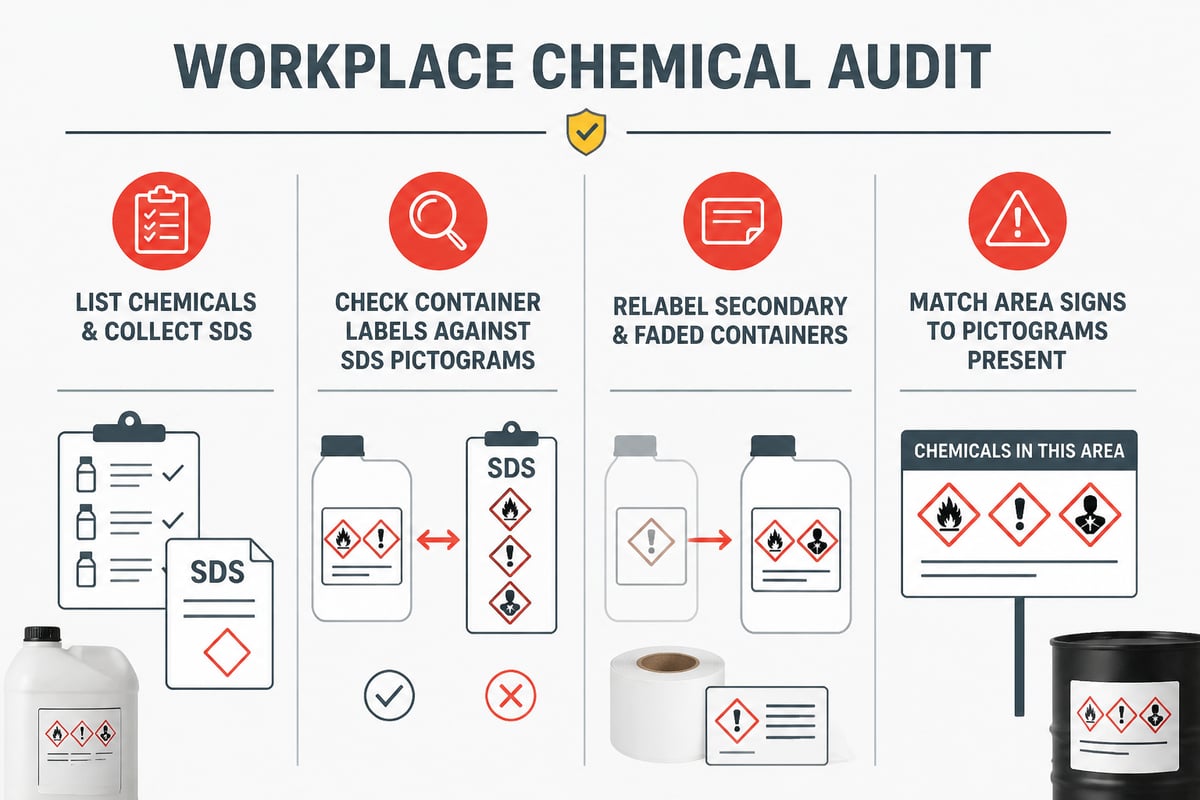
A practical audit takes four steps:
- List every chemical on site and collect its current SDS.
- Check each container label against the SDS pictograms and signal word.
- Relabel any secondary containers and replace faded or orange-symbol labels.
- Match storage-area and process-area signs to the pictograms present, so the signage and labels tell the same story.
9. Common GHS labelling mistakes
Most failures follow a short list of patterns:
- Using paper labels in wet or washdown areas, where they peel or smudge within weeks.
- Showing GHS07 together with GHS06 or GHS05, which breaks the precedence rules.
- Leaving decanted containers unlabelled because the product "is used straight away".
- Mixing old orange symbols and new diamonds in the same store.
- Posting area signs that describe a hazard no longer stored there.
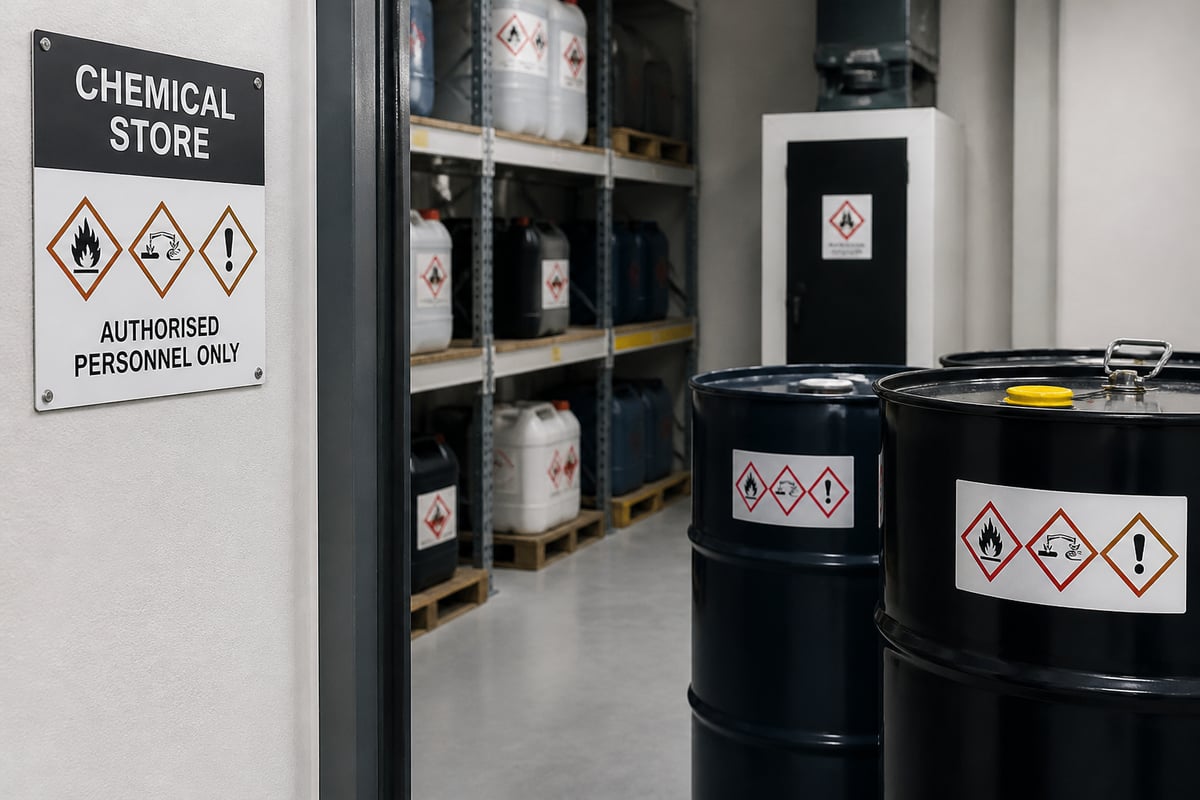
A short monthly walk-through catches most of these. Check that every container label is legible, every pictogram matches the SDS, and every sign at the door reflects what is actually inside. Note any change in stored products at the same time, so signage is updated when stock changes rather than at the next annual review.
Start by walking your chemical store with the current SDS folder and checking each container's pictograms against it. Where the labels are fading or the area signage no longer matches what is stored, SafetySignsForSale can supply made-to-order safety signs with nationwide delivery. Send your list of storage and process areas and Request a Quote so the signage can be matched to the hazards on your site.