


Fire Extinguisher Sign Guide: Types, Rules and Placement
A fire extinguisher sign is a red-and-white safety sign that shows where an extinguisher is kept, which type it is, or how to use it. Most workplaces need all three kinds: a location sign visible from a distance, an identification label that matches the extinguisher's contents, and instructions at the point of use.
For facility managers and procurement staff, the practical question is rarely whether to display signs. It is which signs to specify, how many to order, and where to fix them so they remain visible during an emergency. This guide works through each of those decisions in order.
What does a fire extinguisher sign indicate?
A fire extinguisher sign indicates the position of portable firefighting equipment and, depending on its format, the type of fire the equipment is suitable for. Under the SANS 1186 series of safety sign standards, fire equipment signs use a red square or rectangle with a white pictogram, which separates them from warning, prohibition and mandatory signs.
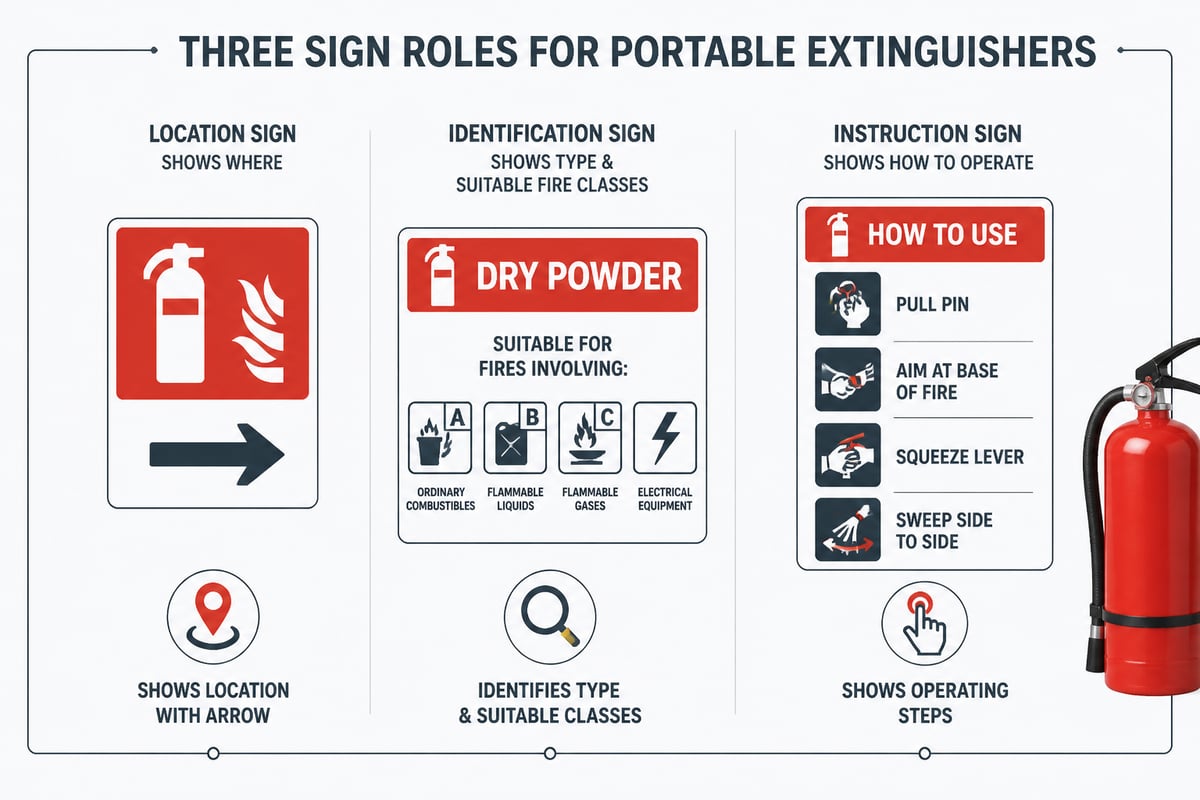
Three functions are commonly confused:
- Location signs tell people where an extinguisher is, often with an arrow or chevron pointing the way.
- Identification signs tell people what type of extinguisher it is and which fires it may be used on.
- Instruction signs tell people how to operate it, usually with a numbered pictogram sequence.
Each does a different job, and one sign rarely does all three. A pictogram alone says nothing about whether the extinguisher holds water, foam, dry powder or carbon dioxide. That distinction matters, because using the wrong agent on a fire can make it worse.
Are fire extinguisher signs required in South Africa?
Yes. South African occupational health and safety and fire regulations expect portable extinguishers to be clearly marked and readily visible, and local municipal fire by-laws add their own requirements for commercial and industrial premises. Signage built to the SANS 1186 series is a sound benchmark, and SafetySignsForSale's signs are SABS approved.
The exact obligations depend on your building class, occupancy and local authority, so confirm them with your fire safety officer or insurer before finalising an order. Insurers frequently inspect signage as part of risk surveys, and missing or faded signs are an easy finding to avoid.
International rules point in the same direction. The US federal regulation for portable extinguishers, 29 CFR 1910.157, requires extinguishers to be readily accessible and kept in designated locations. Although it is not South African law, it shows the common principle: equipment that cannot be found quickly does not protect anyone.
What colour and format should a fire extinguisher sign be?
A compliant fire extinguisher sign is red with a white symbol or text, in line with the standard safety colour for fire equipment. Directional variants add a white arrow on the same red background, while photoluminescent versions use a glow-in-the-dark material that remains legible when lighting fails.
Common formats include:
- Square or rectangular pictogram signs for wall or column mounting
- Chevron or arrow signs that point along a corridor
- Explanatory signs combining a pictogram with a short line of text
- Projecting or flag-mounted signs that can be seen from the side
Choose the format according to how people approach the extinguisher. In a straight corridor, a wall-mounted sign may be enough. In a warehouse with high racking or a factory floor with forklift traffic, a sign mounted flat against a wall can be hidden from most angles, so a projecting sign or a floor-to-ceiling column marker is the better choice.
How do you match a fire extinguisher sign to the extinguisher type?
Match the sign to the contents of the extinguisher, not to its shell. Extinguishers are usually red, and the agent is shown by a coloured band or label, so identification signs and labels must reflect what is actually inside each unit. The table below summarises the standard agents and where each is used.
| Extinguisher type | Suitable for | Avoid on |
|---|---|---|
| Water | Wood, paper, textiles (Class A) | Live electrical equipment, flammable liquids, cooking oil |
| Foam | Class A and flammable liquids (Class B) | Live electrical equipment, cooking oil |
| Dry powder | Class A, B, C and live electrical equipment | Enclosed spaces, because of reduced visibility and inhalation |
| Carbon dioxide (CO2) | Live electrical equipment, flammable liquids | Deep-seated Class A fires |
| Wet chemical | Cooking oils and fats (Class F or K) | Live electrical equipment |
Class letters vary between standards. European and South African practice commonly labels cooking-oil fires as Class F, while the US system uses Class K. Check which designation appears on your extinguishers' labels and keep your signs consistent with it.
A frequent compliance gap occurs after an extinguisher is replaced or recharged with a different agent while the old label stays on the wall. When you service or swap units, check the sign at the same time.
Where should a fire extinguisher sign be placed?
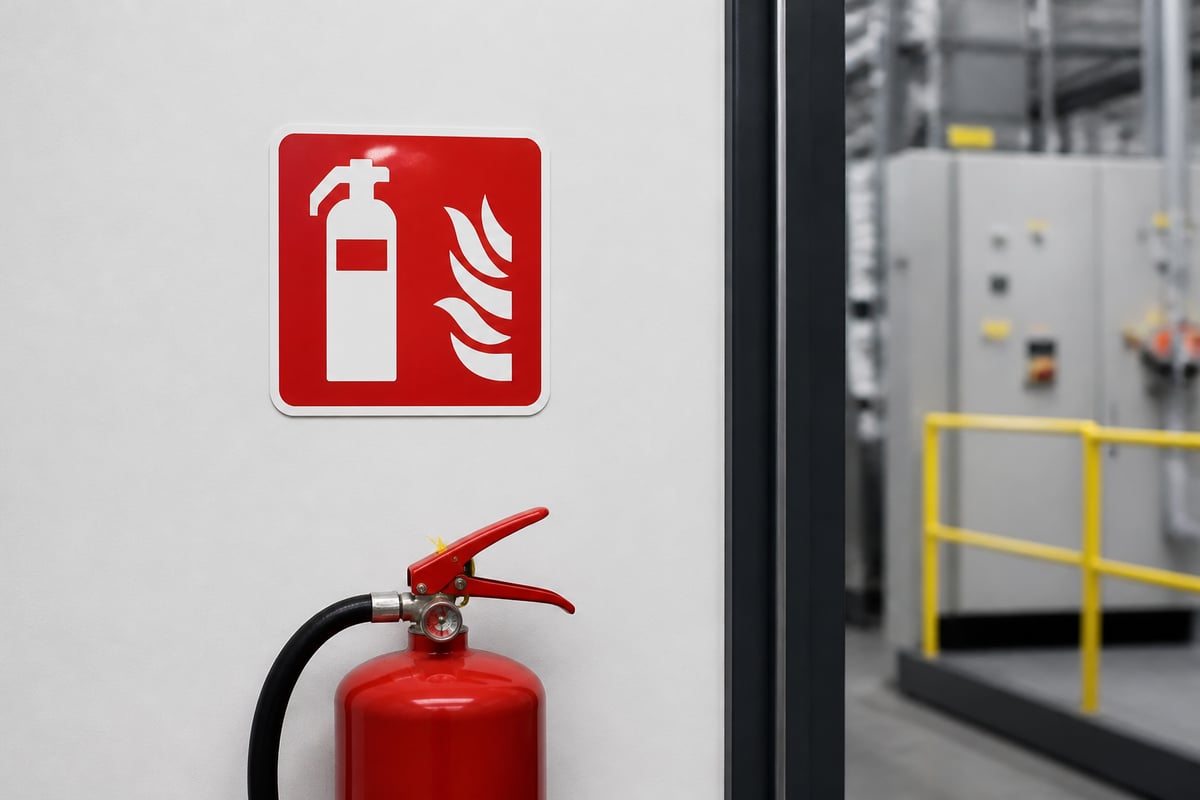
Place a fire extinguisher sign directly above or beside each extinguisher at eye level or higher, so it is visible from the normal approach routes and is not blocked by doors, stock or equipment. A sign low on a wall or hidden behind an open door fails the purpose it was bought for.
Practical placement rules:
- Mount the sign above the extinguisher. Mount it high enough to be seen over people and stock, clear of the floor.
- Use directional signs where the extinguisher is not in direct line of sight. At a corridor corner or behind a column, add an arrow sign so people can follow it.
- Position the extinguisher itself on a bracket or backing board. Handle height and mounting method matter as much as the sign. Pine backing boards and wall brackets from the fire extinguisher accessories range keep units off the floor and in a fixed, signed position.
- Keep a clear zone. Nothing should be stacked, parked or stored within the sign's sightline.
- Fit vehicle brackets and a sign inside vehicles that carry extinguishers. Service vehicles and forklifts need a visible, secured unit, and fire extinguisher vehicle brackets hold it safely in transit.
How far apart should extinguishers and their signs be?
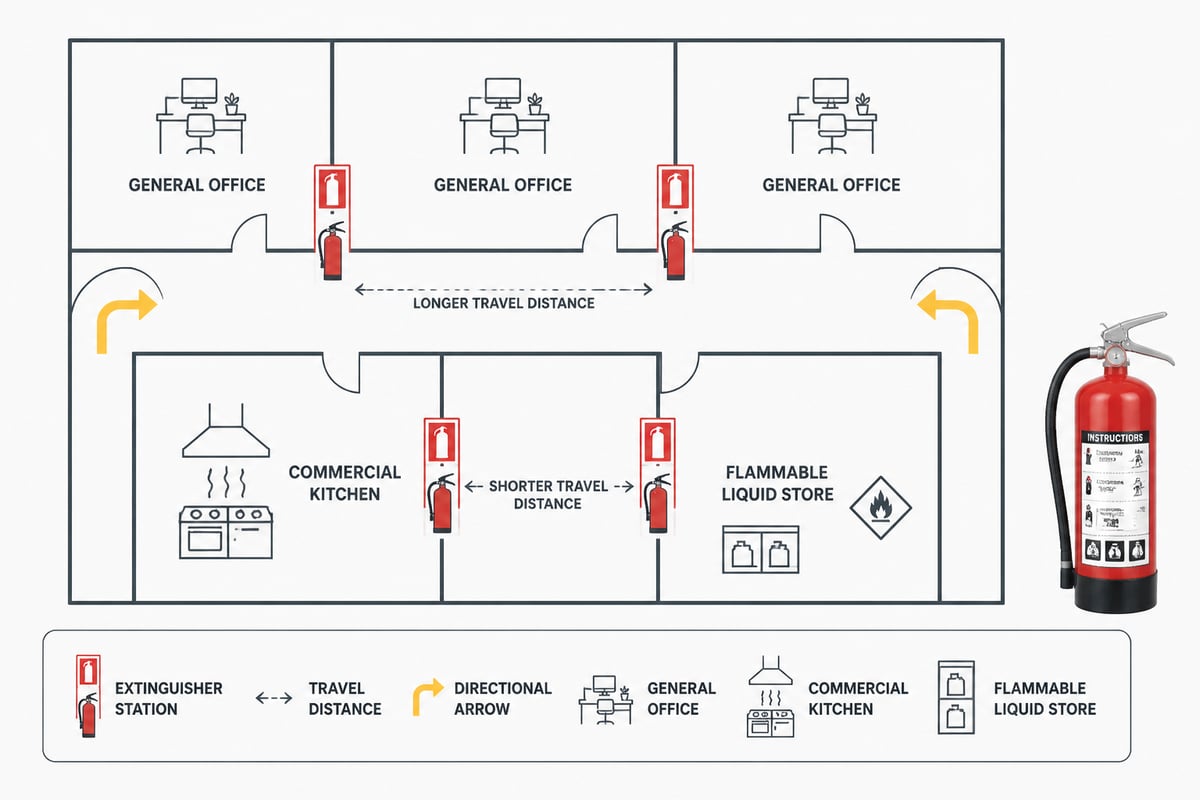
Spacing depends on the fire hazard, and the signs must be positioned so the next extinguisher is always findable within the permitted travel distance. The best-documented figures come from the US Occupational Safety and Health Administration (OSHA). They are a useful reference point, but South African requirements follow SANS and local authority rules, so confirm the local numbers before applying them.
OSHA states that employees must be able to reach a Class A extinguisher within 75 feet of travel distance. For Class B hazards, OSHA's maximum travel distance is 30 or 50 feet depending on the extinguisher's rating and the hazard level. For cooking-oil and fat hazards, Class K extinguishers have a maximum travel distance of 30 feet. Class D extinguishers for combustible metals must be within 75 feet of the hazard where such materials are generated at least once every two weeks.
The takeaway for sign planning is that high-risk areas such as commercial kitchens, paint stores, fuel dispensing areas and metal workshops need closer spacing and clearer signage. A single sign on a distant wall is not enough in those areas.
Which locations need a sign most?
The locations that most need a clear sign are the ones where people are likely to look first during an emergency: exits, corridors, kitchens and plant rooms. OSHA lists hallways, laundry rooms, meeting rooms, kitchens, mechanical or electrical rooms and areas near exit doors as typical accessible extinguisher locations.
A practical priority list for a factory, mine or retail site:
- Exit routes and doorways, where people naturally head when evacuating
- Plant, generator and electrical rooms, which need CO2 or dry powder signage
- Kitchens and canteens, which need wet chemical identification
- Flammable liquid stores and workshops, where foam or dry powder units apply
- Loading bays and vehicle areas, where mounted units and vehicle brackets are used
- Open-plan shop floors and warehouses, where racking blocks sightlines and projecting signs help
Walk each route as a visitor would. If you cannot spot the nearest extinguisher within a few seconds from any point along the path, add a sign.
When should you choose photoluminescent signs?
Choose photoluminescent signs where lighting may fail or where extinguishers sit in dim areas such as stairwells, basements, plant rooms, mines and underground parking. These signs absorb ambient light and glow in the dark, so the extinguisher can still be found during a power outage, which is common in an emergency.
Photoluminescent options cover several layouts. A fire extinguisher chevron photoluminescent sign works well along corridors, while combined signs showing an extinguisher with a hydrant or hose reel and a directional arrow suit equipment clusters. For example, an arrow down, fire extinguisher and fire hydrant photoluminescent sign marks a station where both are present.
Photoluminescent material needs to charge from light, so do not install it in permanently dark spaces with no light source at all.
What should a how-to-use fire extinguisher sign show?
An instruction sign should show the operating sequence in simple pictograms that a first-time user can follow in seconds. The usual order is pull the pin, aim at the base of the fire, squeeze the handle and sweep from side to side. Mount it beside or directly above the extinguisher, not on a far wall.
A how to use a fire extinguisher safety sign is especially useful in retail premises, offices and reception areas, where staff turnover is high and few people have had hands-on training. It supports training; it does not replace it. Staff who are expected to use extinguishers should still be trained and refreshed on a schedule.
Which materials and sizes suit a workplace?
Choose the material according to the environment. Indoor offices rarely need more than a standard rigid plastic sign, while outdoor, coastal, chemical and mining environments call for tougher substrates that resist UV, moisture and impact.
SafetySignsForSale makes its safety signs to order from ABS plastic or Cromadek steel, and all are SABS approved. Its range covers fire fighting, photoluminescent, warning, mandatory, prohibitory and general information signs, so a site can source its entire signage set from one supplier and keep the look consistent. For sizes, quantities and lead times on bulk orders, use the product pages or the contact page rather than assuming a standard.
When specifying for a large site, consider:
- Viewing distance. The further the sign must be read from, the larger the pictogram.
- Environment. Moisture, chemicals, sunlight and abrasion all shorten the life of lower-grade materials.
- Mounting surface. Brick, steel, glass and drywall each need a suitable fixing method.
- Consistency. Identical styling across all buildings avoids confusion for staff who move between sites.
How do you audit and maintain fire extinguisher signage?
Audit signage at least as often as you inspect the extinguishers themselves, and record the results. A sign check takes only minutes and catches the problems that cause failed inspections: faded print, peeling adhesive, obstructed views and signs that no longer match the unit beneath them.
A simple inspection routine:
- Confirm every extinguisher has a visible location sign from the main approach routes.
- Check that each identification label matches the extinguisher's current agent.
- Look for fading, cracking, graffiti or damage, and replace anything hard to read.
- Remove obstructions such as stock, coat racks, vehicles and new partitions.
- Re-check after any layout change, renovation or racking reconfiguration.
- Log the date, location and any action taken for your compliance file.
Pair this with a review of the extinguishers themselves. Your supplier's fire extinguishers range lets you replace damaged or outdated units and order matching signs in the same purchase, which keeps the equipment and the signage aligned.
What should procurement teams consider when buying in bulk?
Procurement teams should buy signs against a documented extinguisher register rather than an estimate, so every unit has the correct location, identification and instruction sign. Ordering from a register prevents both shortfalls and costly over-ordering.
Before placing an order:
- Count and map every extinguisher, including vehicle-mounted units.
- List the agent type for each, so identification signs are correct.
- Identify directional needs, such as corridor corners and racking aisles.
- Specify material and finish by area: indoor, outdoor or low-light.
- Add spares for sites where signs are often damaged.
- Confirm SABS approval with the supplier.
SafetySignsForSale offers nationwide delivery across South Africa and has over 25 years of experience in signage, manufacturing quality signage for blue chip clients. For multi-site rollouts, a single order covering fire signs, brackets and backing boards reduces admin and keeps specifications uniform.
Start by walking one floor of your busiest site with a clipboard and listing every extinguisher, its type and whether its sign is visible, correct and undamaged. That register becomes your order list. With it in hand, you can ask SafetySignsForSale to quote for exactly what the site needs, and you can use the Request a Quote form to get made-to-order, SABS-approved signs priced against your count.