


How to Use a Wet Floor Sign Correctly at Work
A wet floor sign warns people that a surface is slippery, and it works only if it is placed before the hazard, kept visible and removed once the floor is dry. Used on its own it is a warning, not a barrier, so correct use means combining the sign with sensible cleaning practice and access control. This guide sets out the steps a facility or safety manager can follow and build into site procedures.
What you need before you start
Gather the following so that signage is never improvised mid-shift:
- Enough signs for the largest area you clean at one time, not just one per cleaner.
- Signs with a clear pictogram and text, ideally bilingual or symbol-led so that every employee, contractor and visitor understands them.
- Barriers or cordon tape for areas that must be closed off.
- A written cleaning procedure that states who places signs, who removes them and who checks the floor.
- Dry mops or squeegees to shorten drying time.
- A fixed storage point near each cleaning cupboard so signs are collected before the mop is.
If you are buying in bulk, consider the signs together with the rest of your warning range. Warning signs for slippery surfaces, steps and overhead hazards can be specified in one order, which keeps your signage consistent across sites.
Step 1: Understand what a wet floor sign is for
The purpose of a wet floor sign is to alert people to a temporary slip hazard so they can adjust their route and walking pace before they reach it. It tells people that something is wrong, but it does not stop them walking onto the surface.
This distinction shapes everything that follows. The UK Health and Safety Executive states that signs and cones warn people about a hazard but do not prevent them from entering a wet area, and recommends barriers, locked doors or cleaning in sections where access needs to be restricted. In a factory canteen, a retail aisle or a mine office corridor, treat the sign as one layer of control and not the whole control.
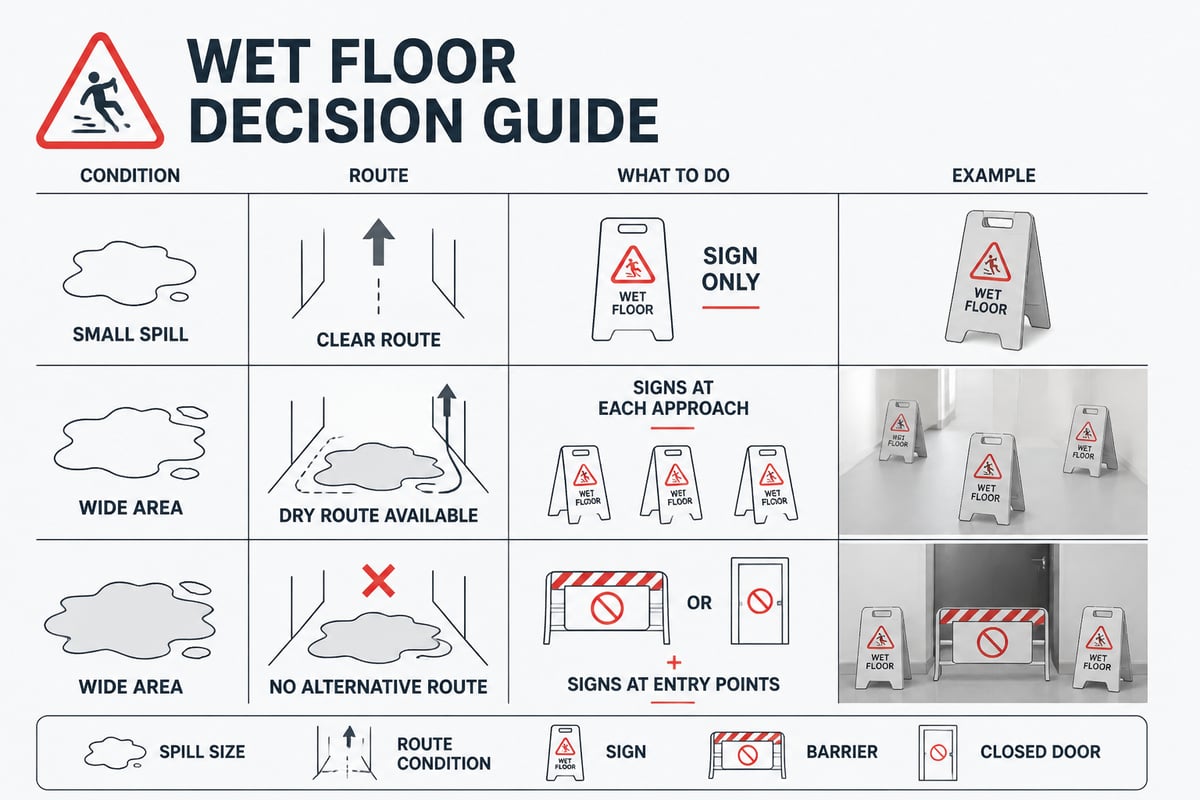
Step 2: Decide whether you need a sign, a barrier or both
Choose a sign alone only when the wet area is small, short-lived and easy to walk around. Choose a barrier or closure when the area covers a full walkway, a stairwell, an entrance or any route that people cannot avoid.
A simple decision guide:
- Small spill, clear alternative route: sign placed at the spill, cleaned and dried promptly.
- Wide area, dry route available: sign at each approach, with the dry route kept clear.
- Wide area, no alternative route: barrier or closed door, with signs at the entry points explaining why.
- High footfall period: postpone the clean if possible, or close the area in sections.
The HSE advises cleaning floors during quieter periods where possible, leaving smooth floors dry or keeping pedestrians out until the floor has dried. Scheduling matters as much as signage. A retail floor cleaned after closing needs far fewer warnings than one mopped at midday.
Step 3: Place the sign before the hazard, not on it
Position the wet floor sign so that a person sees it with enough time to react, which in practice means at the point where they would first step onto the wet surface and again at any other approach.
Follow these placement rules:
- Set the sign at every entry point, including side doors and cross-corridors, not only the end you started from.
- Place it before you start mopping, so the hazard is never unmarked, even for a minute.
- Keep it upright and fully opened, with the locking mechanism engaged so it does not fold or slide.
- Face the message toward oncoming traffic. A dual-message A-frame sign should have a face visible from both directions.
- Never block fire exits, extinguishers or first aid points with the sign or the cleaning equipment.
- Keep sight lines clear, so the sign is not hidden behind pillars, racking or displays.
Height and contrast matter too. A bright yellow A-frame stands out on grey concrete and dark vinyl, but is less visible against yellow safety markings, so check the background at each location.
Step 4: Clean in sections and keep a dry route open
Cleaning in sections lets people keep walking through a corridor or aisle while only part of it is wet, which reduces the temptation to cut across a signed area.
The HSE recommends cleaning in sections to maintain a dry route through the area. Work from the far end back toward the exit, so that you never stand on the clean floor you have just left behind and never trap yourself on the wet side.
Use as little water and detergent as the job needs. Excess liquid lengthens drying time and spreads the hazard to adjacent areas. A dry mop or squeegee can shorten drying time, though the HSE cautions that a damp floor can still be slippery. Do not remove the sign just because the surface looks clean.
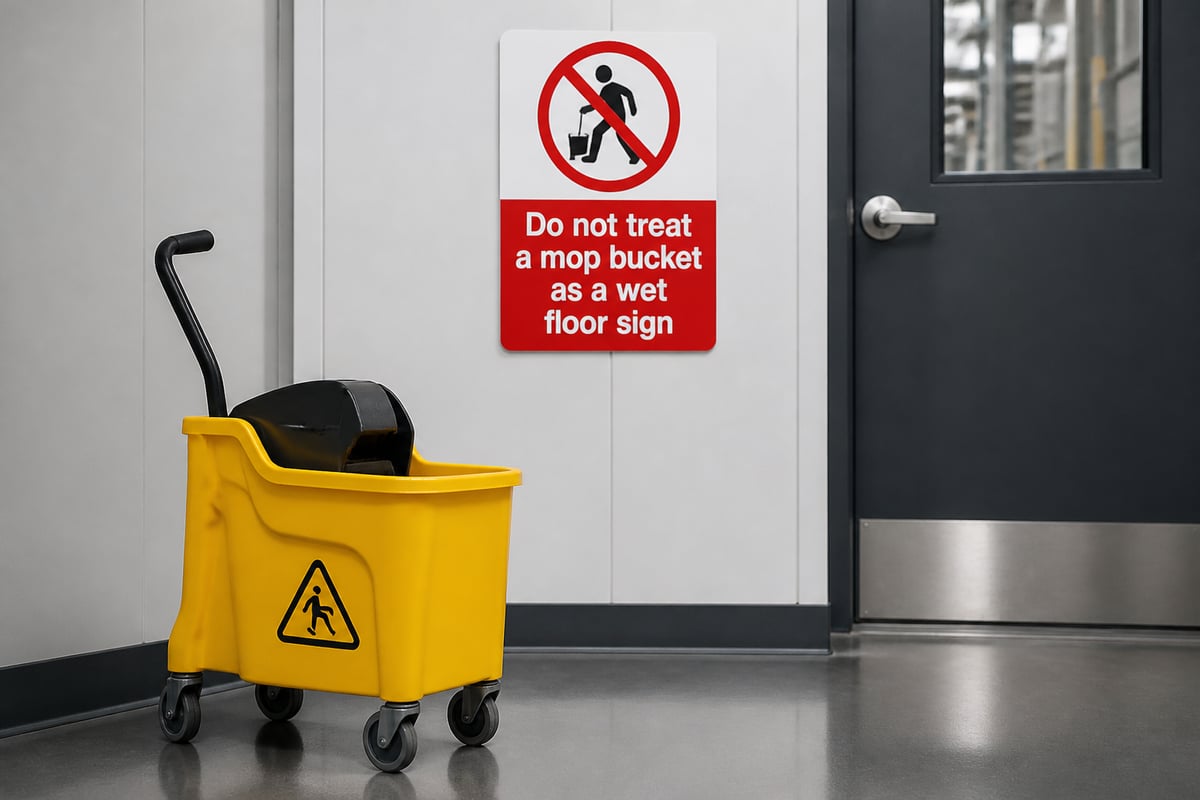
Step 5: Do not treat a mop bucket as a wet floor sign
A mop bucket does not count as a wet floor sign, because it is not a recognised warning and it is not designed to be seen from a distance. It is also frequently moved to the next section while the previous one is still wet.
Equipment left standing on a floor can itself become a trip hazard, and a bucket gives no pictogram and no message in any language. Put the sign out first, then bring the bucket in, and store both separately when the job is done. Include this in your cleaner induction so the practice is consistent across shifts and across contractor teams.
Step 6: Match the sign to your site and your workforce
A sign that cannot be read or understood does not do its job, so choose a format that suits your environment and the people in it.
| Site type | Practical considerations |
|---|---|
| Factory floor | Durable materials, high-contrast symbol, space to store near wash-down areas |
| Mine offices and change houses | Clear pictograms for multilingual teams, easy to carry |
| Retail stores | Sturdy A-frames visible above shopper eye-level, minimal clutter |
| Warehouses and distribution | Signs at the end of each aisle, plus barriers for forklift routes |
For permanent wet areas such as wash bays, kitchens or food-processing rooms, a freestanding sign is the wrong tool. A fixed wall or floor-adjacent warning sign, supplied in ABS plastic or Cromadek steel, stays in place and is read before anyone enters. SafetySignsForSale's made-to-order safety signs are SABS approved, and the range can be specified for both temporary and fixed positions. Use product pages or the contact page to confirm sizes and options for your site.
Where a hazard is not floor-related, use the right category. Mandatory signs for slip-resistant footwear, for example, belong alongside a wet floor warning in kitchens and wash areas, where the risk cannot be removed entirely.
Step 7: Remove the sign when the floor is dry
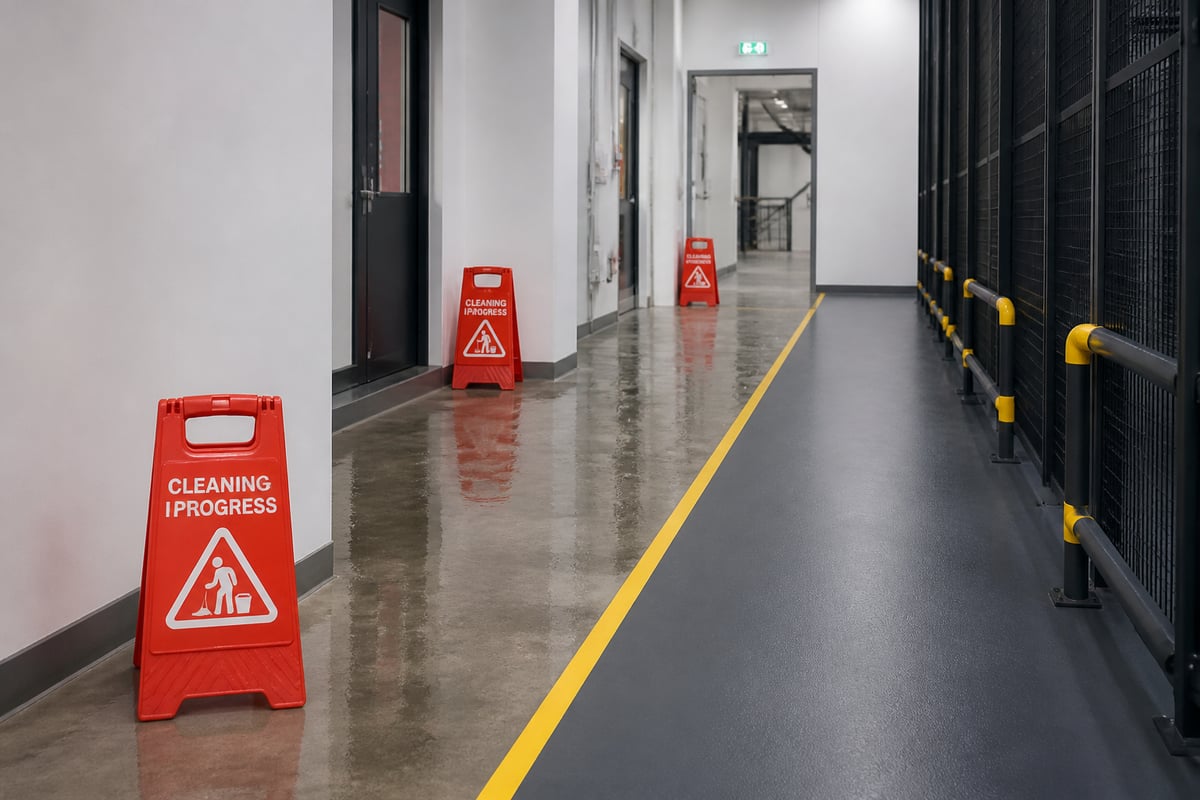
Remove the wet floor sign as soon as the floor is completely dry, because a sign left standing over a dry floor teaches people to ignore it.
The HSE advises removing warning signs once the floor is clean and dry. Make this a named task. Whoever places the sign is responsible for checking the floor and taking it away, and a supervisor should walk the area at the end of each cleaning round.
Over-use is a genuine risk. When signs stay out all day, employees and visitors stop registering them. The HSE also notes that signs and cones can be ignored when a spill is not visible, so they should not stand in for restricting access. Fewer, correctly timed signs are more effective than permanent clutter.
Step 8: Fix the source of the wet floor
A sign manages a hazard for a few minutes, while fixing the cause removes it. Walk your site and ask where floors get wet and why.
Common sources include:
- Leaking pipes, roofs or air-conditioning condensate
- Entrances during rain, where wet footwear carries water inward
- Wash-down areas and kitchens
- Spills from processes, vehicles or stock
- Poor drainage near loading bays
Entrance matting, drip trays, repaired drainage and better storage all reduce how often a sign is needed. The HSE's guidance on floor contamination explains common sources and how to prevent or control them, and it is a practical reference for a site audit. For healthcare and similar settings, the Health Service Executive in Ireland sets out advice on housekeeping, flooring and clear, well-placed temporary signs that translates well to other public-facing buildings.
Keep an incident record. If the same corridor appears in your near-miss log repeatedly, the answer is repair or redesign, not another sign.
Step 9: Train staff and record the procedure
A procedure only works if everyone follows it, so train cleaners, supervisors and contractors and keep a record of that training.
Cover these points in induction and toolbox talks:
- Why a sign does not replace restricting access
- Where signs are stored and how many to carry
- How to place, open and lock them
- Who removes them and when
- How to report a spill or a leak outside cleaning hours
Be careful with legal claims. Wet floor signs are not named as a standalone requirement in every rulebook, but employers in South Africa have a general duty to provide a safe working environment under the Occupational Health and Safety Act, and a visible warning is a standard, defensible control. Confirm specific obligations for your industry with your safety officer or legal adviser.
Common mistakes and troubleshooting
Most problems with a wet floor sign come from timing and placement, and they are easy to correct once identified.
- Sign placed after mopping starts. The hazard goes unmarked at the most dangerous moment. Always set signs first.
- One sign for a long corridor. People entering from the other end see nothing. Place a sign at every approach.
- Sign left out all day. It loses meaning and people ignore it. Assign removal to a named person.
- No dry route. People walk across the wet area anyway. Clean in sections or use a barrier.
- Sign hidden or knocked over. Check sight lines and make sure the frame locks open.
- Relying on a bucket as the warning. It is not a sign. Use a proper, recognised one.
- Sign worn or faded. Replace damaged signs, because an illegible pictogram is as good as none.
- Assuming a sign stops entry. It does not. Use a barrier where access must be restricted.
FAQ
Is a wet floor sign a legal requirement?
There is no single rule that names the wet floor sign on its own, but employers must keep the workplace safe, and a visible warning is a recognised way to control a temporary slip hazard. In South Africa this duty sits within the Occupational Health and Safety Act, so confirm the details for your industry with your safety officer.
What are examples of a warning sign?
Common warning signs include wet floor, caution steps, overhead hazard, beware of swinging objects, electrical hazard, forklift operating and slippery surface signs. They are typically triangular or rectangular with a yellow background and a black symbol. A site usually needs several types, chosen to match its actual risks.
How many wet floor signs should I put out?
Use one at every point where someone could step onto the wet area, which usually means each end of a corridor and any side entrance. The number depends on the layout, not the size of the cleaning team. Where the area cannot be avoided, add a barrier.
Start by walking your site this week and listing every location where floors are regularly wet, then check that a correctly sized sign and a barrier option are stored nearby. SafetySignsForSale has over 25 years of experience in signage and delivers nationwide across South Africa, with warning signs made to order in ABS plastic or Cromadek steel, so you can specify temporary and permanent signage in one go. For a bulk or multi-site order, you can Request a Quote from SafetySignsForSale and have your warning signage supplied to suit your workplace.