


Fire Hazard Symbols: A Guide to What They Mean
Fire hazard symbols are standardised pictograms that warn people about flammable materials, ignition risks and fire equipment, and the one most people look for is the black flame inside a red-bordered diamond, which marks a flammable substance. Other fire symbols appear on triangular warning signs, red prohibition signs, blue mandatory signs and green or red emergency signs, each with a specific job. For facility and safety managers, knowing which symbol belongs where is the foundation of compliant signage.
This guide explains what each group of fire hazard symbols means, how the shapes and colours work, and where each type should be displayed across factories, mines, warehouses and retail premises.
What Are Fire Hazard Symbols and Why Do Standards Matter?
Fire hazard symbols are graphical signs that communicate a fire-related risk, instruction or piece of equipment without relying on language. They matter because a workforce in South Africa often speaks several languages, and a picture is understood faster than a sentence.
Two systems sit behind most of what you will see on site. The first is chemical hazard labelling under the Globally Harmonized System (GHS), which uses diamond-shaped pictograms on containers. The second is safety signage under the ISO 7010 family, which covers fire protection, accident prevention, health hazard information and emergency evacuation.
ISO 7010:2019 specifies registered safety signs for accident prevention, fire protection, health hazard information and emergency evacuation. It also notes that these signs use the shapes and colours set out in ISO 3864-1, while the graphical symbols follow ISO 3864-3. In practice, that consistency means a sign bought in Johannesburg reads the same way as one fitted in Durban or Rustenburg.
South African signage is often produced to SANS standards, which align with these international conventions. Confirm the specific requirement for your premises with your local fire authority or a registered safety practitioner.
How Shapes and Colours Classify Fire Signs
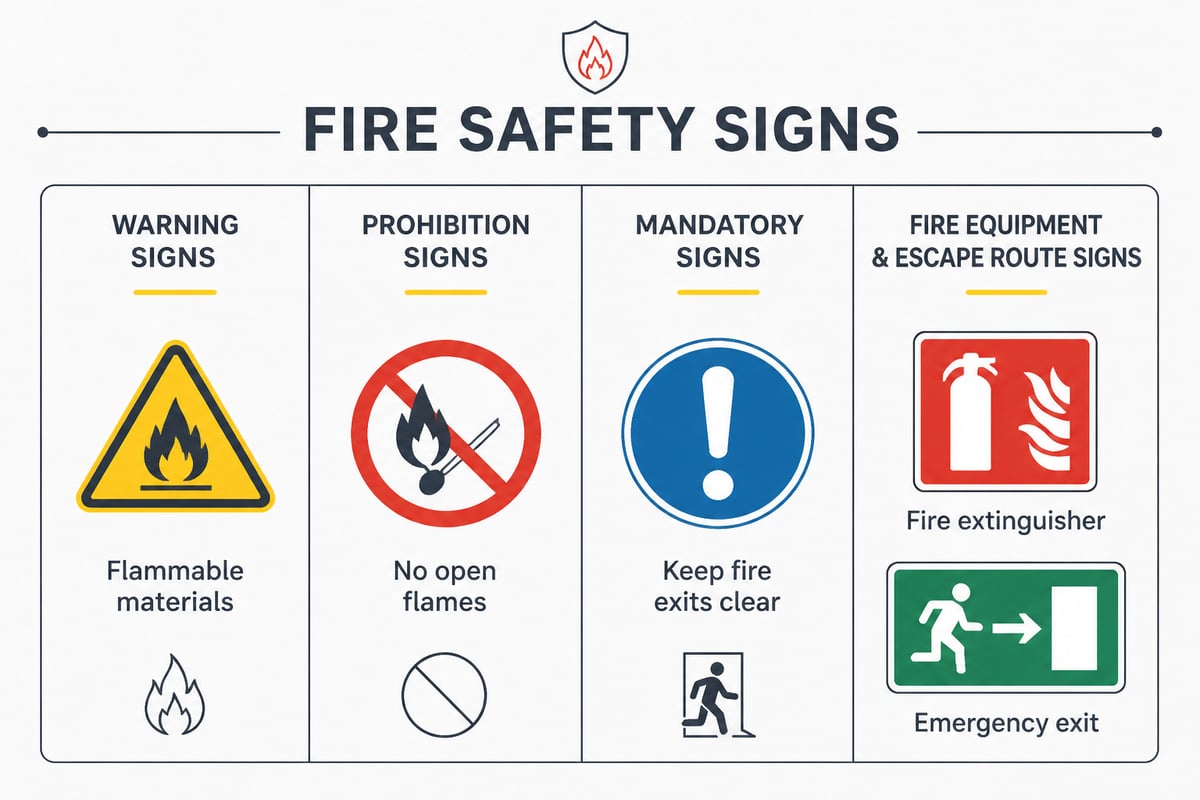
The shape and colour of a safety sign tell you its purpose before you read the symbol inside it. Learn the four categories below and you can interpret almost any fire sign at a glance.
| Sign type | Shape and colour | Message | Fire example |
|---|---|---|---|
| Warning | Yellow triangle, black border | Be aware of a hazard | Warning of fire hazard |
| Prohibition | Red circle with diagonal bar | Do not do this | No smoking, no open flames |
| Mandatory | Blue circle, white symbol | You must do this | Wear flame-resistant protective clothing |
| Fire equipment and escape | Red or green rectangle or square | Location of equipment or exit | Fire extinguisher, fire exit |
Red generally signals fire fighting equipment and prohibition. Green signals safe conditions such as escape routes. Yellow signals caution. Blue signals an action you are required to take.
Which Symbol Represents Flammable?
The symbol for flammable is a black flame on a white background, set inside a red-bordered diamond. This is the GHS flammable pictogram, and it appears on the labels of chemical containers such as solvents, paints, aerosols and fuels.
The same flame is used for several kinds of flammable hazard:
- Flammable gases and aerosols
- Flammable liquids, such as petrol, thinners and alcohol-based cleaners
- Flammable solids
- Self-heating and self-reactive substances
- Substances that emit flammable gas on contact with water
- Pyrophoric materials, which ignite spontaneously in air
The label also carries a signal word, either "Danger" or "Warning", plus hazard statements that specify the exact risk. Always read these alongside the pictogram, because the flame alone does not tell you whether a liquid ignites at room temperature or only when heated.
Where flammable liquids are stored or decanted, the container label is not sufficient on its own. A wall or door sign such as the flammable liquid safety sign tells people entering the area what they are walking into before they ever see a container.
The Related GHS Symbols That Affect Fire Risk
Several other GHS pictograms are directly relevant to fire safety, even though they do not show a flame. A safety manager reviewing a chemical store should recognise all of these.
Oxidising: flame over a circle
The flame over a circle marks oxidising substances, which can cause or intensify a fire by supplying oxygen. Examples include hydrogen peroxide, nitrates and some pool chemicals. Store them well away from fuels and flammable liquids, because an oxidiser turns a small ignition into a serious fire.
Exploding bomb
This pictogram marks explosives, self-reactive substances and certain organic peroxides. These materials can detonate through heat, friction or shock, so ignition control is critical wherever they appear.
Gas cylinder
A gas cylinder symbol marks gases under pressure. A cylinder exposed to fire can rupture violently, so these require heat-protected storage and clear signage on the storage area.
Corrosive and others
Corrosive, toxic, health hazard and environmental pictograms do not describe fire risk directly. They matter in a fire because burning or reacting chemicals can release hazardous fumes, which affects how responders and staff approach the area.
What Are the Different COSHH Warning Signs and What Do They Represent?
COSHH, the UK Control of Substances Hazardous to Health framework, uses the same nine GHS pictograms that appear on South African chemical labels. The nine are explained below, since your suppliers' labels will carry them.
- Exploding bomb: explosive or self-reactive materials.
- Flame: flammable substances.
- Flame over circle: oxidising substances.
- Gas cylinder: gases under pressure.
- Corrosion: substances that damage metals or burn skin and eyes.
- Skull and crossbones: acute toxicity, which can be fatal in small doses.
- Exclamation mark: irritants and less severe health hazards.
- Health hazard (person with star on chest): serious long-term effects such as carcinogenicity or respiratory sensitisation.
- Environment: substances dangerous to aquatic life.
Only the first four relate to fire and explosion. The remaining five describe health and environmental risk, but a thorough chemical store sign-off checks all nine.
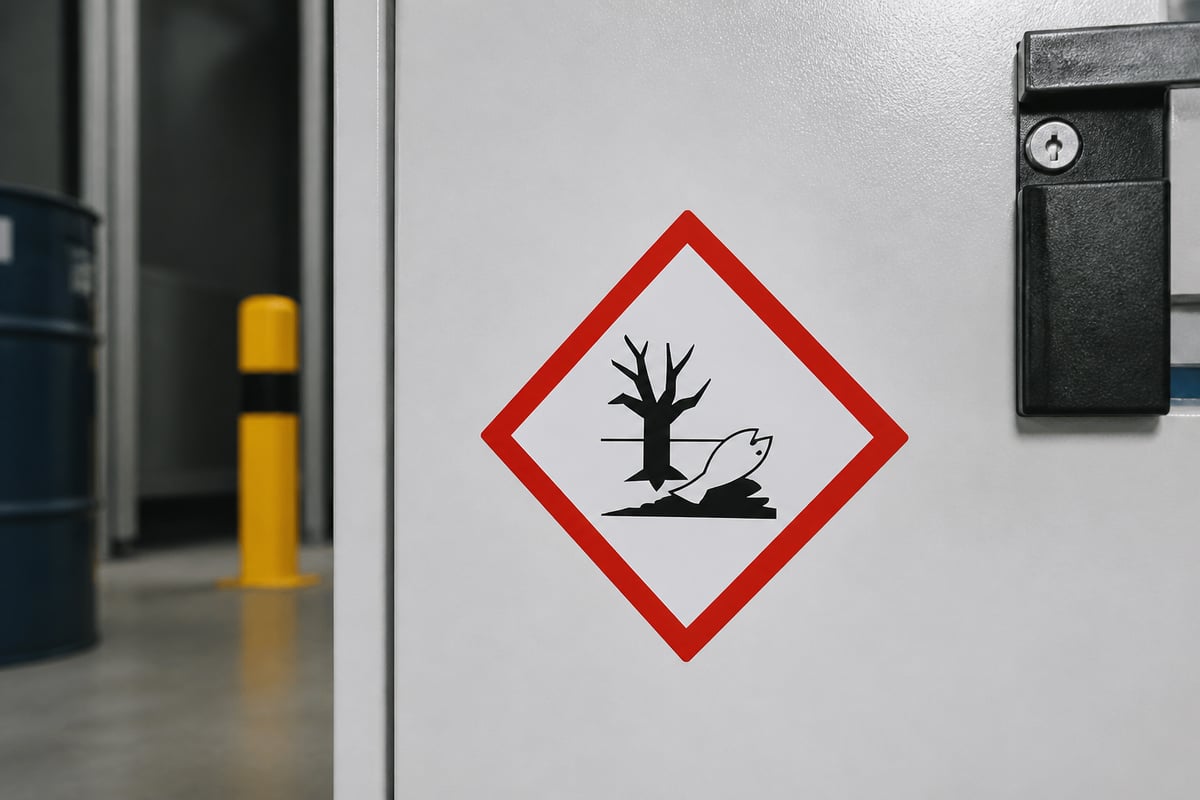
What Is the Symbol for Harmful to Aquatic Life?
The symbol for harmful to aquatic life is the GHS environmental pictogram, a diamond-shaped sign used on chemical containers to show that a substance is dangerous to aquatic life.
It links to fire safety in a practical way. Firefighting water and foam runoff from a burning chemical store can carry these substances into stormwater drains and watercourses. If your site holds products carrying this pictogram, factor containment of runoff into your emergency planning.
Warning Signs for Fire Hazards
A warning sign for a fire hazard is a yellow triangle with a black border and a black symbol, normally a flame, used to alert people to a location where a fire risk exists. Unlike the GHS diamond, which is attached to a product, the triangle is fixed to a place.
Typical positions include:
- Entrances to flammable liquid stores and gas cylinder cages
- Workshops where welding, grinding or cutting produces sparks
- Spray painting booths
- Battery charging areas
- Fuel storage and dispensing points on mines and in transport yards
A warning of fire hazard sign is the standard choice for these locations. Pair it with a prohibition sign where behaviour needs to change, since a warning describes the risk while a prohibition tells people what not to do.
Prohibition and Mandatory Fire Signs
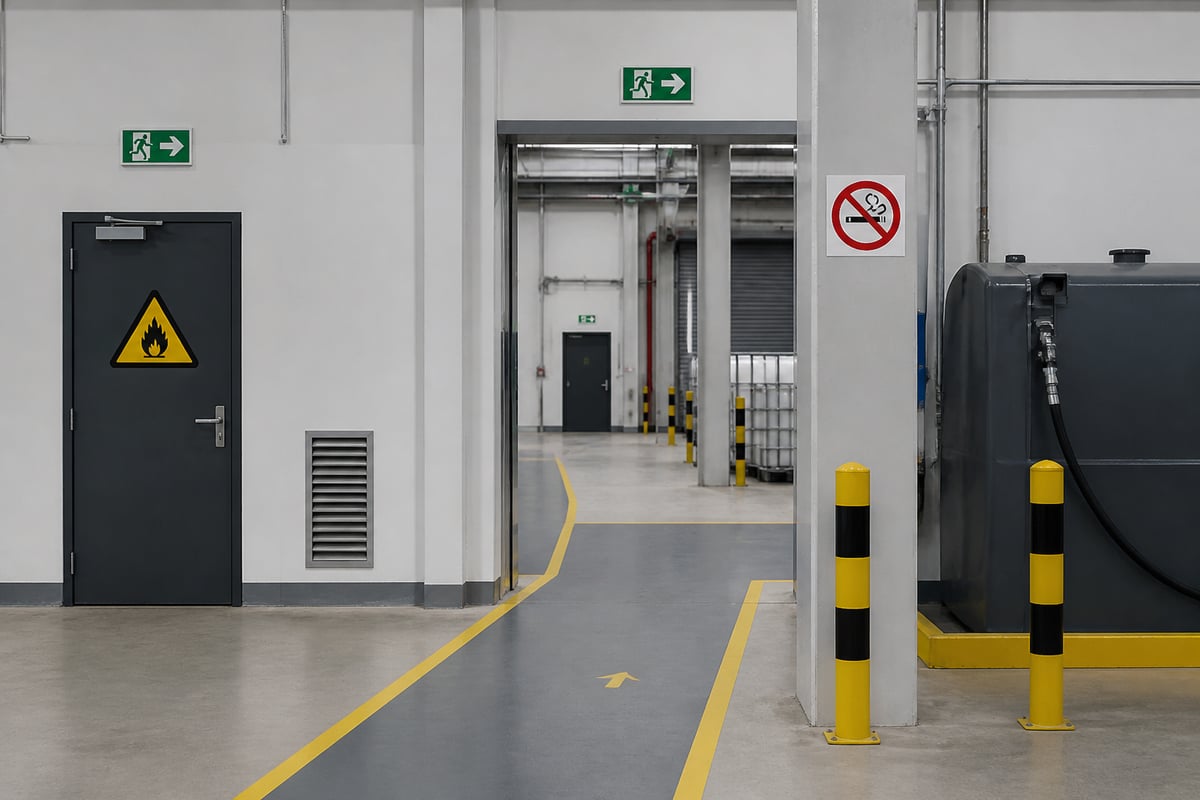
Prohibition signs forbid behaviour that could start a fire, and mandatory signs require protective action. Used together with warnings, they turn a hazard notice into a clear rule.
Common prohibition symbols in fire safety include:
- No smoking: a cigarette inside a red circle with a bar
- No naked flames: a lit match or flame inside a red circle with a bar
- No unauthorised entry to restricted fire-risk zones
The no smoking safety sign is one of the most widely required, particularly at fuel stores, retail stockrooms and anywhere gas is handled.
Mandatory signs are blue circles with a white symbol. In fire-risk areas they typically require flame-retardant clothing, eye protection or the use of an earthing connection when transferring flammable liquids.
Fire Safety Signs: Equipment and Escape Symbols
Fire safety signs for equipment and escape tell people where to find firefighting tools and how to leave safely. They use red for equipment and green for exits, and they must be visible from the point where a person would need them.
Fire equipment signs
Red signs identify the location of:
- Fire extinguishers
- Fire hose reels
- Fire hydrants
- Fire blankets
- Fire alarm call points
An extinguisher sign should be mounted at eye level above the unit, so that staff and visitors can locate it even when something stands in front of it. Match the equipment to the hazard: your fire extinguishers should be appropriate for the classes of fire present on site, and the signage should make their positions obvious.
Fire exit and escape signs
Green signs with a white running figure and arrow mark escape routes and final exits. Directional arrows must point the correct way along the route, and the sign at the final exit should show the figure moving through a doorway. A fire exit left safety sign is an example of a directional sign used along corridors.
In areas that may lose power or fill with smoke, photoluminescent signs keep escape routes visible after lighting fails. These are especially useful in stairwells, basement stores and mine surface buildings.
Placing and Maintaining Fire Hazard Symbols on Site
Correct placement is as important as choosing the right symbol. A compliant sign in the wrong position fails the people it is meant to protect.
Follow these principles:
- Mount at eye level and keep the sign clear of obstructions such as stacked stock or open doors.
- Place signs at decision points, such as corridor junctions, stairwell doors and store entrances.
- Keep lighting adequate so symbols can be read in normal and emergency conditions.
- Use the correct size for the viewing distance, since larger signs are needed in warehouses and yards than in offices.
- Do not mix conflicting messages on the same wall or door.
Inspect signs on a regular schedule. Fading, damage from chemicals or abrasion, and signs covered by paint or posters all reduce effectiveness. Replace anything that is no longer clear. After layout changes, such as a relocated extinguisher or a new storage area, update the signage on the same day so it never contradicts the real situation.
The material matters in harsh environments. Signs made to order in ABS plastic suit most indoor and general industrial settings, while Cromadek steel suits exposed or heavy-duty locations. Browse the full safety signs range at SafetySignsForSale to match the material and sign type to each area of your premises. Made-to-order signs from SafetySignsForSale can support your compliance file during an inspection, since they are produced to the same shape and colour conventions as the ISO 7010 family.
A Practical Fire Signage Audit
A short walk-through audit shows where your symbols are missing, outdated or misleading. Complete it area by area rather than all at once.
- List every fire-risk area: chemical stores, fuel points, workshops, kitchens, plant rooms and battery rooms.
- Check each has a warning sign and, where behaviour matters, a prohibition sign.
- Confirm every extinguisher, hose reel, hydrant and alarm point has its own sign and that it is visible.
- Walk every escape route and confirm that exit signs and arrows are continuous, correctly directed and readable.
- Cross-check chemical labels against your register, making sure GHS pictograms on containers match the safety data sheet.
- Record gaps and replacements with a date, owner and completion target.
Keep the completed audit with your fire plan. It shows that signage is actively managed, not simply installed once and forgotten.
FAQ
What are fire safety signs?
Fire safety signs are standardised signs that warn of fire risks, prohibit dangerous behaviour, show the location of firefighting equipment and mark escape routes. They use set shapes and colours so the message is clear in any language. Together they form the visual part of a site's fire plan.
What colour are fire exit signs?
Fire exit signs are green with a white running figure and arrow, since green indicates a safe condition or escape route. Equipment signs such as extinguisher and hose reel markers are red. This colour split lets people tell an escape route from a piece of equipment instantly.
Do chemical labels and wall signs both need fire symbols?
Yes, because they serve different purposes. The GHS flame pictogram on a container identifies the product hazard, while a wall or door sign warns anyone approaching the area. A flammable store needs both to be properly signed.
Start by walking your site with the audit above and listing every fire-risk area, extinguisher point and escape route that lacks a clear, current symbol. With over 25 years of experience in signage and more than 10,000 happy clients, SafetySignsForSale makes made-to-order signs in ABS plastic or Cromadek steel, with nationwide delivery across South Africa. If you need replacements or a full set for a new area, you can Request a Quote with your list of required signs and receive competitive pricing.