


Danger and Caution Signs: A Guide to Choosing Them
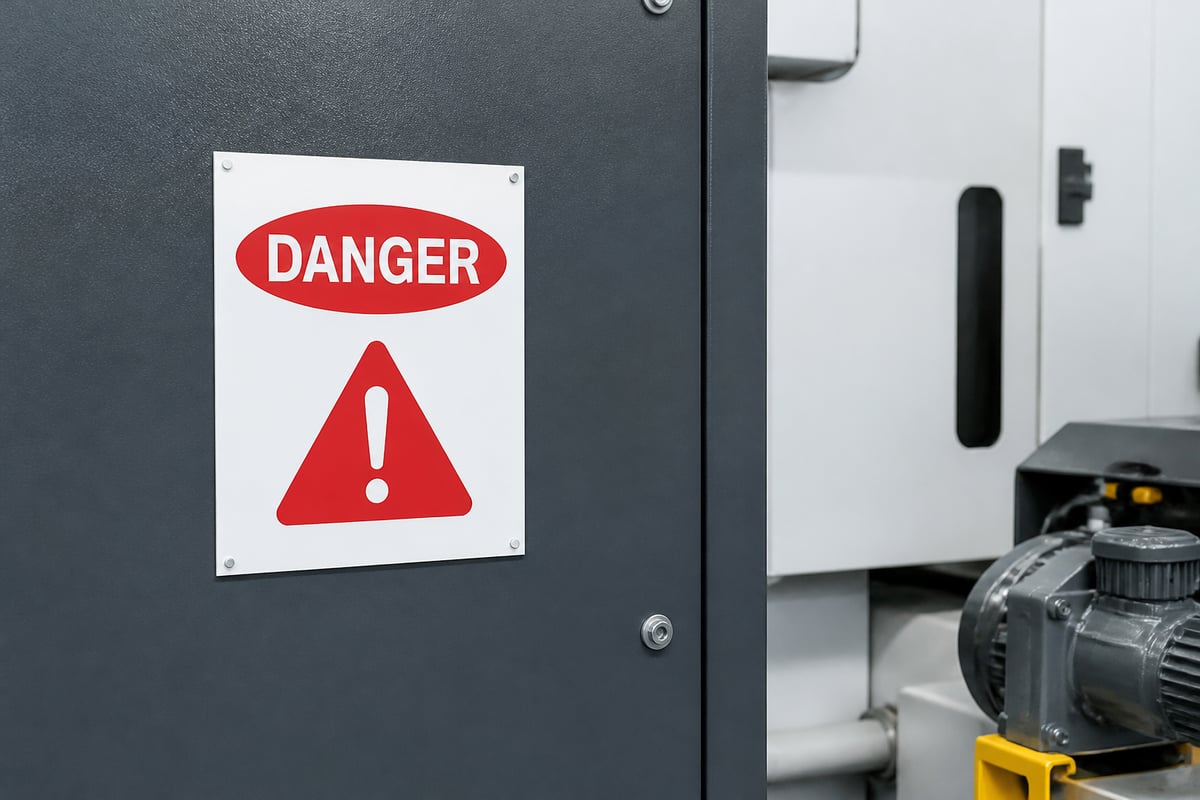
A danger caution sign tells people how serious a hazard is before they reach it: "danger" signals a hazard likely to cause death or serious injury, while "caution" signals a lower-level risk that could cause minor injury or damage. Choosing the right one means matching the wording, colour and symbol to the real level of risk on your site, then placing it where people will see it in time to act.
For facility managers and procurement staff, the choice affects more than appearance. A sign that overstates or understates a hazard weakens trust in all your signage, and a sign that is faded, badly placed or the wrong specification will not do its job when it matters.
What is the difference between a danger sign and a caution sign?
A danger sign warns of an immediate, severe hazard, while a caution sign warns of a potentially hazardous situation that could cause lower-level harm if ignored.
The distinction comes from signal words, which rank the seriousness of a risk. OSHA's Hazard Communication Standard uses only two signal words on chemical labels: DANGER denotes the more severe hazards and WARNING the less severe ones. Many industrial sign systems add CAUTION as a third tier for minor hazards, which is why the three words are often mentioned together.
A practical way to think about the tiers:
- Danger: the hazard is present and could kill or seriously injure, such as exposed high-voltage equipment or an open excavation.
- Warning: the hazard could cause serious injury if the person does not take care, such as overhead cranes or forklift routes.
- Caution: the hazard could cause minor injury or damage, such as a wet floor or a low beam.
South African workplaces commonly use symbolic safety signs built around the same logic of category, colour and pictogram. Where a sign is read quickly, often by workers who speak different languages, the symbol and colour must carry the message even before the words are read.
Colours, shapes and symbols that make a sign compliant
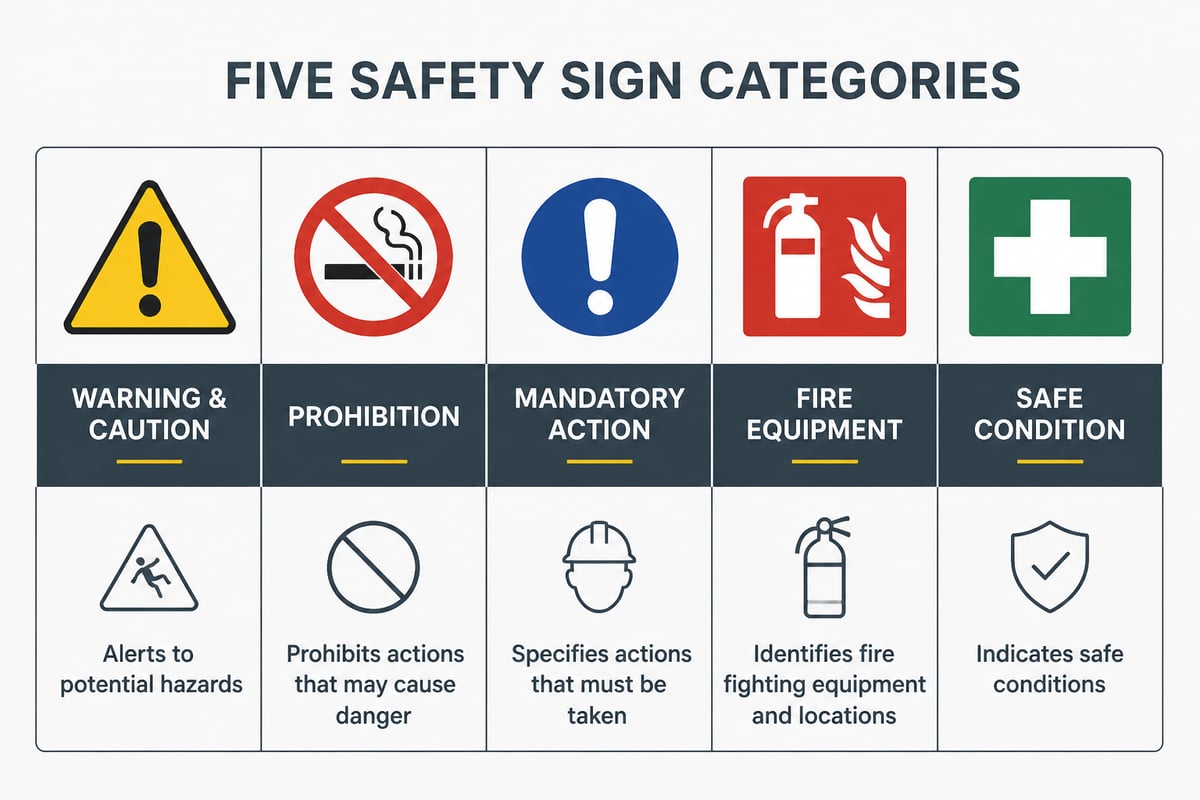
Compliant signs rely on a fixed combination of colour, shape and pictogram so that the category is recognisable at a glance, even from a distance.
The general convention is straightforward:
| Sign category | Typical shape | Typical colours | Meaning |
|---|---|---|---|
| Warning / caution | Triangle | Yellow with black symbol | Be aware of a hazard |
| Prohibition | Circle with slash | Red and white | Do not do this |
| Mandatory | Circle | Blue and white | You must do this |
| Fire equipment | Square or rectangle | Red and white | Location of fire equipment |
| Safe condition | Square or rectangle | Green and white | Exit, first aid or safe route |
For hazard signs, UK HSE guidance describes warning signs as triangular, with a black pictogram and at least 50% yellow background. That proportion matters because the yellow field is what makes the sign stand out against concrete, steel and brickwork.
The ANSI system takes a slightly different approach, using a dedicated "DANGER" header panel in white lettering on a red background, then a message panel below. If your site belongs to a multinational group or supplies equipment to export markets, it is worth understanding how ANSI Z535.3 defines symbol types for hazard alerts, required actions, prohibitions and information, so that your local signs and imported machinery labels do not contradict each other.
When a danger caution sign is required
You need a danger caution sign when a significant risk remains after you have done everything reasonable to remove or control it, not as a substitute for proper controls.
HSE guidance makes the principle clear: safety signs are needed where a significant risk remains despite other relevant measures. Guarding, isolation, training and safe systems of work come first. Signs are the final layer, reminding and informing people about the hazards that cannot be engineered out.
In practice, this covers a predictable set of locations across South African industrial and commercial sites:
- Mines and quarries: blasting zones, unstable ground, vehicle and conveyor hazards.
- Factories and workshops: machinery guards, hot surfaces, moving parts, noise zones.
- Warehouses and distribution centres: forklift routes, pedestrian crossings, racking load limits.
- Retail premises: wet floors, delivery bays, restricted back-of-house areas.
- Construction sites: excavations, overhead work, site access and speed limits, for which dedicated construction signs are available.
- Electrical and chemical areas: substations, switchrooms, chemical stores and gas cupboards.
Your risk assessment should drive the list. Walk the site, note each remaining hazard, then decide what level of sign each one needs.
Choosing the right wording and message
Effective sign wording names the hazard in a few plain words, states the consequence where it is not obvious, and tells the reader what to do.
A three-part structure works well: the signal word, the hazard, and the required action. "DANGER: High voltage. Authorised personnel only" does all three. "CAUTION: Wet floor" is shorter because the hazard is self-explanatory and the action is obvious.
A few rules keep wording useful:
- Use the signal word that matches the real severity, and apply it consistently across the site.
- Keep text short enough to be read at walking pace.
- Pair text with a pictogram so the message survives language barriers. South African workforces often include several home languages, so consider bilingual or multilingual signs where English alone may not reach everyone.
- Avoid over-signing. HSE notes that too many signs can cause confusion, which dilutes the signs that matter most.
For chemical hazards, labelling follows its own requirements. OSHA's standard requires that labels or other warnings be legible, in English and prominently displayed on the container, or readily available in the work area throughout each shift. South African operators should check the equivalent requirements under local regulations and the GHS-aligned SANS standards, and make sure signage in chemical stores agrees with the labels on the containers inside.
Size, placement and visibility
A sign only protects people if it can be read from a safe distance, which depends on its size, height, lighting and position relative to the hazard.
Size should match viewing distance. A sign at a pedestrian door can be small, while a sign facing approaching vehicles at a mine entrance or yard gate needs to be considerably larger. Sign size should be matched to viewing distance, so ask your supplier to confirm the correct dimensions for your layout rather than guessing.
Placement guidance that applies broadly:
- Mount signs at the point where the hazard begins, with enough distance for the reader to react.
- Place them at eye level, or higher where vehicles or crowds could obscure them.
- Keep them clear of obstructions such as racking, stacked stock or open doors.
- Fix them securely to walls, fences, gates or equipment so wind and vibration do not dislodge them.
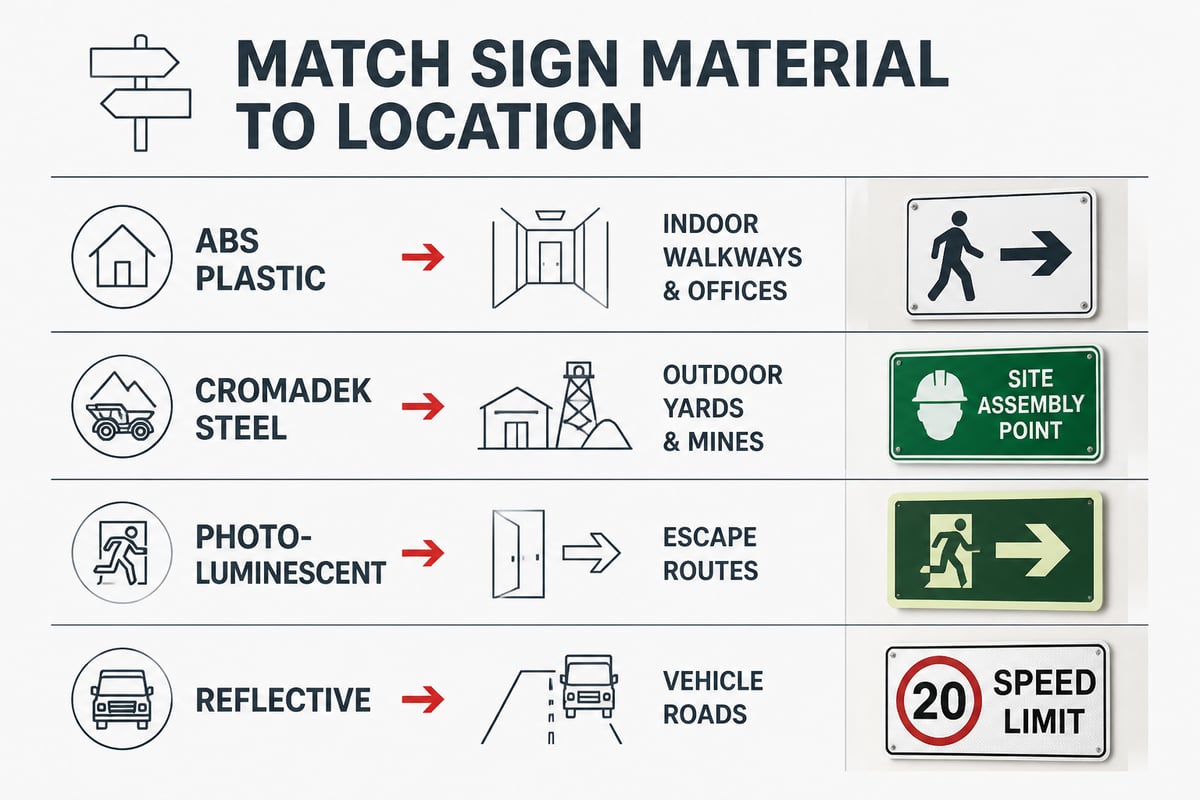
Darkness changes the requirement. HSE advises that signs should be noticeable, clean, well maintained, and reflective or lit where they need to be visible in the dark. Photoluminescent signs, which glow after absorbing light, are well suited to escape routes and areas that may lose power, while reflective sheeting suits yards, roads and outdoor perimeters.
Materials and durability for South African conditions
The right material depends on where the sign will hang: indoor offices, hot factory floors, coastal yards and open-cast mines place very different demands on a sign.
Two options cover most needs:
- ABS plastic: lightweight, impact resistant, and cost effective for internal areas, walkways and general-purpose signage.
- Cromadek steel: a durable coated steel that holds up to harsher outdoor conditions, strong sun, dust and knocks.
UV exposure is a particular issue for outdoor signs. A sign that fades can lose the colour contrast that makes it recognisable, so outdoor installations should be specified for long-term weather resistance. Chemical splash, abrasion and cleaning routines matter too, so tell your supplier about the environment when you order.
Buying danger and caution signs in bulk
Bulk buying works best when you audit the site first, standardise the specification, and order against a defined sign schedule rather than a loose list.
For procurement teams, a clear process avoids the usual problems of duplicated orders, mismatched sizes and missing signs:
- Audit: walk each area with the risk assessment and record every location that needs a sign.
- Classify: assign each location a category, whether danger, warning, caution, prohibition, mandatory, fire or safe condition.
- Standardise: set one size, material and wording style per category so the site looks and reads consistently.
- Confirm standards: ask for SABS-approved signage so your purchase aligns with local requirements.
- Schedule replacement: record installation dates and plan routine checks so faded or damaged signs are replaced early.
SafetySignsForSale makes safety signs to order in ABS plastic or Cromadek steel, covering warning, mandatory, prohibitory, fire fighting, general information, photoluminescent and road signs. It offers made-to-order safety signs and delivers across South Africa, which simplifies ordering for multi-site operations. For site-specific wording, sizes or quantities, speak to the team directly through the product pages or contact page.
Maintaining and auditing your signage
Signs need routine inspection because their value drops quickly once they are dirty, damaged, outdated or obscured.
Build sign checks into existing safety inspections rather than treating them as a separate task. Look for fading, cracking, peeling, graffiti, loose fixings and anything that now blocks the line of sight. HSE's guidance on keeping signs clean and well maintained applies equally to a Johannesburg warehouse or a Limpopo mine.
Review the signage whenever the site changes. A new production line, relocated stores area, altered traffic route or different chemical inventory can make existing signs wrong overnight. Remove signs that no longer apply: a sign warning of a hazard that has gone teaches people to ignore signs.
Link signage to the rest of your safety arrangements. A hazard sign pointing towards a first aid point is only useful if that point is stocked, so keep medical kits checked and complete, and make sure warning signs are updated alongside your risk assessments.
Common mistakes when specifying a danger caution sign
Most signage failures come from a handful of avoidable errors in specification and installation.
- Using the wrong signal word. Labelling a minor trip hazard "DANGER" teaches workers to discount the word.
- Relying on text alone. Without a pictogram, the message fails for readers with limited English or poor literacy.
- Mounting too high, too low or too far away. The sign is present but not seen in time.
- Mixing standards. Combining ANSI-style red header panels with SANS-style symbols on the same site creates inconsistency. Choose a system and apply it throughout.
- Over-signing. Every wall covered in signs means no individual sign stands out.
- Ignoring the environment. Indoor-grade signs fitted outdoors fade and fail within a season or two.
Frequently asked questions
Is a danger sign the same as a warning sign?
No. A danger sign denotes the highest level of hazard, where death or serious injury is likely, while a warning sign indicates a serious but less immediate hazard. Caution sits below both for minor risks.
Do danger and caution signs have to be SABS approved?
Choosing signs that follow recognised South African standards is the safest route to meeting expectations for symbol design, colour and format. Confirm with your supplier which standards their signs follow, and keep records for audits.
How often should safety signs be replaced?
There is no fixed interval. Replace a sign when it fades, cracks, becomes illegible or no longer matches the hazard. Outdoor signs in strong sunlight typically need earlier attention than indoor ones.
Can I customise the wording on a sign?
Yes, in most cases, provided the signal word, colour and symbol still follow the relevant standard. Ask SafetySignsForSale about made-to-order options through its product pages.
Start by walking your busiest area with a clipboard, listing each remaining hazard and marking whether it needs a danger, warning or caution sign. Once you have that schedule, you can compare it against SafetySignsForSale's Safety Signs range, built on over 25 years of signage experience, and send your list to the team so you can Request a Quote tailored to your site.