


Road Signage and Meaning: A Complete Guide
Road signage represents one of humanity's most successful attempts at creating a universal visual language. Every day, millions of drivers, pedestrians, and cyclists rely on these carefully designed symbols to navigate safely through complex traffic environments. Understanding road signage and meaning goes beyond simple memorisation of symbols; it involves recognising the systematic design principles, regulatory frameworks, and human-factors research that make these signs effective across diverse populations and contexts. Whether managing a construction site, operating a logistics fleet, or maintaining workplace vehicle access routes, comprehensive knowledge of traffic sign systems ensures safety compliance and reduces accident risk.
The Fundamental Categories of Road Signage
Road signs fall into distinct categories, each serving specific communication functions within the traffic environment. This classification system enables drivers to process information quickly based on visual cues such as shape, colour, and border treatment.
Regulatory signs command or prohibit specific actions and carry legal weight. These signs inform road users of traffic laws and regulations that apply to specific locations or situations. Speed limits, stop signs, yield signs, and no-entry symbols all fall within this category.
Warning signs alert drivers to potentially hazardous conditions ahead. These preventative markers give road users advance notice of curves, intersections, pedestrian crossings, or changing road conditions. The advance warning allows drivers to adjust speed and increase vigilance appropriately.
Informational signs provide guidance about routes, destinations, services, and points of interest. Unlike regulatory signs, these do not impose legal obligations but instead assist with navigation and journey planning.
The official U.S. standard for traffic control devices establishes comprehensive specifications for each category, ensuring consistency across jurisdictions. Similarly, the UK Traffic Signs Manual provides detailed technical guidance for British road networks, demonstrating how different countries adapt core principles to local needs.
Shape and Colour as Immediate Recognition Cues
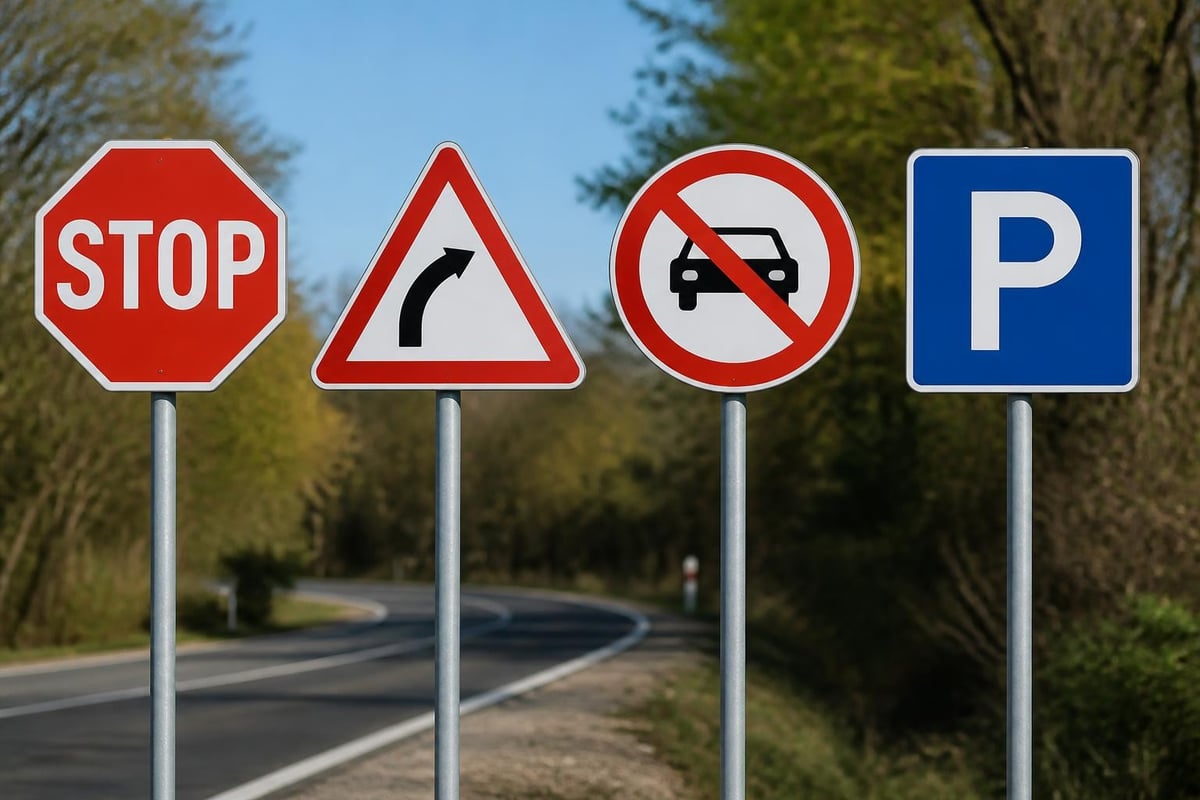
Road signage and meaning rely heavily on shape-coding to enable instant recognition even before drivers can read text or process detailed symbols. This redundancy of information ensures communication even under challenging visibility conditions.
| Sign Shape | Primary Meaning | Typical Application |
|---|---|---|
| Octagon | Stop/Absolute prohibition | Stop signs at intersections |
| Triangle (point up) | Warning/Caution | Hazard alerts, yield signs |
| Circle | Regulatory order or prohibition | Speed limits, restrictions |
| Rectangle (vertical) | Regulatory information | Parking regulations, lane use |
| Rectangle (horizontal) | Directional guidance | Route markers, destinations |
| Diamond | Warning (US system) | Hazard warnings on highways |
Colour coding provides additional layers of meaning that transcend language barriers:
- Red signals prohibition, danger, or mandatory stop
- Yellow/Amber indicates warning or caution
- Blue denotes mandatory instructions or motorway information (UK) / services (US)
- Green shows directional guidance and route information
- White provides regulatory information or supplementary details
- Orange marks temporary conditions such as roadworks
Symbol Design and Universal Comprehension
The effectiveness of road signage and meaning depends upon symbols that communicate clearly across linguistic, cultural, and educational boundaries. International efforts to standardise traffic signs have produced a remarkably consistent global visual vocabulary.
Research published in human-factors guidance for road systems demonstrates that well-designed symbols achieve comprehension rates above 85% even among unfamiliar populations. This success stems from several design principles:
Core Symbol Design Principles
Simplicity: Effective symbols reduce concepts to their essential visual elements, eliminating decorative details that might confuse or distract. A pedestrian crossing sign, for instance, shows a simplified human figure rather than anatomically detailed persons.
Consistency: Related concepts use similar visual treatments. All warning symbols maintain consistent internal styling, creating family resemblance that aids categorisation and memory.
Contrast: Strong figure-ground relationships ensure symbols remain legible under varying lighting conditions, viewing angles, and weather situations. This principle governs everything from border widths to internal spacing.
Cultural neutrality: International symbols avoid culturally specific imagery that might prove meaningless or offensive in certain regions. A telephone symbol uses the handset shape universally recognised rather than region-specific phone designs.
The GOV.UK 'Know your traffic signs' resource provides excellent examples of how these principles manifest in practical sign design, offering clear explanations that benefit both road users and safety professionals.
Regulatory Signs and Legal Obligations
Understanding road signage and meaning becomes particularly critical when dealing with regulatory signs, as these impose legal requirements on road users. Non-compliance can result in penalties, accidents, and liability issues.
Speed Limit Signs
Speed restriction signs establish maximum (or occasionally minimum) permitted velocities. These circular signs with red borders communicate absolute legal limits that adjust based on road type, location, and conditions. Variable message signs increasingly supplement fixed signage, responding to real-time traffic, weather, or incident conditions.
Prohibition and Restriction Signs
These regulatory markers forbid specific actions or vehicle types:
- No entry signs prevent vehicles from entering one-way streets or restricted areas
- No parking signs establish time-based or permanent parking prohibitions
- Weight limit signs protect infrastructure by restricting heavy vehicle access
- Height and width restriction signs prevent oversized vehicles from entering spaces with clearance limitations
For organisations managing vehicle fleets or operating commercial premises, complementary road signs that reinforce public highway regulations help maintain safety and compliance within private property boundaries.
Mandatory Instruction Signs
Blue circular signs with white symbols impose positive obligations rather than prohibitions. These might require specific directions of travel, mandate minimum speeds on certain lanes, or designate routes for particular vehicle types.
Warning Signs and Hazard Communication
Warning signs constitute a crucial element of preventative safety strategy. By alerting road users to upcoming hazards, these signs enable appropriate behavioural adjustments before encountering dangerous situations. For a full breakdown of what each hazard traffic sign means and where to use them, see our hazard traffic sign guide.
Common warning sign categories include:
Geometric warnings: Sharp curves, steep gradients, uneven road surfaces, and road narrowing all require advance notice so drivers can reduce speed appropriately.
Intersection warnings: Crossroads, T-junctions, roundabouts, and merge points present collision risks that increase significantly when unexpected.
Vulnerable road user warnings: Pedestrian crossings, school zones, and cycle route junctions alert drivers to locations where people outside vehicles may be present.
Environmental hazard warnings: Ice risk, flooding potential, strong crosswinds, and falling rocks represent location-specific dangers that drivers must anticipate.
The Transport for London Streetscape Guidance addresses warning sign placement in complex urban environments, considering factors such as visual clutter, sight lines, and the needs of vulnerable road users.

Temporary Warning Signs
Construction zones, road maintenance, and incident management require temporary warning signage that differs from permanent installations. These typically employ orange or yellow backgrounds to distinguish temporary conditions from permanent road features.
Organisations conducting work near roadways should integrate warning signs that align with public highway standards, ensuring workers and contractors receive clear, consistent hazard communication.
Informational and Directional Signage
Whilst perhaps less critical to immediate safety than regulatory or warning signs, informational signage plays essential roles in traffic efficiency and driver decision-making. Poor or absent directional information increases driver uncertainty, resulting in hesitation, sudden manoeuvres, and congestion.
Route Guidance Systems
Motorways and major roads employ comprehensive sign systems that provide layered information:
- Advance direction signs appear several hundred metres before junctions, listing destinations and distances
- Junction signs confirm exit numbers and immediate destinations
- Confirmation signs appear after junctions to reassure drivers they've chosen correctly
This progressive information delivery matches human information processing capabilities, preventing cognitive overload whilst ensuring drivers have adequate time to position vehicles appropriately.
Service and Facility Signs
Blue informational signs direct drivers to petrol stations, restaurants, accommodation, and other services. These standardised symbols enable quick recognition without requiring text comprehension, benefiting international travellers particularly.
Distance and Destination Markers
Kilometre markers, town name signs, and distance countdown markers help drivers monitor progress and estimate arrival times. These seemingly simple signs contribute to journey planning and fuel management decisions.
Visibility and Legibility Requirements
Road signage and meaning prove worthless if signs cannot be seen and read under the conditions in which they must function. Visibility research, such as that conducted by the Texas A&M Transportation Institute, establishes technical requirements for retroreflectivity, size, and placement.
Retroreflective Materials
Modern road signs employ retroreflective sheeting that returns light toward its source, making signs dramatically more visible in vehicle headlight illumination. Various grades of retroreflective material suit different applications:
| Retroreflective Type | Performance Level | Typical Application |
|---|---|---|
| Engineer Grade | Basic | Low-speed, low-traffic areas |
| High Intensity | Enhanced | Most general highway use |
| Diamond Grade | Premium | High-speed motorways, critical warnings |
| Fluorescent | Daytime enhancement | School zones, pedestrian crossings |
Just as road authorities specify retroreflectivity for traffic signs, workplace safety managers should ensure safety signs meet visibility standards appropriate to their environment, including photoluminescent signs for emergency egress routes.
Size and Placement Standards
Sign dimensions must account for viewing distance, approach speed, and complexity of message. A simple stop sign requires smaller dimensions than a complex directional sign with multiple destinations. Mounting height balances visibility against potential sight-line obstructions and vulnerable road user safety.
Lateral placement considers:
- Clear zone requirements (maintaining safe distances from travel lanes)
- Sight distance around curves and over hills
- Potential visual clutter from competing signs or commercial displays
- Accessibility for maintenance and replacement
International Variations and Harmonisation Efforts
Whilst international conventions have achieved remarkable consistency in road signage and meaning, significant regional variations persist. Understanding these differences proves essential for organisations operating across borders or managing international driver populations.
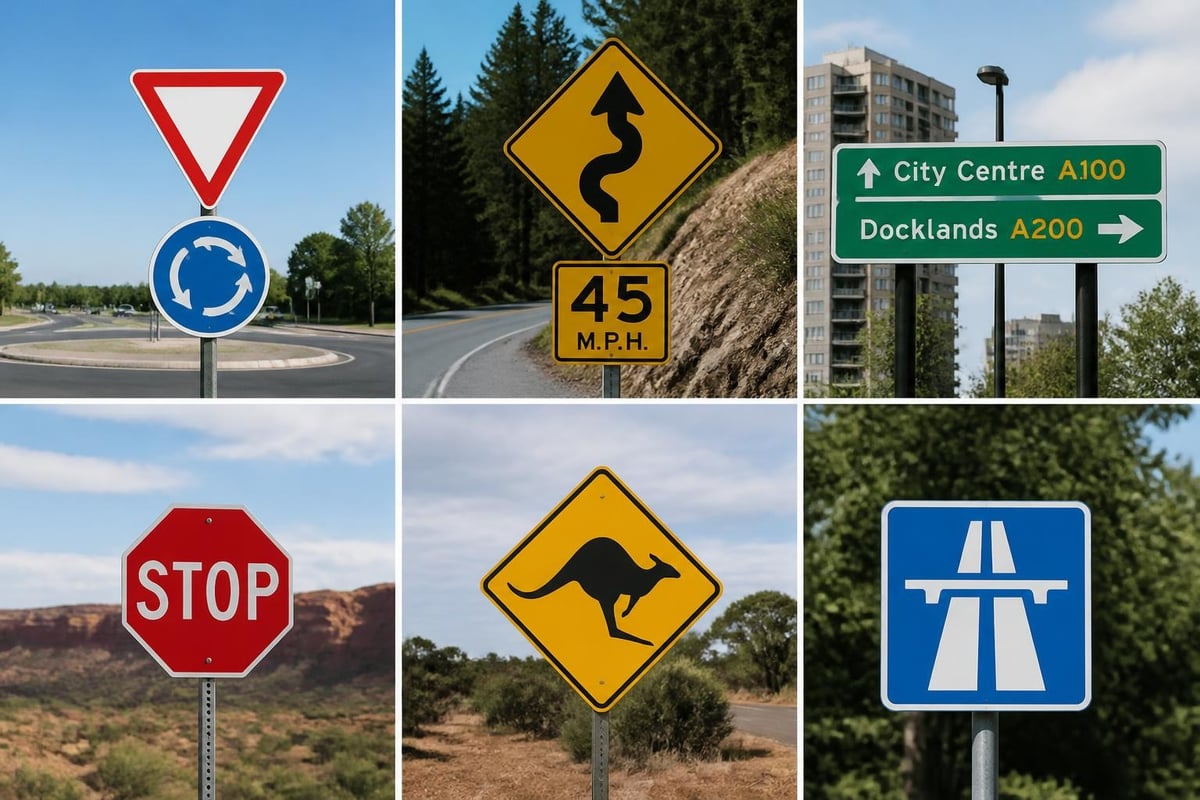
The Vienna Convention on Road Signs and Signals (1968) established foundational principles adopted across much of Europe, Asia, and Africa. North American practice, codified separately, shares many principles but employs different shapes and symbols for certain sign types.
Key differences include:
Stop sign design: Universally octagonal and red, but text varies ("STOP" in English-speaking countries, "STOP" in most European nations, translated equivalents elsewhere)
Prohibition symbols: European practice favours red circular borders with diagonal red bars, whilst some regions use different treatments
Warning sign shapes: Triangular in most of the world, diamond-shaped in North America
Directional sign colours: Green in North America, blue on European motorways, variations elsewhere
These variations highlight why driver education must extend beyond simple symbol memorisation to understanding underlying principles that transcend specific implementations.
The Role of Road Signage in Systemic Safety
Road signage and meaning exist within broader traffic safety systems that include road design, vehicle technology, enforcement, and driver education. The World Health Organization's road safety resources position signage as one element within comprehensive safety strategies.
Effective signage complements rather than compensates for poor road design. Self-explaining roads employ geometry, surface treatment, and visual cues that communicate appropriate behaviour even without signs. Where signs prove necessary, they reinforce rather than contradict environmental messages.
Reducing Sign Proliferation
Paradoxically, excessive signage can reduce safety by creating visual clutter, dividing driver attention, and reducing the authority of truly critical messages. Modern traffic engineering increasingly emphasises:
- Removing redundant signs that communicate obvious information
- Consolidating multiple messages onto single sign structures where appropriate
- Employing road design features that communicate naturally rather than requiring explicit signage
- Reserving prominent placement for high-priority safety messages
This principle applies equally to workplace environments, where mandatory signs, prohibitory signs, and general informational signs should be deployed strategically rather than indiscriminately.
Maintenance and Asset Management
Even perfectly designed road signage and meaning deteriorate without proper maintenance. Faded retroreflective sheeting, damaged sign faces, obscuring vegetation, and missing signs create gaps in the communication system that lead to confusion and accidents.
Systematic sign management programmes include:
Regular inspection cycles: Scheduled assessments identify signs requiring cleaning, repair, or replacement before functionality becomes critically compromised.
Retroreflectivity monitoring: Measurement protocols ensure signs maintain minimum visibility standards throughout their service life rather than waiting for obvious failure.
Vegetation management: Tree and shrub growth can obscure signs surprisingly quickly, requiring proactive trimming schedules.
Damage response: Vandalism, weather events, and vehicle impacts necessitate rapid replacement to restore system integrity.
Inventory systems: Database management tracks sign locations, types, installation dates, and maintenance history, supporting evidence-based replacement scheduling.
Organisations responsible for private road networks or large facilities should apply similar asset management principles to their signage inventories, ensuring consistent communication quality over time.
Emerging Technologies and Future Developments
Road signage continues evolving through technological advancement and research into human factors. Several developments promise to enhance or supplement traditional static signage:
Variable message signs employ LED or LCD displays to communicate time-sensitive information about traffic conditions, weather hazards, or incident-related lane closures. These dynamic systems respond to real-time conditions in ways fixed signage cannot.
Connected vehicle systems may eventually deliver sign information directly to vehicle displays, potentially supplementing or replacing some physical roadside signs. However, the need to serve all road users, including pedestrians, cyclists, and older vehicles, ensures traditional signage will remain relevant for decades.
Solar-powered illumination enhances sign visibility without requiring mains electrical connections, particularly valuable in remote locations or for temporary installations.
Improved retroreflective materials continue advancing, offering longer service life and better performance across wider viewing angles and weather conditions.
Whilst technology advances, the fundamental principles of road signage and meaning remain constant: clear communication, standardised symbols, appropriate placement, and reliable visibility under all operating conditions.
Integration with Workplace Safety Signage
Organisations managing facilities with vehicle access should recognise the relationship between public road signage standards and workplace safety communication. Consistency between public highway signs and private property signage reduces cognitive load and prevents confusion.
Speed limits, directional arrows, parking restrictions, and pedestrian crossing designations on private property benefit from visual consistency with public road equivalents. Simultaneously, workplace-specific requirements such as fire-fighting signs and pedestrian safety zones require clear differentiation to prevent confusion about which standards apply in which contexts.
The comprehensive approach to safety signage extends beyond roads themselves. Just as traffic signs protect road users, PPE requirements and first aid equipment locations require clear signage following their own standardised conventions. The common thread is systematic application of shape, colour, and symbol conventions that enable intuitive understanding across diverse user populations.
Mastering road signage and meaning requires understanding both the specific symbols deployed on today's roads and the underlying design principles that make visual communication effective. Whether managing public highways, private roadways, or comprehensive workplace safety programmes, successful signage systems combine standardised symbols, strategic placement, proper maintenance, and integration with broader safety measures. SafetySignsForSale provides the full spectrum of safety signage solutions needed to create coherent visual communication systems, from road signs that maintain consistency with public highway standards to the complete range of workplace safety markers, fire safety equipment, PPE, and first aid supplies that protect people across diverse environments.