


Hazard Traffic Sign Guide: Meanings and Uses
A hazard traffic sign is a warning sign that alerts road users to a danger ahead, such as a bend, junction, uneven surface or crossing pedestrians, so they can slow down and prepare before they reach it. Most are triangular with a red border, a white or yellow background and a black pictogram, and the same logic applies on public roads and inside private sites such as warehouses, mines, farms and factory yards.
This guide explains how to read these signs, which categories matter most, what the rules require of workplaces, and how to choose and place signs so that they genuinely change behaviour.
What a Hazard Traffic Sign Tells You
A hazard traffic sign tells road users that a specific risk lies ahead and that they should adjust their speed, position or attention before reaching it. It does not instruct a driver to stop or forbid an action. It informs, and the driver decides how to respond.
That distinction separates warning signs from the other two main families:
- Warning signs alert you to a hazard. They are usually triangular with a red border.
- Regulatory signs control behaviour, such as stop, give way or speed limits. They are usually circular or octagonal.
- Information signs give direction or facilities and are usually rectangular.
Understanding the family a sign belongs to helps road users react correctly in seconds. A triangle prompts caution. A circle prompts compliance. For a broader view of how these categories sit together, SafetySignsForSale has a useful overview of traffic board signs.
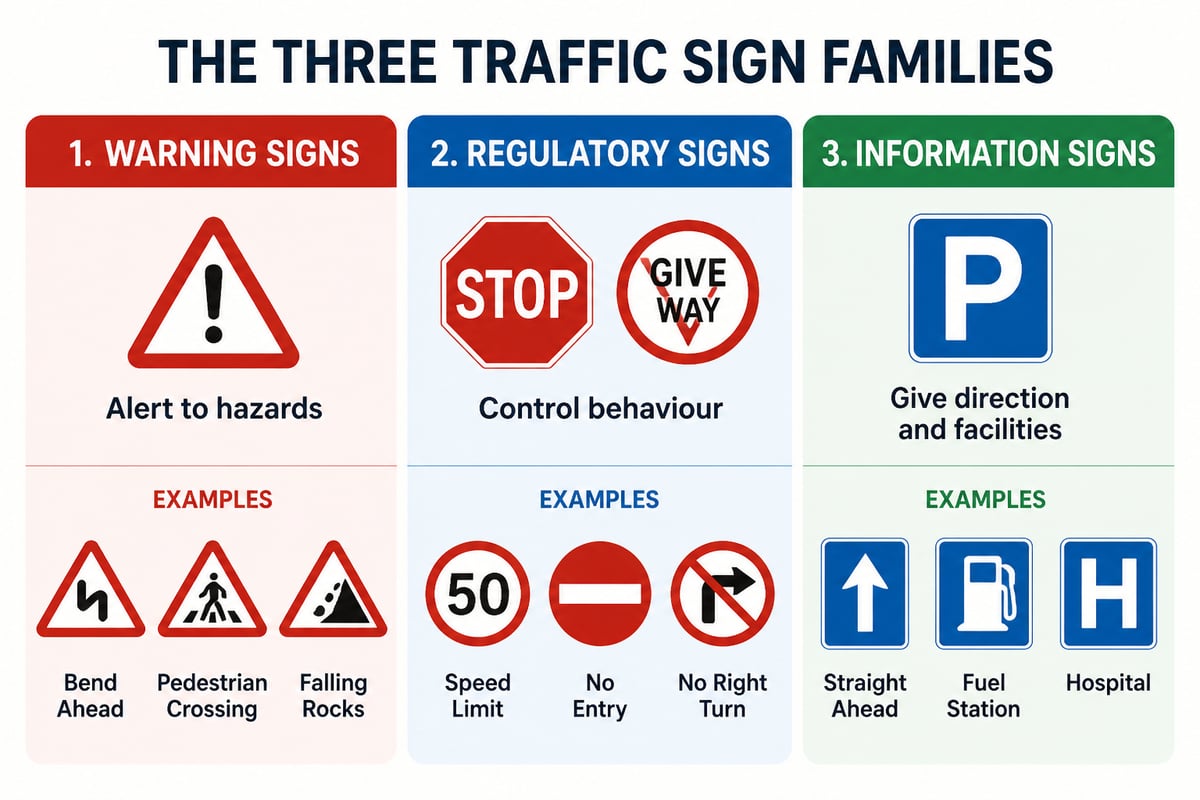
How Shape, Colour and Symbol Work Together
Shape, colour and symbol each carry part of the message, and together they let a driver recognise a hazard at a glance, often before they can read any text.
Shape is processed first. A triangle pointing upwards signals caution. Colour comes next: a red border indicates danger, while a yellow background is common on temporary or workplace warnings because it stands out in poor light. The pictogram then specifies the hazard, whether a falling-rock slope, a pedestrian crossing or a slippery surface.
The Health and Safety Executive advises that signs should be clear and easy to understand, and stand out enough to be noticed. That principle should guide every decision about size, contrast, mounting height and condition. A faded or dirty sign fails on all counts, however correct its design.
Supplementary plates add detail. A small rectangular plate beneath a triangle might give a distance ("300 m"), a duration ("Next 2 km") or a time-based condition ("When children are present"). Where a plate is present, it forms part of the instruction and should be read with the symbol above it.
Common Types of Hazard Traffic Sign
Hazard traffic signs fall into several of recurring categories, and learning the categories is quicker than memorising every individual symbol.
Junction and Priority Hazards
These warn of crossroads, side roads, roundabouts and merging traffic. The symbol usually shows a simplified layout of the junction, with the heavier line representing the main road. Where traffic must yield, a give way sign forms the regulatory counterpart to the warning that precedes it.
Bends and Road Geometry
Single bends, double bends, sharp deviations and steep gradients are all shown with simplified road shapes or slope percentages. These signs matter most where a bend cannot be judged from a distance. The Highway Code's guidance on warning signs also covers road narrowing, with separate symbols for a road narrowing on the right, on the left when the symbol is reversed, and on both sides.
Surface and Elevation Risks
Slippery roads, uneven surfaces, loose chippings, low bridges and falling rocks belong here. In a workplace setting, a sign warning of a slippery walking surface serves the same purpose at pedestrian speed.
Vulnerable Road Users and Animals
Pedestrians, children, cyclists, horse riders, livestock and wildlife each have their own pictogram. These signs usually mark places where such users are likely to appear without warning, including school zones, farm crossings and rural lanes.
Traffic Flow Changes
Signs for two-way traffic, lane merges, queues and temporary roadworks warn that the pattern of movement is about to change. A two-way traffic ahead sign is a typical example, often needed where a dual carriageway reverts to a single road or where site roads share a lane.
General Danger
The exclamation mark inside a triangle indicates a hazard that has no dedicated symbol. It is almost always paired with a supplementary plate that names the danger. Without that plate, it tells the driver very little.
Hazard Traffic Signs on Private Sites and Workplace Roads
Private sites need hazard traffic signs for the same reasons public roads do: vehicles and pedestrians share space, and visibility, speed and surface conditions vary. Many businesses assume that signage rules stop at the gate. They do not.
The HSE states that road signs used to warn or inform drivers and pedestrians in private workplaces must match public-road signs wherever a suitable sign exists. This is sensible. Drivers, whether employees, contractors or visitors, already understand the public symbols, so no retraining is required.
The HSE's guidance on workplace road signs also notes that hazards such as sharp bends and blind corners may need a warning. Beyond those, typical site-specific risks include:
- Forklift and reach-truck crossing points, where a forklift warning sign gives pedestrians advance notice
- Overhead or suspended loads near loading bays
- Low headroom at entrances and walkways, addressed by a mind your head sign
- Fragile roofs and surfaces
- Blind corners and pedestrian crossings between buildings
- Speed-limit transitions between yard and public road
Legal frameworks differ by country, so businesses should check the standards that apply to their sector and location. The underlying principle holds everywhere: use recognised symbols, and use them consistently.
Hazard Signs Beyond the Road: Chemical, Electrical and Physical Risks
A site's hazards are rarely limited to vehicle movement, and its signage should reflect that. Warning triangles with workplace pictograms follow the same visual logic as road signs, which is why they work.
Common examples include:
- Electrical: a warning of electric shock sign near switchgear, or a sign for exposed live high-voltage equipment
- Chemical: corrosive hazard and carbon dioxide warnings at storage areas and process rooms
- Fire and explosion: a fire hazard sign at flammable stores and fuelling points
- Confined spaces: a confined space warning at tank hatches, manholes and ducts
- Biological: sharps and biohazard containers in clinical areas, such as a sharps container
For a fuller look at warning categories beyond the road, the SafetySignsForSale guide to hazard signs is a practical companion.
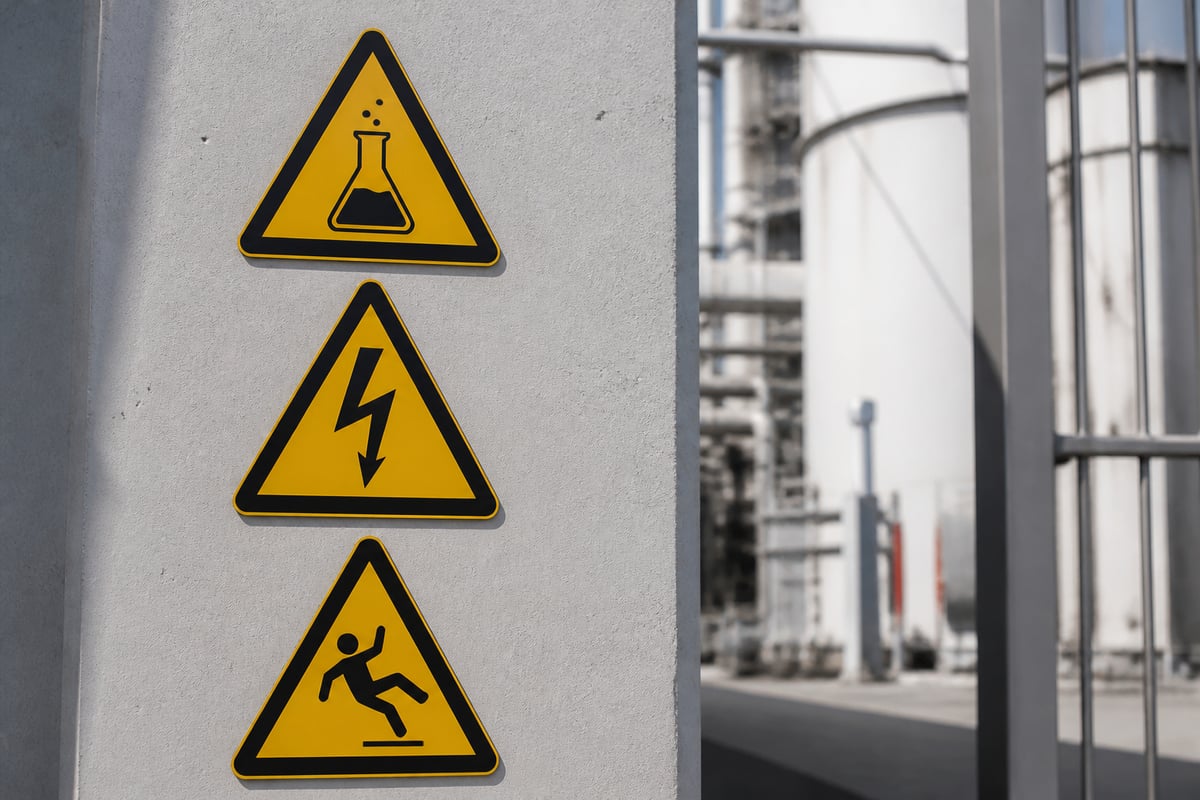
Reading Warning Light Signals
Hazard signals are not always static signs. Amber flashing lights serve as active warnings, and they follow clear rules. According to the Highway Code's guidance on motorways, amber flashing lights warn of a hazard ahead; drivers should reduce speed, prepare for the hazard, and increase speed only after the signal stops flashing or an applicable sign indicates it is safe.
On sites, amber beacons on forklifts, gate barriers and overhead cranes work the same way. They tell nearby people that something is moving or about to move.
Hazard warning lights on vehicles follow separate rules. The Highway Code sets out when they may be used, including restrictions on use while driving, in its general rules for all drivers and riders. Site safety policies should mirror those rules so that internal practice and public-road practice do not contradict each other.
Choosing the Right Hazard Traffic Sign for Your Site
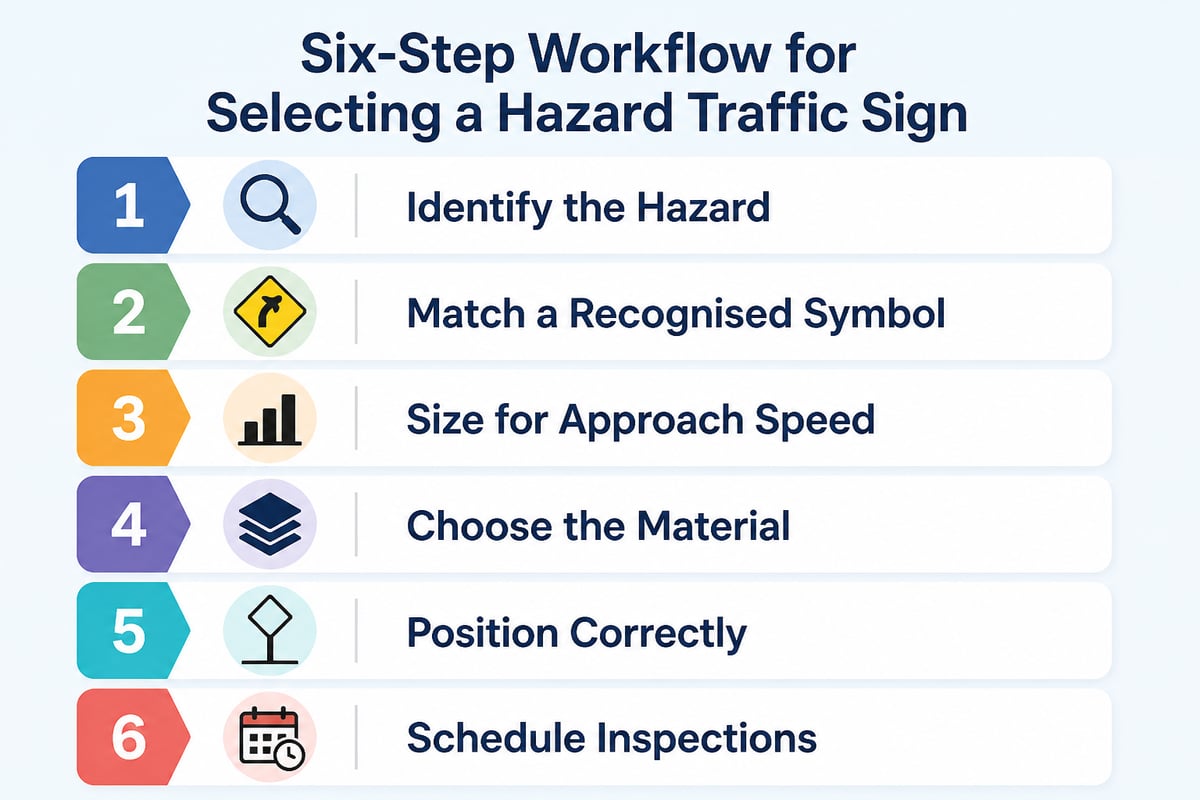
The right sign is the one that matches a specific, assessed risk, is legible at the speed and distance at which people approach it, and is made from a material suited to its environment. Work through these steps in order:
- Identify the hazard. Walk the routes used by vehicles and pedestrians and note blind corners, crossings, gradients, surface changes and shared spaces.
- Match a recognised symbol. Where a public-road sign fits, use it. Where none does, use a standard workplace pictogram with a clear text plate.
- Size for approach speed. A site road used at 20 km/h needs larger lettering and symbols than a pedestrian corridor.
- Choose the material. Reflective sheeting suits outdoor and low-light locations. Photoluminescent signs remain visible when lighting fails, which suits stairwells and emergency routes.
- Position correctly. Place the sign far enough ahead of the hazard that a driver can respond, at a consistent height, and clear of obstructions.
- Schedule inspections. Check signs for fading, damage and obstruction, and record the checks.
Placement and Maintenance Mistakes That Undermine Safety
A correct sign in the wrong place or in poor condition provides false reassurance, so placement and upkeep deserve as much attention as selection. The most frequent faults are easy to prevent.
- Too close to the hazard. A driver at 40 km/h needs distance to react. A sign positioned level with the danger arrives too late.
- Sign clutter. Several signs clustered together dilute each other. Prioritise the most serious risk and remove redundant signs.
- Obstruction. Vegetation, parked vehicles, stacked pallets and new structures often block signs that were originally well placed.
- Fading and damage. Sun exposure, abrasion and impact degrade reflectivity. Replace signs when the symbol loses contrast.
- Outdated signs. When a layout changes, old warnings may point to hazards that no longer exist while new ones go unmarked.
- Inconsistency between areas. If one yard uses a symbol and another uses a different one for the same risk, people learn to ignore both.
Temporary hazards, such as maintenance work or a spill, need temporary signs that are removed when the hazard clears. Leaving them in place trains people to disregard warnings.
Layering Hazard Signs with Other Safety Controls
Signs work best as one layer of a wider safety system, not as a replacement for physical controls. The accepted order of control prioritises eliminating the hazard, then engineering measures such as barriers and speed humps, then administrative measures, with signage sitting among the administrative layer.
In practice, a blind corner might combine a convex mirror, a speed hump, a warning triangle and a painted pedestrian crossing. Each element supports the others. Pair prohibitory signs and mandatory signs with warnings so that people know what is dangerous and what they must do about it.
Training reinforces all of this. New employees, contractors and regular visitors should be shown the site's signage on induction, including the meaning of any non-standard symbols.
Start by walking your site's vehicle and pedestrian routes this week and listing every point where a driver or walker faces a hazard without a clear warning. Once you know what is missing, SafetySignsForSale can supply the full range of warning, prohibitory, mandatory and photoluminescent signs, along with fire, PPE and first aid products to support them. Browse the full safety signs range or visit SafetySignsForSale to find the right signs for your site.