


Mandatory Road Signs: What Each One Requires You to Do
Road signs mandatory for drivers are the signs that give a legal order: you must do what they say, and ignoring them can lead to a fine, a prosecution or a collision. Most are circular, and the colour of the disc tells you whether the sign commands an action (blue) or forbids one (red border).
For facility and safety managers, this matters twice over. Drivers entering your premises read the same visual language they use on public roads, so the signs you display on private roads, loading bays and yards should follow the same logic. The sections below explain what each type of mandatory sign requires, how to read plates and supplementary panels, and how to specify signage for a site.
What Are Mandatory Road Signs?
Mandatory road signs are signs that give an order. The driver has no discretion: the instruction must be followed, and failure to comply is an offence on public roads.
The UK Highway Code states that drivers must obey traffic signs giving orders, including temporary signs, and cites the Road Traffic Act 1988, section 36, among the relevant laws, as set out in Rule 109 of the Highway Code. South Africa applies the same principle through its own road traffic regulations, which draw heavily on the international system of pictograms.
Signs generally fall into three groups by shape:
- Circular signs give orders, either positive or prohibitive
- Triangular signs warn of hazards ahead
- Rectangular signs give information, such as directions or facilities
Understanding this shape logic helps new drivers, contractors and visitors read an unfamiliar site quickly.
How Do Blue and Red Mandatory Signs Differ?
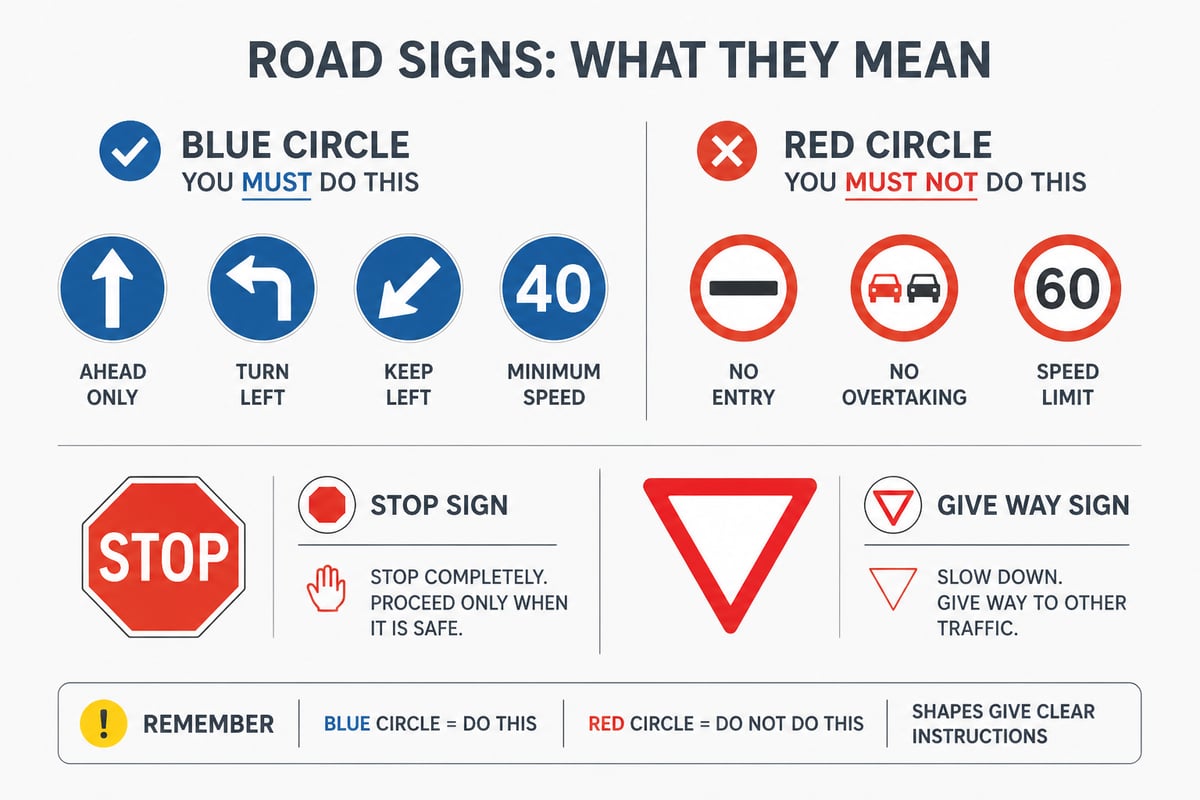
Blue circular signs tell a driver what to do, while circular signs with a red border tell a driver what not to do. This split is the single most useful rule for reading orders at speed.
According to the UK Highway Code guidance on traffic signs, signs with red circles are mostly prohibitive, while blue circular signs without a red border mostly give positive instructions. The same guidance lists examples of positive instructions on blue discs: ahead only, turn left, keep left and minimum speed.
| Sign feature | What it means | Typical examples |
|---|---|---|
| Blue disc, white symbol | A positive instruction: do this | Ahead only, turn left, keep left, minimum speed |
| White disc, red border | A prohibition: do not do this | No entry, no overtaking, speed limit, no vehicles |
| Red octagon | A full stop is required | Stop |
| Inverted triangle, red border | Yield to other traffic | Give way |
Two signs sit slightly outside this pattern. The stop sign is an octagon and demands a complete halt, and the give way sign is an inverted triangle. Both are still orders, and both are legally binding.
Which Road Signs Are Mandatory and What Does Each Require?
The mandatory signs most drivers meet daily are stop, give way, no entry, speed limits, direction orders and the minimum speed sign. Each one requires a specific action, set out below.
Stop and give way
A stop sign requires you to bring the vehicle to a complete halt at the line, check that the way is clear, and proceed only when it is safe. A give way sign requires you to slow down and yield to traffic on the major road, stopping if necessary. At private sites, a four-way stop arrangement at an internal crossroads works on the same principle, and a stop 4-way sign tells every driver that all approaches must halt.
No entry and one-way orders
A no entry sign (a white bar on a red disc) forbids vehicles from entering that road or lane from that direction. Its partner is the one-way sign, which tells drivers the permitted direction of travel. A one-way roadway sign is common in factory yards, depots and shopping centre service areas where reversing and head-on conflicts are a risk.
Speed orders
A maximum speed sign requires you not to exceed the figure shown. A minimum speed sign, a blue disc with a number, requires you to travel at least that speed unless conditions make it unsafe. On private property, the internal limit should be displayed clearly at each entrance and repeated along long straights.
Direction orders
Ahead only, turn left, turn right and keep left all instruct a vehicle to take the shown route. These signs are positioned to guide traffic around obstacles, pedestrian zones or temporary works.
Do Plates and Supplementary Panels Change the Order?
Yes. A plate fixed below a sign qualifies the message on the sign above it, so the two must be read together.
The UK Highway Code notes that plates below signs qualify the message shown on the sign above. A speed limit sign with a plate reading "School hours", for instance, applies only during those hours. A no entry sign with an "Except buses" plate permits one class of vehicle and still forbids all others.
Common plate types include:
- Time plates limiting the order to certain hours or days
- Vehicle class plates such as "Except cycles" or "Heavy goods vehicles"
- Distance plates showing how far the order applies
- Condition plates such as "When lights show" or "In wet conditions"
For site managers, the lesson is practical. A plate that has faded, been knocked askew or been separated from its sign leaves drivers guessing what the order actually means. Inspect plates alongside the primary sign.
What Do Zone Signs Mean, Including the Grey Zone Ends Sign?
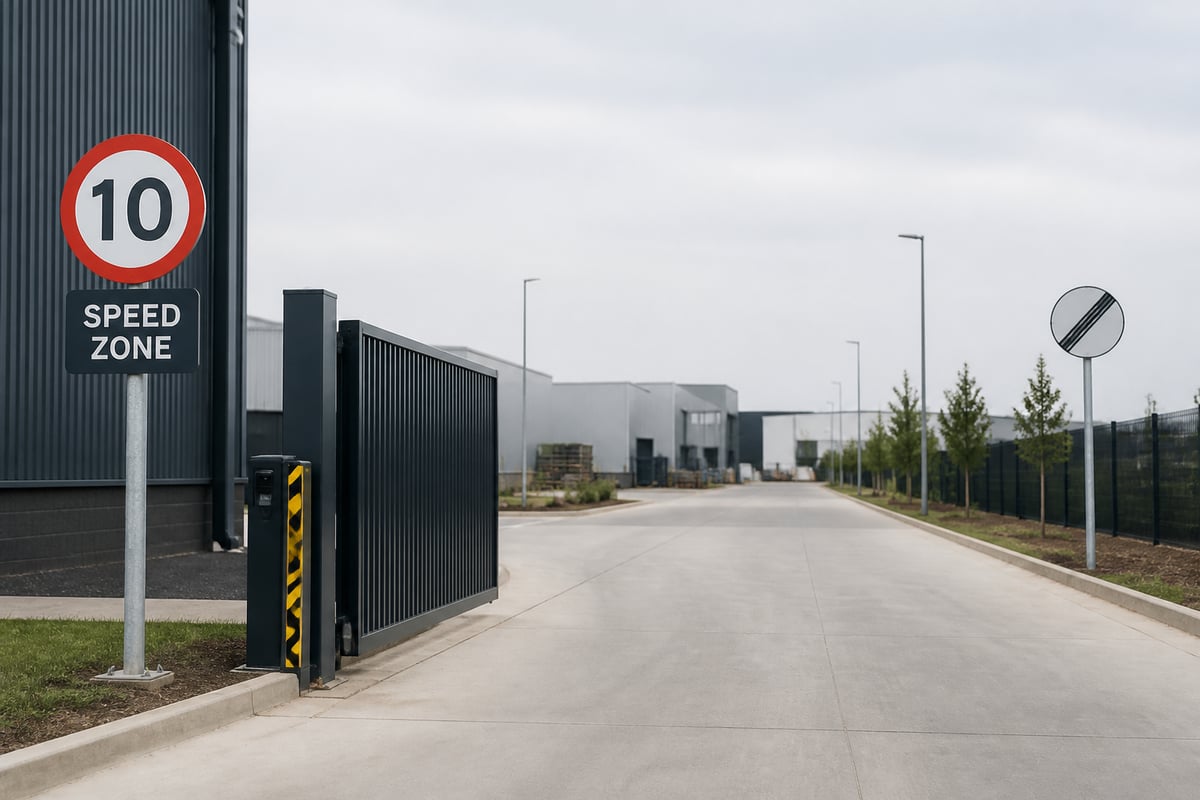
A zone sign applies an order across an area rather than at a single point, and a zone ends sign cancels that order. The grey zone ends sign (often a sign with a black diagonal stripe through the original symbol) tells drivers that the restriction no longer applies from that point.
This matters because zone signs are not repeated on every street. A 30 km/h residential or delivery zone may be signed only at the entrance, and the order stays in force until the driver passes the end-of-zone sign. Treating the end sign as a formality leads to confusion about when a restriction has lifted.
The same logic applies in a warehouse complex or mine surface area. A pedestrian priority zone or reduced speed area should be marked at its entrances and at its end, so that the order has a clear start and finish.
Are Motorway and Temporary Signs Also Mandatory?
Yes. Motorway signals and temporary roadworks signs carry the same legal weight as permanent roadside signs.
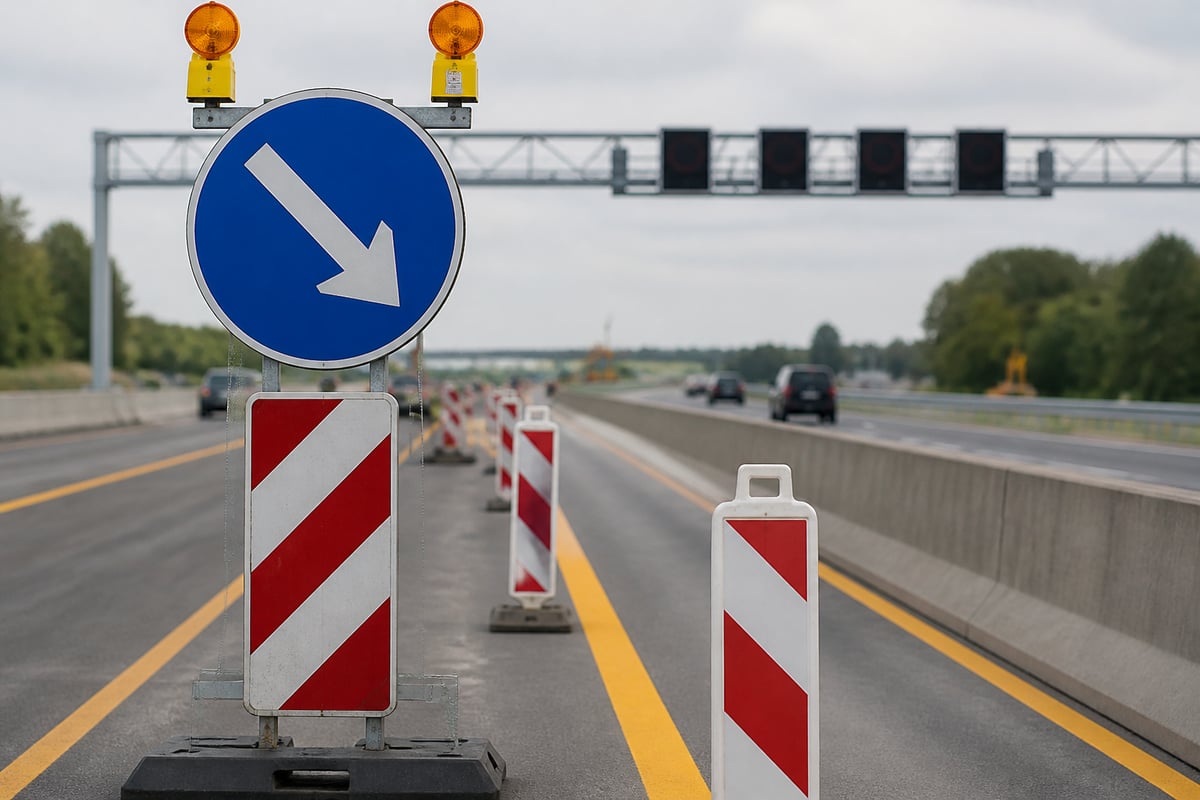
On motorways, red X signals above a lane mean that lane is closed and must not be used, and the Highway Code section on motorways also covers restrictions on using the hard shoulder. Ignoring an overhead signal is both dangerous and an offence.
Temporary signs deserve the same respect as permanent ones. Cones, lane closures and diversion boards at construction sites are orders for the duration of the works. Falling objects signs, for example, warn site users of overhead hazards where work is under way, and a falling objects sign belongs in the same planned signage layout as the traffic control signs around it.
Who Is Responsible for Road Signs?
The authority that controls a road is responsible for the signs on it, and the owner or occupier of private land is responsible for signs on private roads and premises.
On public roads, this normally means the national, provincial or municipal roads authority, depending on the classification of the road. On private property such as factory grounds, mine haul roads, retail parking areas and logistics yards, the duty falls on the site owner or the person in control of the premises. That is the facility manager's responsibility in practice.
The UK Health and Safety Executive publishes guidance on signs, signals and road markings in workplace transport that is a useful reference point for how traffic control should be organised within a workplace. The principles it sets out, such as clear routes, consistent signage and separating pedestrians from vehicles, translate directly to South African sites, where the Occupational Health and Safety Act places a duty on employers to maintain a safe working environment.
How Should a Site Specify Compliant Signage?
A site should audit its traffic routes, match each hazard or control point to the correct mandatory sign, and specify materials that will survive the environment. A structured approach prevents gaps and duplicate purchasing.
- Map the routes. Walk every vehicle route, junction, loading area and pedestrian crossing, and note where an order is needed.
- Assign the correct sign. Use blue positive-instruction signs for required actions and red-bordered signs for prohibitions, keeping to the standard pictograms.
- Check for plates. Where an order applies only at certain times or to certain vehicles, specify the qualifying plate at the same time.
- Choose the material. Outdoor and high-impact locations suit rigid, weather-resistant substrates, while indoor areas allow lighter options.
- Position for sight lines. Signs must be visible early enough for a driver to react, and not obscured by stacked goods, vegetation or parked vehicles.
- Schedule inspections. Record each sign's location and check for fading, damage and missing plates on a set cycle.
For procurement teams buying in bulk, a single specification across all sites prevents mismatched signs and simplifies reordering. SafetySignsForSale offers a range of safety signs with over 25 years of experience in signage, which gives purchasers a consistent supplier to specify. The road signs range covers traffic control and construction categories, while the mandatory signs collection covers the blue instruction signs used inside buildings and on plant, such as PPE requirements.
What Is the Difference Between Road Signs and Workplace Mandatory Signs?
Road signs govern the movement of vehicles, while workplace mandatory signs govern behaviour and protective equipment inside a site. Both use the same blue disc and white symbol, which is why they are often confused.
A workplace mandatory sign instructs people to wear a hard hat, use ear protection, put on safety footwear or wash their hands. The blue circle carries the same meaning as on a road: this action is required. A facility therefore typically needs both sets. Road signs control the yard, and standard mandatory signs control conduct on foot.
Standards also keep evolving across jurisdictions. The US Federal Highway Administration, for example, periodically issues new editions of the MUTCD, according to its FHWA MUTCD news page. The practical point for South African facility managers is to check that signs ordered today match current approved specifications and are SABS approved, rather than reusing old artwork.
FAQ
What do all UK road signs mean?
UK road signs follow a shape and colour system. Circles give orders, triangles warn of hazards, and rectangles give information, with the border and background colour showing whether the message is an instruction, a prohibition or a guide. The Highway Code reproduces every official sign with its meaning.
Which road signs must a driver obey?
Every sign that gives an order must be obeyed, whether it is permanent or temporary. This includes stop, give way, no entry, speed limits, direction orders and lane closure signals. Warning and information signs do not carry a direct order, but they should be heeded.
Can a private site enforce its own road signs?
A private site can set and enforce its own traffic rules for people on its premises, usually through site induction, contractor agreements and disciplinary procedures. The signs should mirror public road conventions so that every driver recognises them without explanation. Consistent signage also supports the site's position if an incident is investigated.
Start by walking your site's vehicle routes this week and listing every junction, gate and loading area that lacks a clear order sign. Once you have the list, the next job is turning it into a specification, and SafetySignsForSale can help with SABS-approved signs made to order and delivered nationwide, backed by over 25 years of experience in signage. Send your list through to SafetySignsForSale to request a quote for the signs and plates your site needs.