


Workplace Safety Signs: Types, Meanings and Rules
Safety signs in the workplace are standardised notices that use colour, shape and pictograms to warn of hazards, prohibit unsafe behaviour, require protective action or direct people to emergency equipment and exits. Four categories cover almost every situation: prohibition (red), warning (yellow), mandatory (blue) and safe condition or fire equipment (green and red). Knowing what each means, where it belongs and how to keep it in good condition is the foundation of a compliant sign programme.
South African facilities typically work to SABS-aligned signage, while much international guidance, including the UK material cited below, uses the same ISO-style colour and shape logic. The principles are consistent, which makes them useful reference points for factories, mines, warehouses and retail sites alike.
When Safety Signs Are Required
A safety sign is required when a significant risk remains after you have tried to remove or control it by other means. The UK Health and Safety Executive states that employers must provide safety signs where a significant risk cannot be avoided or controlled, and that signs are not needed where they would not reduce the risk or the risk is not significant.
This principle matters for procurement. A sign is the last layer in the hierarchy of controls, not a replacement for guarding, ventilation, training or safe systems of work. Over-signing dilutes attention, while under-signing leaves workers guessing.
A practical test before ordering:
- Has the hazard been eliminated or engineered out where possible?
- Does a residual risk remain that a worker could reasonably encounter?
- Would a sign change behaviour or help someone respond faster?
- Is the sign understandable to everyone who enters the area, including contractors and visitors?
If the answers point to a residual risk, a sign is justified.
The Four Categories of Safety Signs in the Workplace
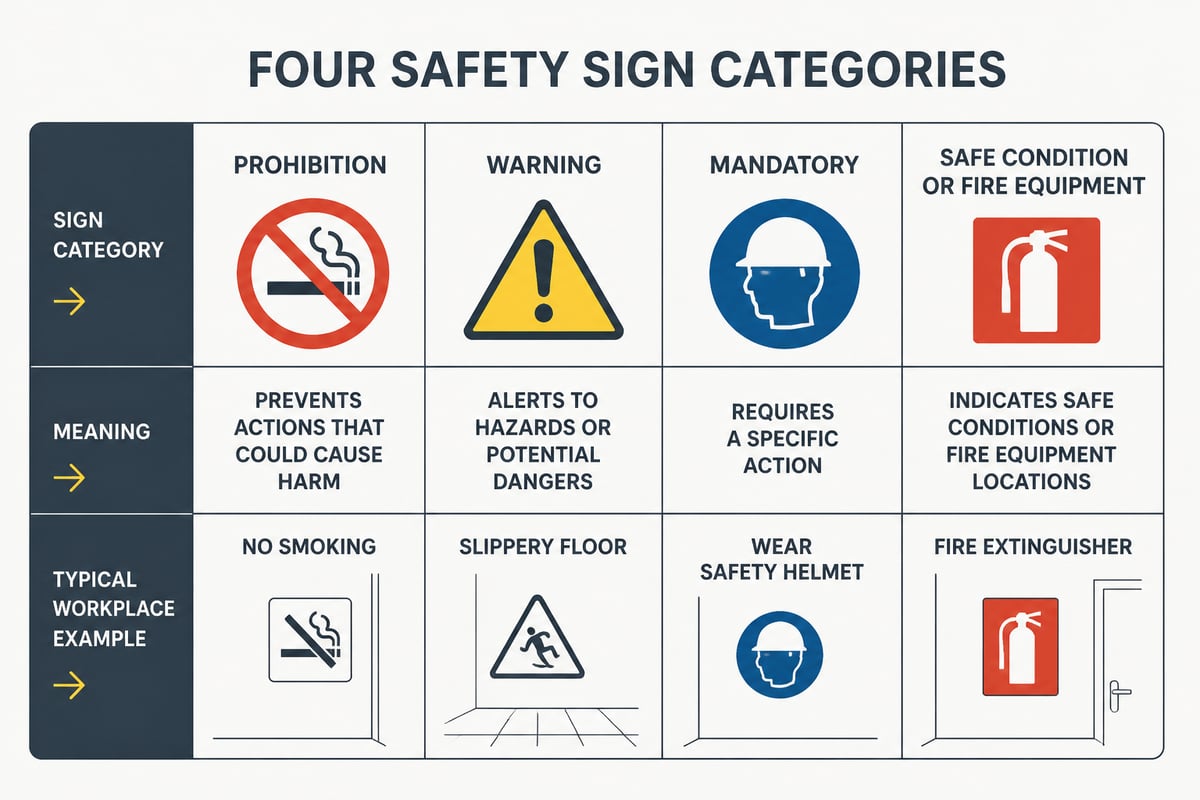
The four standard categories are distinguished by shape and colour, so a worker can read the type of message before reading any text. Each has a defined purpose.
| Category | Shape | Colours | What it tells people | Typical example |
|---|---|---|---|---|
| Prohibition | Round | Red edging and diagonal bar, black pictogram on white | Do not do this | No smoking, no entry |
| Warning | Triangular | Yellow background, black pictogram | Be aware of a hazard | Wet floor, laser, overhead crane |
| Mandatory | Round | White pictogram on blue | You must do this | Wear hearing protection |
| Safe condition and fire | Rectangular or square | White pictogram on green; red for fire equipment | Here is the exit or equipment | Fire exit, first aid point, extinguisher |
Prohibition signs
Prohibition signs forbid behaviour that could cause harm. Under HSE guidance, they are round, with a black pictogram on white, red edging and a diagonal red line. Typical uses include no smoking, no naked flames, no unauthorised access and no mobile phones near sensitive equipment. A no open or naked flames photoluminescent sign is a common example for fuel stores, paint shops and chemical areas.
Warning signs
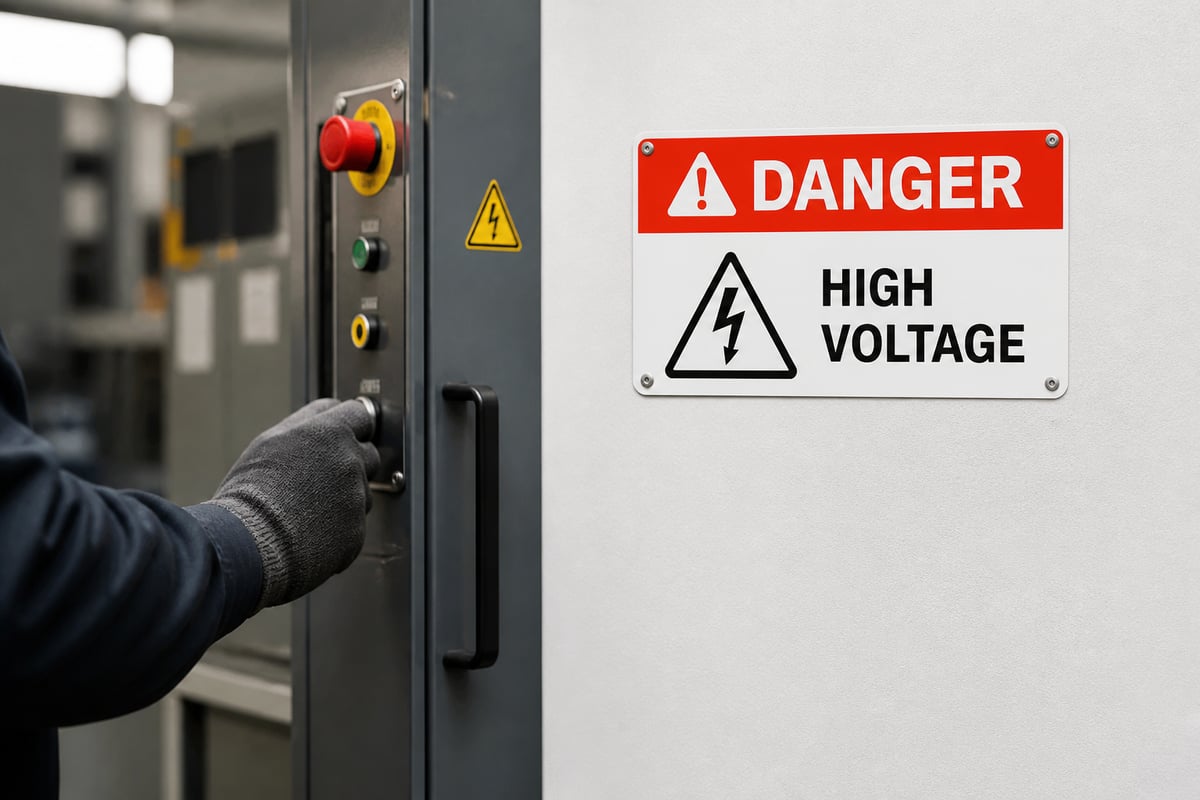
Warning signs alert people to a hazard that exists in an area or on a piece of equipment. The same HSE guidance describes them as triangular, with a black pictogram on a yellow background. They suit hazards such as electrical risk, forklift traffic, slippery surfaces, hot surfaces and radiation. Specialised hazards have their own symbols, for example a warning of laser hazard sign in laboratories or workshops using Class 3 and 4 lasers.
Mandatory signs
Mandatory signs require a specific action, most often the wearing of personal protective equipment. HSE guidance specifies them as round, with a white pictogram on blue. Place them at the point where the action must begin, such as the entrance to a noisy plant room or a foundry floor, not at the far end of the building.
Safe condition and fire equipment signs
These signs show where to go or what to use in an emergency. Green signs mark exits, escape routes, first aid stations, eyewash points and assembly areas. Red signs identify fire-fighting equipment such as extinguishers, hose reels, hydrants, fire blankets and alarm call points. Because they must be found quickly under stress, consistency of design matters more here than anywhere else in the facility.
Colours, Shapes and Symbols: How to Read a Sign Quickly
Colour signals the category, shape reinforces it, and the pictogram supplies the specific message. A worker who cannot read the language of the text can still understand a red circle with a diagonal bar over a cigarette.
Three habits keep this system reliable:
- Use symbols over words wherever possible. Pictograms cross language barriers, which is valuable in workforces speaking several languages.
- Add short text only to clarify. The US OSHA accident-prevention sign rule says that wording should be concise, easily read and understood, and accurate.
- Never mix conventions. A blue circle should always mean an instruction, never a hazard. Home-made signs in non-standard colours undermine trust in the whole system.
Facilities that supply international clients, or that follow parent-company standards, may also meet ANSI Z535 signs, which use different signal words and layouts. ANSI's overview of the Z535 series covers colours, symbols, placement and sign design, and is useful context where both systems coexist.
What the Law Expects of Employers
Legal duties centre on providing the right signs, keeping them in good order and making sure workers understand them. In South Africa, signage obligations sit within the Occupational Health and Safety Act framework and related regulations, and sites should confirm specific requirements with their safety officer or legal adviser.
The UK offers a clear model of the duties. Under the Health and Safety (Safety Signs and Signals) Regulations 1996, employers must maintain signs and explain unfamiliar signs and the actions workers should take. HSE's guidance to those regulations sets out how signs should be used for prohibitions, safeguards, hazards, exits and safety equipment. The Irish Health and Safety Authority signage guidance takes a similar approach and points to its own national regulations.
The common thread across jurisdictions is that a sign is only compliant if it is correct, visible and understood. Three duties follow:
- Provide signs for every significant residual risk.
- Maintain them, replacing any that are faded, damaged or obscured.
- Inform and train workers so that each sign triggers the right response.
Placement, Visibility and Maintenance
A sign that cannot be seen at the moment of decision has no value, so placement and upkeep are as important as the sign itself. HSE guidance for workplace transport says signs should be clear, easy to understand, noticeable, clean and maintained, and that signs needed in darkness should be reflective and lit.
Apply these placement rules during a site walk:
- Mount signs at eye level, or at a consistent height along escape routes.
- Position warnings before the hazard, with enough distance to react.
- Keep sightlines clear of stacked stock, racking, doors that open across the sign and temporary banners.
- Use one sign per message. Clusters of five or six signs on one post are rarely read.
- Check illumination. Corridors, stairwells and mine workings that lose power need signs that remain visible.
Choosing the right material
Environment dictates material. Outdoor yards, wash-down areas and corrosive atmospheres call for durable substrates, while indoor offices need less. SafetySignsForSale makes its safety signs to order in ABS plastic or Cromadek steel, so a site can match the substrate to the conditions on each wall, gate or machine guard.
Setting an inspection routine
Build sign checks into existing inspections rather than creating a separate task. A quarterly walk-through, recorded on a simple checklist, will catch peeling adhesive, sun-bleached colours, graffiti and signs left behind after a layout change. Replace rather than patch: a partly legible sign is worse than no sign because it implies a control that is not working.
Fire and Emergency Signage Deserves Its Own Plan
Fire and evacuation signs should be planned as a connected system from every point in the building to a place of safety. Isolated signs leave gaps at the exact moments when people are under pressure.
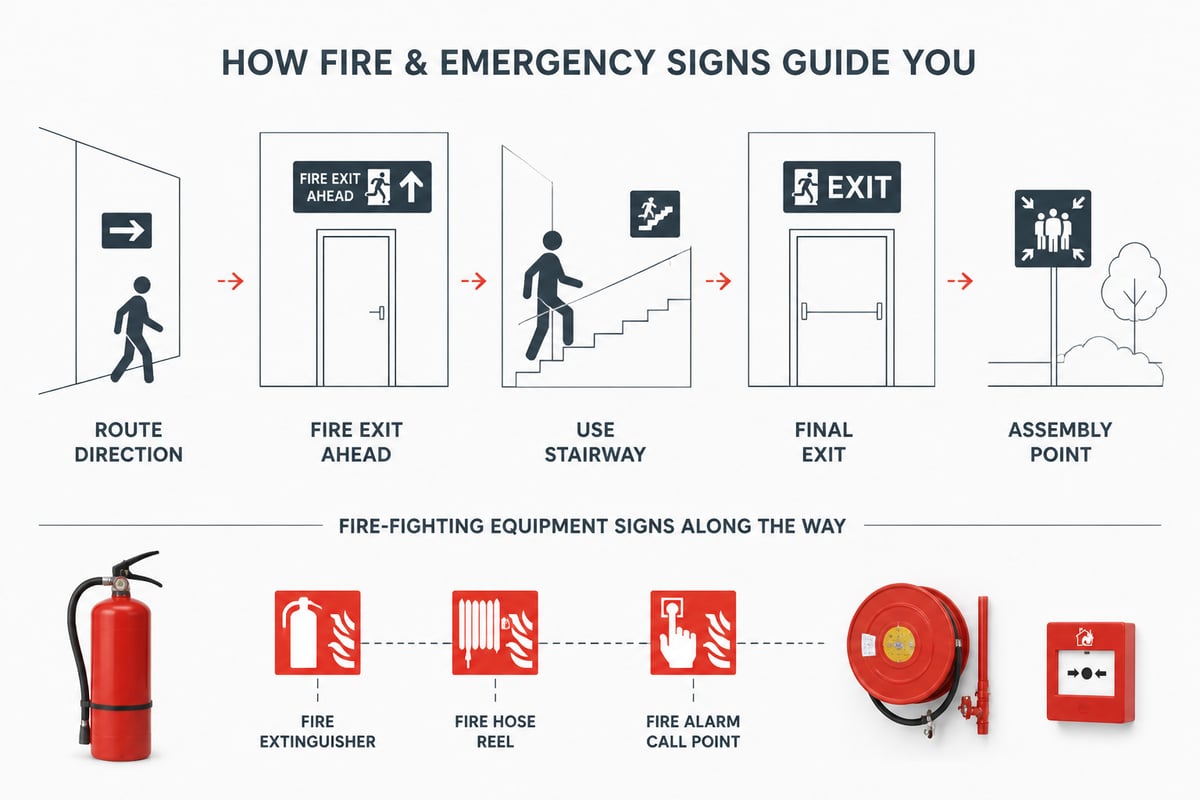
A well-planned system includes:
- Direction signs at every change of direction along escape routes, such as a fire exit ahead safety sign before a corridor junction.
- Equipment location signs above or beside extinguishers, hose reels and alarm points, so that equipment is findable from a distance.
- Instruction signs at the equipment itself, for instance a how to use a fire extinguisher safety sign mounted next to the unit.
- Photoluminescent signs in stairwells and windowless corridors, where a power failure leaves standard signs unreadable. The photoluminescent range glows after lighting is lost, which supports evacuation in smoke or darkness.
Retail and multi-tenant sites should add one point: customers and visitors do not know the building. Their only guide is the signage, so test the route as an outsider would, starting from the furthest point of the sales floor or the most remote office.
Signs for Vehicles, Yards and Site Roads
Internal roads, loading bays and mine haul routes should carry traffic signs that match those on public roads. HSE guidance for workplace transport states that road signs used to warn or inform drivers and pedestrians must match public-road signs wherever a suitable sign exists.
The reasoning is practical. Drivers entering from the public road already know the standard meanings, so a stop sign, speed limit or pedestrian crossing needs no explanation. A sign for a sharp junction ahead or a roadway narrowing from the right works because it looks like the signs a driver meets every day.
Sites with mixed pedestrian and vehicle traffic should separate the two where possible, mark crossing points clearly and use mandatory signs to require high-visibility clothing in vehicle zones.
Building a Site Signage Register
A signage register turns a collection of signs into a managed control, and it simplifies bulk purchasing. For each area, record the hazards, the sign required, its category, size, material and quantity, along with the location and inspection date.
A register delivers three practical benefits for procurement teams:
- Accurate bulk orders. You order what the risk assessment calls for, rather than guessing at quantities.
- Faster replacement. When a sign is damaged, the specification is already on file.
- Audit evidence. Inspectors and insurers can see that signage is planned and maintained, not ad hoc.
Review the register whenever a process changes, a new machine arrives or a layout is altered. A forklift route that moves by ten metres can strand a warning sign in the wrong place.
Training, Language and Contractors
A sign works only if the people who see it understand it and act on it. This is an explicit duty in the UK regulations, which require employers to explain unfamiliar signs, and it applies equally to any South African site with new starters, contract labour or seasonal staff.
Build sign recognition into induction. A short walk-around that points to each category of sign in the real environment is more effective than a slide deck. Where several languages are spoken on the floor, rely on pictograms and add short supplementary text in the main languages used.
Contractors and visitors need the same briefing before they enter a hazardous area. A sign at the gatehouse listing mandatory PPE, backed by a verbal briefing, covers most of the gap.
Common Mistakes to Avoid
Most signage failures are avoidable errors of selection, placement or upkeep:
- Using a warning sign where a prohibition is needed, or the reverse.
- Mounting signs behind doors, racking or parked equipment.
- Leaving faded or damaged signs in place.
- Choosing a material unsuited to heat, chemicals or sunlight.
- Relying on signs alone, without training or physical controls.
- Installing excessive signage, which makes critical messages harder to notice.
Reviewing your site against this list during the next scheduled inspection is a low-cost way to find the gaps before an auditor or an incident does.
Start by walking your highest-risk area this week with a clipboard, noting every sign that is missing, faded, blocked or in the wrong category. SafetySignsForSale has over 25 years of experience in signage and more than 10,000 happy clients, so once your list is ready you can match it against the made-to-order safety signs range. When you are ready to price a full site order, Request a Quote from SafetySignsForSale and send your signage register for a competitively priced response.