


Safety and Health Signs: A Guide to Choosing Compliant Signage
Safety and health signs are standardised notices that use colour, shape and symbols to communicate a hazard, a prohibition, a required action or a safe route, and in South Africa they should conform to SANS 1186 so they are understood by every worker on site. For facility managers and procurement teams, choosing compliant signage means matching the right sign category to each risk, specifying durable materials, and placing every sign where it can be seen in time to act.
This guide sets out the categories, colour rules, sizing logic, materials and placement decisions you need to get right, along with a buying checklist for bulk orders.
What are the main categories of safety and health signs?
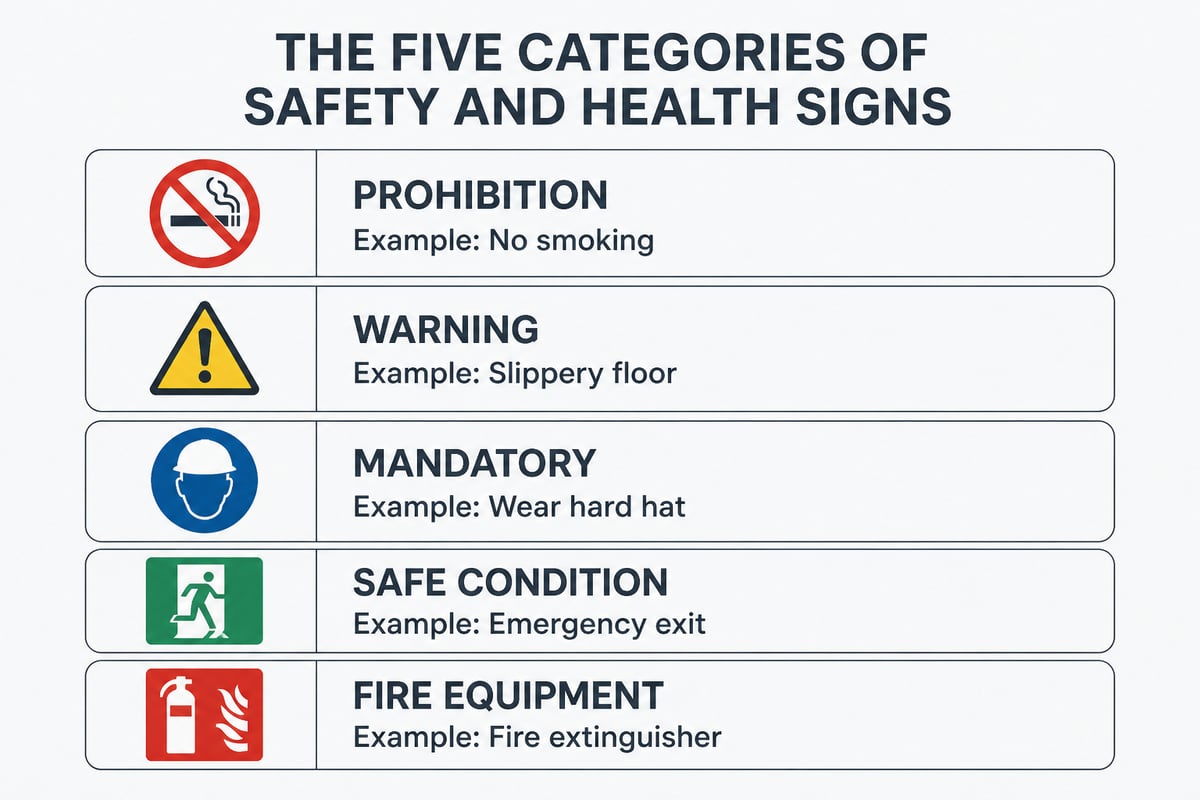
There are five main categories of safety and health signs: prohibition, warning, mandatory, safe condition (including emergency escape and first aid) and fire equipment signs. Each category has its own colour and shape, so a worker can recognise the message before reading any text.
| Category | Shape and colour | Purpose | Typical example |
|---|---|---|---|
| Prohibition | Red circle with diagonal bar, black symbol on white | Forbids behaviour that could cause danger | No smoking, no naked flames |
| Warning | Yellow triangle with black border and symbol | Alerts to a hazard | Slippery floor, overhead crane |
| Mandatory | Blue circle, white symbol | Requires a specific action | Hearing protection must be worn |
| Safe condition | Green rectangle or square, white symbol | Shows escape routes and first aid | Emergency exit, eyewash station |
| Fire equipment | Red rectangle or square, white symbol | Locates firefighting equipment | Fire extinguisher, hose reel |
A fifth category worth separating from the rest is the supplementary sign, a plain text panel placed beneath a symbol sign to add detail such as "Authorised personnel only" or the name of the chemical in use. Supplementary text should never replace the symbol, because symbols work across language barriers on sites where workers speak isiZulu, Sesotho, Afrikaans, English and other languages.
Prohibition signs
Prohibition signs tell people what they must not do. Common examples on industrial sites include smoking prohibited signs at fuel stores and no naked flames signs in paint booths and gas rooms. They should sit at the point where the prohibited behaviour would begin, such as the door of a flammable store, rather than in a corridor some distance away.
Warning signs
Warning signs identify a hazard that cannot be fully removed. They are most effective when specific: "Forklift crossing" tells a pedestrian far more than a generic "Danger" panel. Use them for wet floors, live electrical equipment, moving machinery, overhead loads, hot surfaces and chemical storage.
Mandatory signs
Mandatory signs state an action that is required to enter an area or carry out a task. In factories and mines, the most common are hearing, eye, head, hand and foot protection. The range of mandatory signs is wide enough to cover specialist requirements such as respiratory protection, hand protection and hearing protection, so each PPE requirement in your risk assessment can have its own matching sign.
What are the requirements for safety signs and signals in South Africa?
South African employers must provide signage that communicates workplace hazards and emergency information, and the recognised specification for design is SANS 1186, which sets out symbolic safety signs. The Occupational Health and Safety Act 85 of 1993 places the general duty on employers to provide a working environment that is safe and without risk to health, and signage is one of the practical controls used to meet that duty.
In practice, auditors and inspectors look for four things:
- Signs that match the hazards identified in your risk assessment.
- Standard colours, shapes and symbols, not improvised notices.
- Signs that are legible, undamaged and positioned where they can be seen.
- Emergency and fire signage that remains visible during a power failure.
Because South African buyers often reference international practice, it helps to know how other regimes frame the same principles. OSHA's accident-prevention sign rules, for example, apply to signs intended to identify specific hazards where failing to designate them could lead to injury or property damage, and they require that new and replacement signs follow the specifications. The full regulatory text is available on the eCFR. It is not South African law, but it is a useful benchmark when a multinational client or insurer asks how your signage compares.
Where you hold a contract with a client whose site standards are stricter than the statutory minimum, specify to the stricter standard. Mixing designs from different standards within one building causes confusion, so choose one system and apply it consistently.
What do safety sign colours and shapes mean?
Safety sign colours carry fixed meanings: red for prohibition and fire equipment, yellow for warning, blue for mandatory action and green for safe conditions. Shape reinforces colour, which matters for workers with colour-vision deficiency: circles instruct or forbid, triangles warn, and rectangles or squares inform.
Wording and layout follow the same logic as colour. OSHA's guidance on sign text recommends wording that is easy to read, concise, factually accurate and phrased as a positive rather than negative suggestion. "Keep guards in place" is clearer than "Do not operate without guards", and the principle carries over to supplementary text on South African signs.
A few design points are worth checking before you place an order:
- Contrast: symbols must stand out clearly against the background, with no decorative borders or logos crowding the safety message.
- Consistency: the same hazard should carry the same sign across every building and site.
- Edges and corners: OSHA requires signs to have rounded or blunt corners and to be free of sharp edges, burrs and splinters, a sensible requirement for any sign mounted at head height in a busy walkway.
- Colour fastness: a faded red or yellow loses its meaning, which is why material choice matters as much as design.
How do you choose the right size and material?
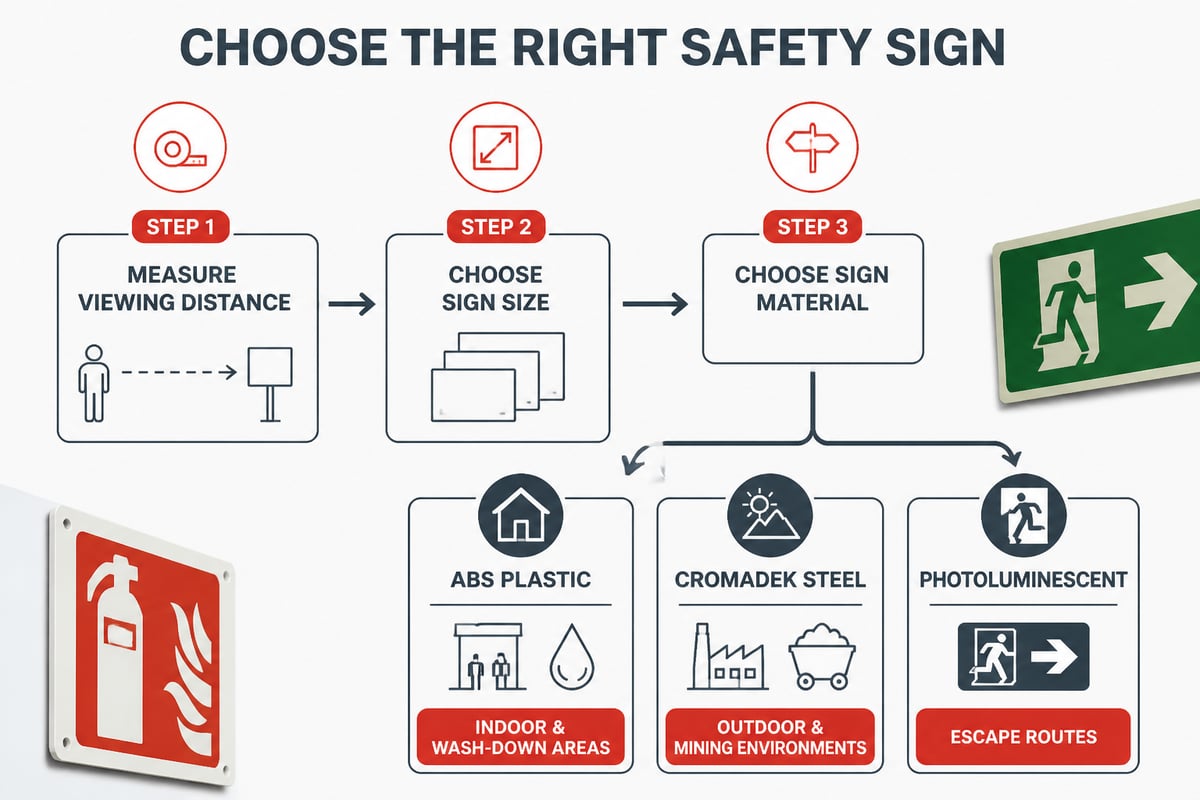
Choose sign size by viewing distance and material by the environment the sign will live in, since an undersized or degraded sign fails its purpose even if the design is compliant. As a working rule, larger symbols are needed the further a person stands from the sign, so a sign for a pedestrian at a door can be small, while a sign for a driver approaching a loading bay must be considerably larger.
Use this approach when specifying sizes:
- Measure the greatest distance from which the sign must be read.
- Match that distance to a sign size using the sizing guidance from your supplier or the SANS 1186 recommendations.
- Allow for obstructions such as racking, pipework or vehicles that will narrow the angle of sight.
- Order the same size for like signs in the same area, so the site looks consistent.
Materials for different environments
Material choice depends on moisture, chemicals, impact, temperature and cleaning regime.
- ABS plastic: lightweight, resistant to moisture and many cleaning agents, suitable for indoor areas, warehouses, retail floors and food-handling zones.
- Cromadek steel: a rigid, coated steel that suits outdoor use, mines, yards, mounting on poles and areas subject to knocks and weather.
- Photoluminescent finishes: glow after light exposure and are used for escape routes and fire equipment so they remain readable if the lights fail.
SafetySignsForSale makes signs to order in ABS plastic or Cromadek steel, and it makes its signs to order. For specific dimensions and finishes, check the individual product pages or contact the team directly rather than assuming a standard size will suit your layout.
Where should safety and health signs be placed?
Safety and health signs should be placed at the point of hazard, at eye level or within the natural line of sight, and in good light, so the message reaches a person before they are exposed to the risk. A sign that is hidden behind an open door, mounted too high or obscured by stock does not meet its purpose, however compliant its design.
Apply these placement rules:
- Position mandatory PPE signs at the entrance to the area, not inside it.
- Put warning signs ahead of the hazard with enough distance for a person or vehicle to react.
- Mount signs on fixed surfaces such as walls, doors and posts, not on movable items.
- Avoid clutter: too many signs in one spot dilute each message.
- Keep signs clear of reflective glare, steam, dust build-up and overhanging stock.
First aid and emergency welfare points need the same discipline. A manned first aid station sign, an eyewash sign or a safety shower sign must be visible from every approach, because a person with chemical in their eyes cannot search for equipment.
How should you sign escape routes and fire equipment?
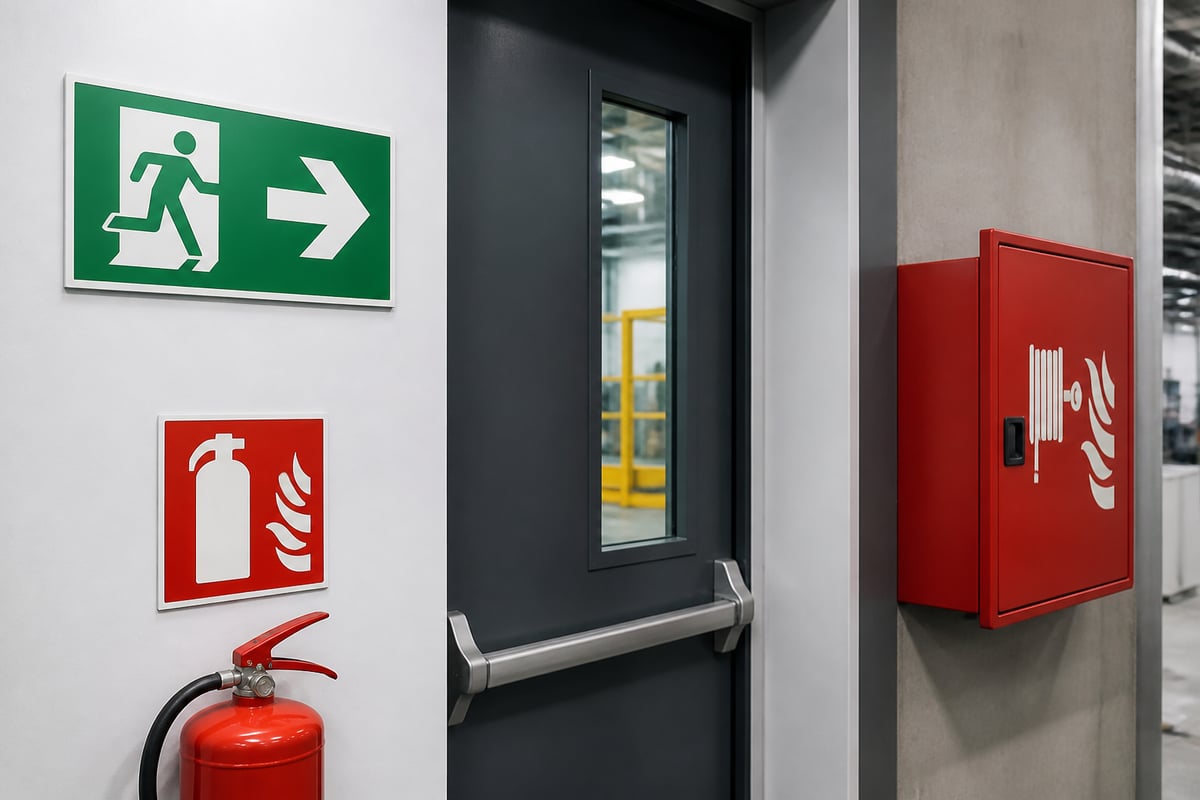
Escape route and fire equipment signs must show the shortest safe route to an exit and the exact location of firefighting equipment, and they should remain visible when the power fails. This is where photoluminescent signage earns its place, since it absorbs ambient light and releases it in the dark.
A sound escape route scheme follows a simple sequence:
- Place a sign above every final exit door.
- Add directional arrows at each change of direction along the route.
- Repeat signs at regular intervals in long corridors and open-plan floors.
- Mark stairs and floor levels so people can orient themselves in smoke or darkness.
- Locate fire extinguishers, hose reels and hydrants with signs visible from a distance.
Options for this work include arrow and fire extinguisher photoluminescent signs, running man and arrow escape signs and break glass instructions at emergency call points. SafetySignsForSale's Safety Signs range includes warning, mandatory, prohibitory, fire fighting, general information, photoluminescent and road signs, made to order, so a single supplier can cover an entire site from the car park to the fire assembly point.
How often should signs be inspected and replaced?
Safety and health signs should be inspected on a regular schedule, and any sign that is faded, damaged, dirty or no longer accurate should be cleaned or replaced immediately. A sign that no longer reflects site conditions is arguably worse than no sign, because it teaches workers to ignore signage.
Build sign checks into routine inspections:
- Monthly: walk the site and look for damaged, missing or obstructed signs.
- After changes: review signage whenever layouts, processes, chemicals or machinery change.
- After incidents: check whether the relevant sign was present, visible and understood.
- Annually: audit the full sign register against the risk assessment and emergency plan.
Keeping a sign register, listing each sign by location, type and installation date, makes audits faster and simplifies reordering. It also gives procurement a clear basis for bulk purchasing instead of ad hoc replacements.
What are the seven key areas of health and safety that signs support?
Signs support the key areas of workplace health and safety by turning risk controls into visible, repeatable instructions. The commonly cited areas are hazard identification, risk assessment, training, emergency preparedness, PPE, fire safety and first aid, and signage connects to each.
- Hazard identification: warning signs mark hazards found during inspections.
- Risk assessment: the assessment determines which signs are needed and where.
- Training: signs reinforce what workers learn in induction.
- Emergency preparedness: escape route and assembly point signs support evacuation plans.
- PPE: mandatory signs state what must be worn in each zone.
- Fire safety: fire equipment and prohibition signs control ignition sources and locate extinguishers.
- First aid: safe condition signs point to treatment points and equipment, such as first aid equipment locations.
Where a site stocks stretchers and immobilisation equipment, signs should direct responders to where these are stored so that the first minutes after an injury are not lost searching.
What should procurement teams check before a bulk order?
Before placing a bulk order for safety and health signs, confirm compliance, quantities by category, materials by environment and delivery arrangements for multiple sites. Treating signage as a planned purchase, rather than a series of emergency buys, reduces cost and avoids mismatched designs across locations.
Use this checklist:
- Confirm the signs conform to SANS 1186.
- Map sign quantities against the site's risk assessment and escape plan.
- Specify material per zone: ABS plastic indoors, Cromadek steel outdoors, photoluminescent for escape routes.
- Standardise sizes by viewing distance.
- Order spares for high-wear areas.
- Confirm lead times for made-to-order items against your project deadlines.
- Check delivery to every site, including remote operations.
SafetySignsForSale has over 25 years of experience in signage, manufactures for blue chip clients and has over 10,000 happy clients, which makes multi-site orders manageable. For quantities, pricing and lead times, contact the team through its quote page rather than relying on assumptions about standard terms.
FAQ
What are the 5 main safety signs?
The five main types are prohibition, warning, mandatory, safe condition and fire equipment signs. Each uses a distinct colour and shape, so the meaning is clear before any text is read.
What are the 7 basic safety rules?
Common workplace rules include following procedures, wearing the required PPE, reporting hazards, keeping walkways clear, knowing emergency exits, never bypassing guards and reporting every incident. Signs reinforce each rule at the point where it applies.
Do safety signs need to be replaced if they are only faded?
Yes. A faded sign loses colour contrast and may no longer be recognised at distance. Replace it promptly, because legibility is a core compliance expectation.
Start by walking one section of your site with a clipboard and listing every hazard, PPE requirement and escape route that currently has no sign or a damaged one. That list becomes your order specification, and SafetySignsForSale can turn it into made-to-order signs in ABS plastic or Cromadek steel, so you can request a quote for the full set in one go. Their Safety Signs range covers everything from prohibitory signs to photoluminescent escape route markers.