


Safety Signs: Essential Guide for Workplace Protection
Safety signage represents one of the most fundamental components of workplace protection, serving as the first line of defence against accidents, injuries, and regulatory non-compliance. Effective visual communication through properly designed and strategically placed signs can mean the difference between a safe working environment and a preventable tragedy. Whether operating a manufacturing facility, construction site, warehouse, or office building, understanding the principles behind effective safety signage is essential for protecting employees, visitors, and assets whilst maintaining compliance with health and safety legislation.
Understanding the Regulatory Framework for Safety Signage
The legal requirements surrounding workplace safety signage vary by jurisdiction, but most frameworks share common principles rooted in international standards. In the United Kingdom, the HSE guidance on safety signs and signals provides comprehensive direction on implementing ISO 7010 standards and meeting legal obligations under the Health and Safety (Safety Signs and Signals) Regulations 1996.
These regulations mandate that employers use safety signs where risks cannot be avoided or adequately controlled through other means. The legislation distinguishes between several categories of signs, each serving specific communication purposes within the workplace.
Key regulatory principles include:
- Assessment of workplace hazards requiring visual warnings
- Selection of appropriate sign types matching specific risks
- Maintenance of signs to ensure continued visibility and legibility
- Employee training on sign meanings and required responses
- Regular audits to verify signage remains current and effective
International Standards and Harmonisation
ISO 7010 has become the global benchmark for safety signage design, establishing standardised pictograms that transcend language barriers. This harmonisation ensures workers can recognise hazards regardless of their native language or previous experience. The standard covers colours, shapes, and symbols that communicate prohibition, warning, mandatory action, emergency escape, and fire equipment location.
Research demonstrates that standardised pictograms significantly improve hazard recognition speed and accuracy. A peer-reviewed study on visual communication design in laboratory safety provides evidence-based recommendations for optimising pictogram size, text integration, and layout to maximise safety sign effectiveness.
Categories of Safety Signs and Their Applications
Understanding the different categories of safety signs enables organisations to implement comprehensive visual safety programmes. Each category serves distinct communication purposes and follows specific design conventions.
Prohibition Signs
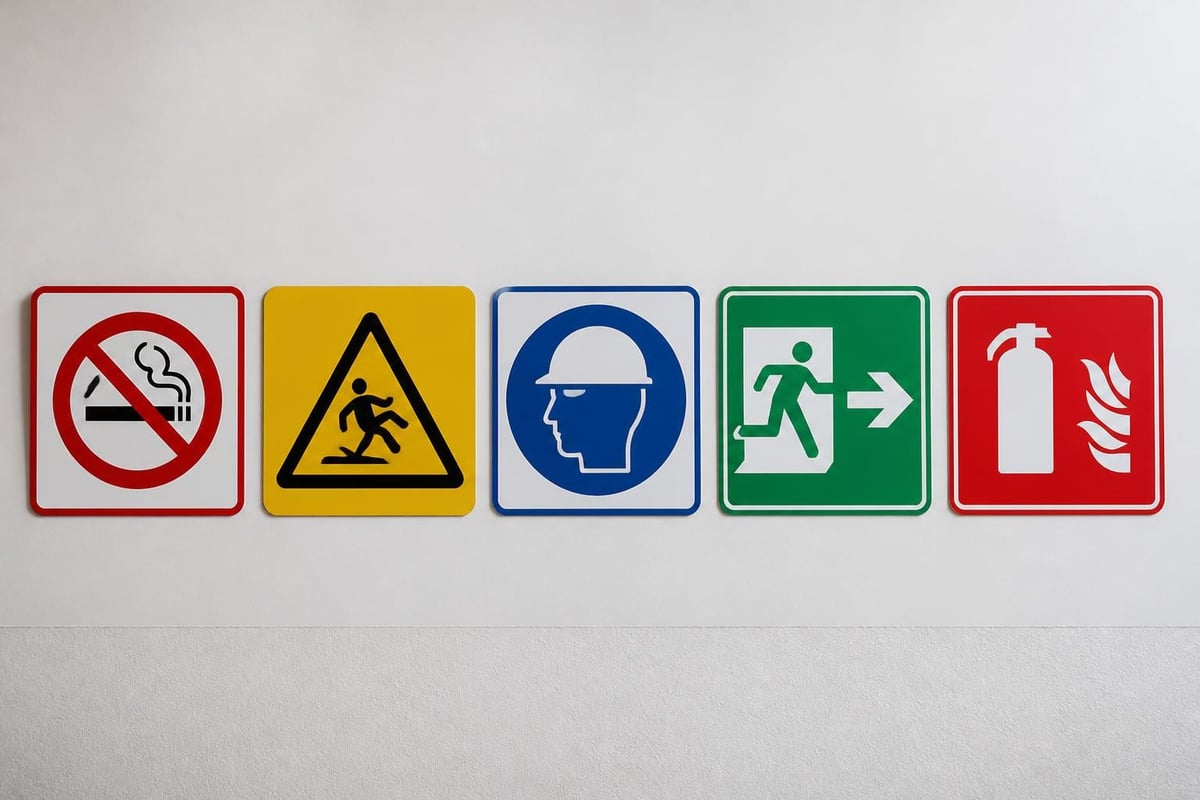
Prohibitory signs prevent dangerous behaviour by clearly indicating actions that are not permitted. These circular signs feature a red border with a diagonal line crossing a black pictogram on white background. Common examples include no smoking, no unauthorised access, and no mobile phones in specific areas.
Manufacturing environments frequently require prohibition signs near machinery, chemical storage areas, and restricted zones. The immediate visual impact of the red circular format ensures instant recognition, even in peripheral vision.
Warning Signs
Triangular yellow signs with black borders and symbols constitute the warning category, alerting people to potential hazards. Warning signs address risks including electrical hazards, slippery surfaces, overhead loads, toxic substances, and extreme temperatures.
Strategic placement of warning signs at point-of-hazard locations provides just-in-time awareness, allowing individuals to take appropriate precautions before encountering danger. These signs prove particularly valuable in environments where hazards may not be immediately obvious.
| Sign Category | Shape | Colour Scheme | Primary Purpose |
|---|---|---|---|
| Prohibition | Circle with diagonal line | Red border, white background | Prevent dangerous actions |
| Warning | Triangle | Yellow background, black border | Alert to hazards |
| Mandatory | Circle | Blue background, white symbol | Require specific actions |
| Emergency | Rectangle/Square | Green background, white symbol | Indicate safety routes/equipment |
| Fire Equipment | Rectangle/Square | Red background, white symbol | Show firefighting resources |
Mandatory Signs
Blue circular signs with white pictograms communicate required actions, typically relating to personal protective equipment usage. Mandatory signs direct workers to wear hard hats, safety glasses, hearing protection, gloves, or other protective gear before entering specific areas.
Enforcement of mandatory requirements becomes significantly easier when clear visual reminders precede entry points. These signs support safety culture by normalising protective equipment usage.
Emergency and Fire Safety Signs
Green rectangular signs indicate emergency exits, assembly points, first aid stations, and safety equipment locations. These signs guide people to safety during emergencies, making their visibility and clarity absolutely critical. Fire-fighting signs use red backgrounds with white symbols to mark fire extinguishers, hose reels, alarm call points, and fire blankets.
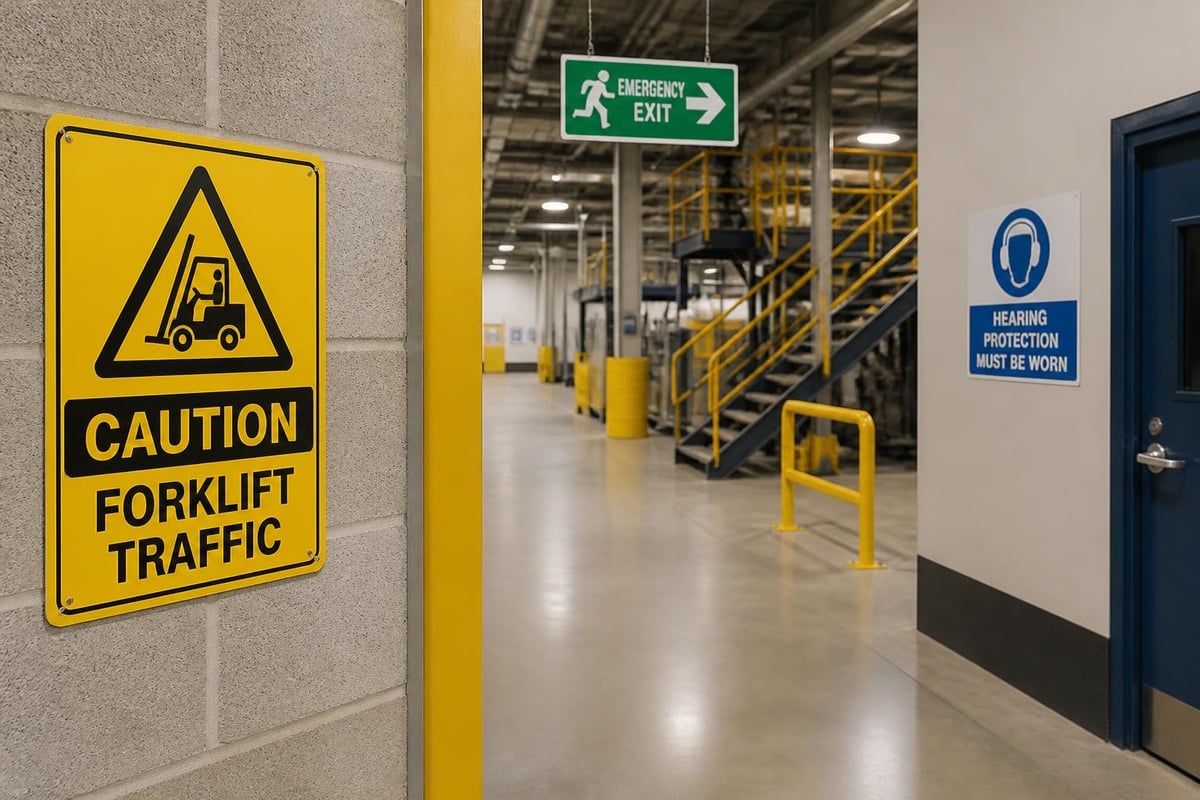
Emergency signage requires particular attention to mounting height, illumination, and sight lines. During evacuations, people under stress must quickly locate exits and safety equipment without confusion or delay.
Strategic Placement and Visibility Considerations
The effectiveness of safety signs depends as much on placement as design. Even perfectly manufactured signs fail if positioned where they cannot be seen or understood by those who need the information.
Mounting Height and Viewing Distance
ADA technical guidance on signage establishes specific requirements for mounting heights, character sizes, contrast ratios, and tactile elements to ensure accessibility. Whilst these standards apply specifically to accessibility in the United States, the principles of readable signage at appropriate heights apply universally.
Standard recommendations suggest:
- Primary safety signs: Mount at eye level (1.5-2 metres) where possible
- Directional signs: Position at decision points before hazards
- Equipment location signs: Place directly above or adjacent to equipment
- Overhead signs: Use for large spaces where wall mounting proves impractical
- Floor-level signs: Employ for trip hazards or marking safe walkways
Lighting and Photoluminescence
Visibility during power failures or low-light conditions requires special consideration. Photoluminescent signs absorb ambient light and glow in darkness, maintaining visibility during electrical failures. These signs prove essential for emergency exit routes, stairwells, and equipment locations needed during evacuations.
External illumination through dedicated sign lighting or general area lighting ensures 24-hour visibility in facilities operating multiple shifts or experiencing varying natural light levels throughout the day.
Material Selection and Durability Factors
The physical construction of safety signs significantly impacts their longevity and continued effectiveness. Environmental conditions, exposure to chemicals, temperature extremes, and physical impacts all influence appropriate material selection. For guidance on signs marking required protective gear, see our article on PPE signs for workplace safety in 2026.
Common Sign Materials and Applications
Rigid plastic signs offer excellent durability for indoor applications, resisting moisture and maintaining colour integrity over extended periods. These signs suit office environments, warehouses, and controlled manufacturing areas.
Aluminium signs provide superior weather resistance for outdoor installations or harsh industrial environments. The metal substrate resists warping and damage from temperature fluctuations whilst accepting various surface treatments.
Vinyl adhesive signs enable application to irregular surfaces or temporary installations. These flexible signs work well for equipment labelling or short-term safety communications during construction or maintenance projects.
Reflective signs incorporate retroreflective sheeting, crucial for roadway applications and outdoor areas requiring visibility during darkness. The Manual on Uniform Traffic Control Devices specifies reflectivity standards for road signs and traffic control devices.
Environmental Resistance Requirements
Different workplace environments demand specific material characteristics:
- Chemical exposure: Requires resistant coatings and substrate materials
- UV exposure: Needs fade-resistant inks and UV-stabilised materials
- High temperatures: Demands heat-resistant substrates and adhesives
- Physical impact: Requires thicker materials or protective mounting
- Moisture/humidity: Needs waterproof construction and corrosion-resistant fasteners
Implementing a Comprehensive Signage Programme
Effective workplace safety communication extends beyond simply installing signs. A systematic approach ensures complete coverage of hazards, maintains sign quality over time, and integrates signage with broader safety initiatives.
Risk Assessment and Sign Selection
The process begins with thorough workplace risk assessment, identifying all hazards requiring visual communication. This assessment should evaluate:
- Fixed hazards (machinery, electrical equipment, chemical storage)
- Procedural requirements (PPE zones, restricted areas)
- Emergency provisions (exits, assembly points, first aid equipment)
- Temporary hazards (maintenance activities, construction zones)
- Wayfinding needs (evacuation routes, equipment locations)
Each identified hazard or requirement then receives appropriate signage matching the communication objective. The comprehensive range of safety signs available addresses virtually every workplace scenario through standardised designs.
Maintenance and Inspection Protocols
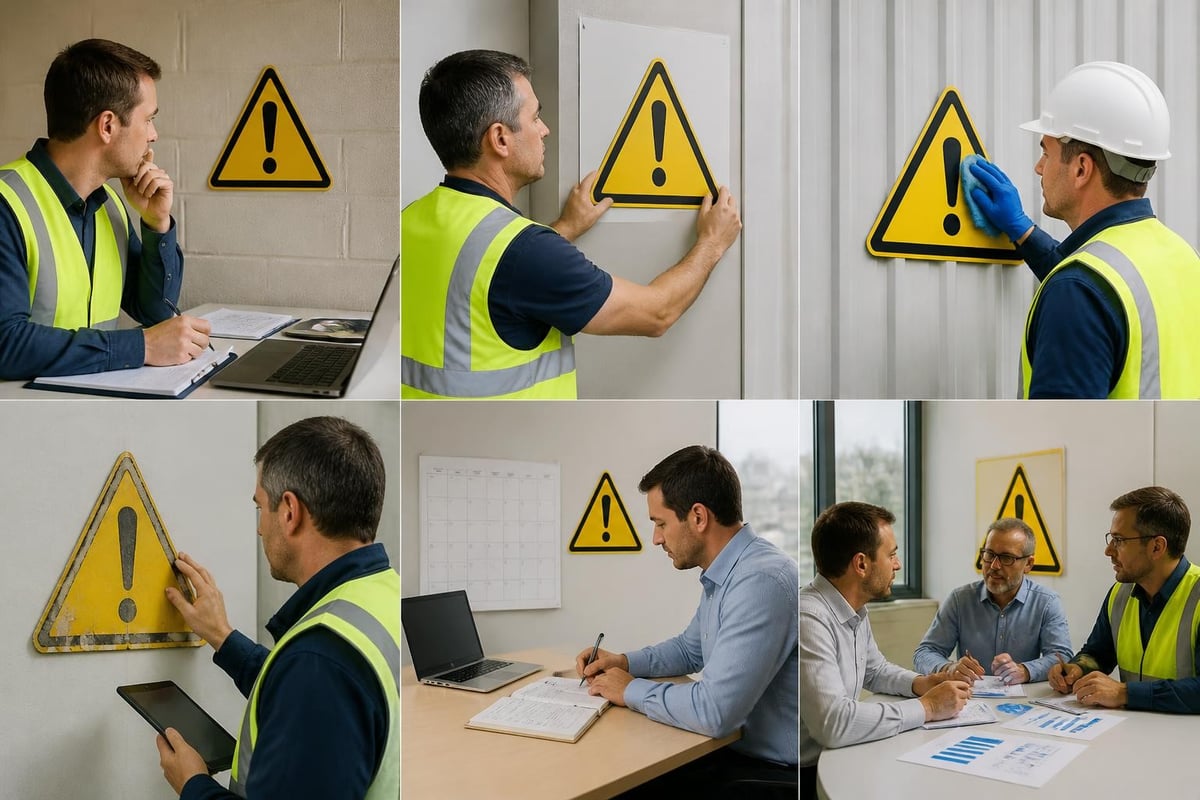
Safety signs deteriorate over time through exposure to environmental factors, physical damage, or vandalism. Regular inspection schedules ensure signs remain visible, legible, and appropriately positioned.
| Inspection Frequency | Activities | Responsibility |
|---|---|---|
| Weekly | Visual check for obvious damage or missing signs | Supervisors/Safety Officers |
| Monthly | Detailed inspection of all signs for fading, damage, obstruction | Facilities Team |
| Quarterly | Verification of photoluminescent charging and glow performance | Safety Specialists |
| Annually | Complete audit of all signage against current hazards and regulations | External Auditors |
| After incidents | Review signage adequacy in affected areas | Safety Committee |
Integration with Training and Safety Culture
Safety signs support but cannot replace comprehensive employee training and strong safety culture. Visual warnings work most effectively when workers understand sign meanings and incorporate compliance into routine behaviour.
Employee Orientation and Ongoing Education
New employee orientation should include systematic review of workplace signage, explaining the meaning of each sign category and expected responses. This training establishes baseline understanding before workers encounter actual hazards.
Ongoing refresher training addresses new signage, changes to layouts, or incident-driven improvements. Interactive methods such as workplace walks, photo recognition exercises, and scenario discussions reinforce sign awareness more effectively than passive presentations.
Behavioural Reinforcement
Safety culture develops when organisations consistently enforce signage requirements. Workers who observe colleagues ignoring mandatory signs without consequence quickly learn that visual warnings lack importance. Conversely, consistent recognition of compliance and correction of violations establishes that signs represent genuine requirements worthy of respect.
Supervisors play crucial roles in this reinforcement, modelling compliance through their own behaviour and addressing non-compliance immediately and constructively.
Specialised Signage Applications
Beyond standard workplace safety signs, certain industries or situations require specialised visual communication approaches addressing unique hazards or regulatory frameworks.
Construction and Temporary Sites
Construction sites present dynamic hazards changing as projects progress. Temporary signage must adapt to evolving risks whilst maintaining visibility amid dust, weather exposure, and frequent layout changes. Portable sign stands, barriers with integrated signage, and high-visibility materials suit these applications.
Multi-Lingual and Pictogram-Heavy Environments
Workplaces employing diverse linguistic groups benefit from pictogram-based signs minimising text reliance. When text becomes necessary, bilingual or multilingual signs ensure all workers receive critical information regardless of language proficiency.
Hazardous Material Storage and Handling
Chemical facilities require highly specific signage communicating exact hazards, emergency procedures, and protective equipment requirements. Integration with general informational signs providing detailed instructions supplements standard warning signs.
NFPA diamond ratings, GHS pictograms, and material-specific hazard information create comprehensive visual communication systems around dangerous substances.
Digital and Smart Signage Innovations
Technology integration introduces new capabilities to traditional safety signage, though fundamental visual communication principles remain constant.
Digital displays enable dynamic messaging adapting to changing conditions, such as variable speed limits in work zones or real-time hazard alerts in processing facilities. These systems update instantly across multiple locations, ensuring consistent messaging during incidents or procedural changes.
Sensor-activated signs trigger when specific conditions occur, such as detection of harmful gas concentrations or unauthorised entry to restricted areas. This targeted activation draws attention more effectively than static signs that may become part of visual background.
Connected monitoring allows facilities management to track sign condition remotely, identifying failures in illuminated or photoluminescent signs requiring replacement before effectiveness diminishes.
Despite technological advances, traditional static signs retain significant advantages in reliability, cost-effectiveness, and independence from power supplies or network connectivity.
Cost-Benefit Analysis of Quality Signage Investment
Decision-makers sometimes view safety signage as discretionary expense rather than essential infrastructure. Quantifying the return on investment demonstrates that quality signage programmes deliver measurable financial and operational benefits.
Direct Cost Avoidance
Proper signage prevents accidents that generate direct costs including:
- Medical treatment and compensation claims
- Lost productivity during injury recovery
- Temporary staffing or overtime to cover absent workers
- Investigation and corrective action expenses
- Potential regulatory fines for preventable incidents
A single serious injury easily costs more than comprehensive facility signage. Even minor incidents requiring first aid from properly marked eyewash stations or medical kits demonstrate signage value through rapid response enabled by clear equipment identification.
Indirect Benefits and Value Creation
Beyond accident prevention, effective signage delivers operational advantages:
- Regulatory compliance: Avoiding citations, work stoppages, and reputation damage
- Insurance premiums: Demonstrating risk management may reduce coverage costs
- Employee confidence: Clear safety communication improves morale and retention
- Visitor impressions: Professional signage enhances credibility with clients and stakeholders
- Operational efficiency: Clear wayfinding and equipment identification reduces time waste
Quality signs manufactured from durable materials provide lower lifecycle costs than frequent replacement of cheaper alternatives. Initial investment in appropriate materials and professional installation pays dividends through extended service life and maintained effectiveness.
Implementing comprehensive, compliant, and effective safety signage requires careful attention to regulatory requirements, proper categorisation, strategic placement, and ongoing maintenance. By understanding these principles and applying them systematically, organisations create safer working environments that protect people whilst satisfying legal obligations. SafetySignsForSale provides the complete range of safety signs, fire equipment, PPE, and first aid supplies necessary to build robust safety communication systems across all industry sectors. Explore the extensive product catalogue to find precisely the right solutions for your specific workplace safety requirements.