


Assembly Point Sign: Essential Guide for Emergency Safety
Every workplace emergency evacuation plan relies on a critical component that often goes unnoticed until disaster strikes: the assembly point sign. These seemingly simple markers serve as lifelines during evacuations, guiding employees, visitors, and emergency responders to designated safe zones. Whether you're responsible for a manufacturing facility, office building, retail space, or educational institution, understanding the importance of proper assembly point signage can mean the difference between chaos and orderly evacuation during an emergency.
Understanding Assembly Point Signs and Their Purpose
An assembly point sign designates a predetermined location where occupants must gather following an emergency evacuation. These signs function as visual beacons that direct evacuees away from danger zones and towards safe areas where headcounts can be conducted, first aid administered, and emergency services coordinated.
The primary functions of these critical safety markers extend beyond simple wayfinding. They reduce confusion during high-stress situations, enable rapid accountability checks, prevent re-entry into dangerous areas, and facilitate communication between safety wardens and emergency responders. The UK Government guidance on fire safety risk assessment emphasises the importance of clearly marked assembly points in evacuation procedures.
Key Design Elements
Effective assembly point signs share several essential characteristics that ensure visibility and comprehension during emergencies:
- High-contrast colour schemes that remain visible in various lighting conditions
- Internationally recognised symbols that transcend language barriers
- Weather-resistant materials suitable for outdoor installation
- Reflective or photoluminescent properties for low-light visibility
- Clear, large-format text readable from significant distances
Recent research on sign visibility and evacuation signage performance demonstrates that luminance, colour contrast, and symbol recognisability significantly impact how quickly people identify and respond to emergency signage during stressful situations.

Regulatory Requirements and Standards
Compliance with safety regulations isn't optional when it comes to assembly point signage. Various jurisdictions maintain specific requirements regarding the design, placement, and maintenance of these critical safety markers.
In the United States, the NFPA 101 Life Safety Code provides comprehensive guidance on evacuation planning and assembly location requirements. This code influences building regulations across numerous states and municipalities, establishing baseline standards for life safety systems.
British and European standards similarly mandate clear assembly point identification as part of comprehensive fire safety strategies. The Regulatory Reform (Fire Safety) Order 2005 requires responsible persons to establish and communicate evacuation procedures, including designated assembly points.
| Regulatory Aspect | Requirement | Compliance Consideration |
|---|---|---|
| Visibility | Unobstructed sightlines from multiple approaches | Regular vegetation trimming, parking restrictions |
| Accessibility | Wheelchair-accessible routes to assembly points | Paved pathways, appropriate gradients |
| Distance | Minimum safe distance from building structures | Site-specific risk assessment required |
| Illumination | Visible in all lighting conditions | Reflective materials or supplementary lighting |
Material and Manufacturing Standards
Assembly point signs must withstand environmental challenges whilst maintaining legibility. Quality signs typically conform to ISO standards for safety colours and symbols, ensuring universal recognition across different facilities and regions.
Materials selection should account for:
- Climate exposure (UV resistance, temperature extremes, precipitation)
- Physical durability (impact resistance, vandal-proofing)
- Maintenance requirements (cleaning frequency, replacement intervals)
- Sustainability considerations (recyclable materials, longevity)
SafetySignsForSale offers a comprehensive range of safety signs manufactured to meet stringent quality standards, including durable assembly point markers designed for long-term outdoor use.
Strategic Placement and Location Selection
Choosing appropriate assembly point locations requires careful consideration of multiple factors. The assembly point sign itself becomes meaningless if placed in a location that poses secondary hazards or impedes emergency operations.
Site Selection Criteria
Optimal assembly points should be positioned sufficiently distant from structures to avoid falling debris, glass, or structural collapse. A general guideline suggests minimum distances of at least twice the height of the tallest adjacent building, though site-specific risk assessments may indicate different requirements.
Additional location considerations include:
- Accessibility from all building exits without requiring evacuees to cross vehicular traffic routes
- Capacity to accommodate maximum anticipated occupancy plus visitors
- Shelter options from adverse weather whilst maintaining safe clearance from structures
- Clear access routes for emergency vehicles and personnel
- Visibility to facilitate monitoring by safety wardens and emergency coordinators
For larger facilities or campuses, multiple assembly points may be necessary, each clearly designated with unique identifiers (Assembly Point A, Assembly Point B, etc.). The UK Government guidance for large places of assembly provides detailed recommendations for complex venues requiring sophisticated evacuation planning.
Signage Placement Tactics
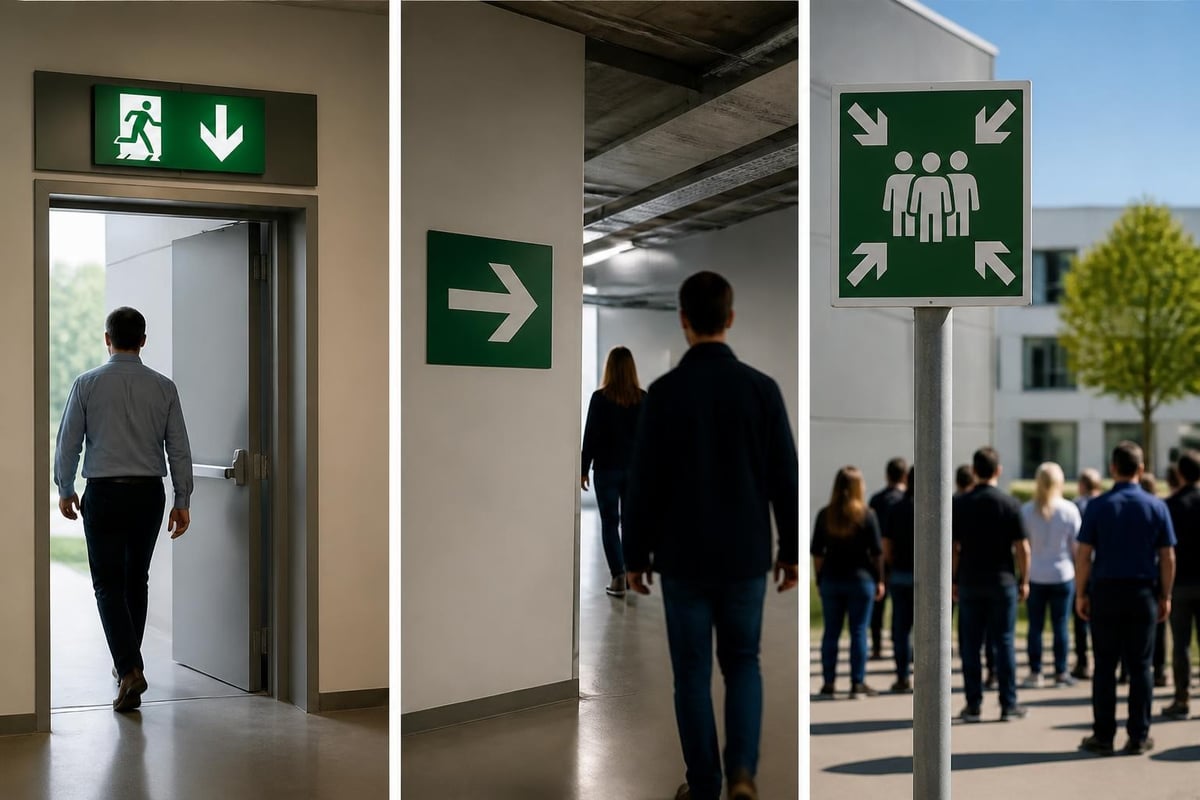
Once assembly point locations are determined, strategic sign placement ensures maximum effectiveness. Primary assembly point signs should be installed at the assembly point itself, typically at eye level (approximately 1.5-2 metres) on permanent structures or dedicated posts.
Directional signage creates a wayfinding system guiding evacuees from building exits to assembly points. These supplementary signs should be installed at decision points where evacuees might become disoriented, including exit doorways, pathway intersections, and car park peripheries.
Design Considerations for Maximum Visibility
The effectiveness of an assembly point sign depends heavily on its visibility under various conditions. Design choices significantly impact how quickly and reliably people can locate assembly points during emergencies.
Colour Psychology and Contrast
Standard assembly point signs typically employ green backgrounds with white symbols and text, following international safety colour conventions where green indicates safe conditions or emergency equipment. This colour scheme provides strong contrast whilst conveying the psychological message of safety and refuge.
However, recent research suggests that high-contrast combinations may be even more effective in certain environments. The Sign Research Foundation's visibility tools offer evidence-based guidance on colour selection, contrast ratios, and legibility distances that can inform assembly point sign specifications.
Alternative colour schemes might be justified in environments where:
- Standard green signs blend with natural backgrounds (extensive landscaping)
- Existing safety signage creates potential confusion
- Special populations require enhanced visual accessibility
- Specific regulatory requirements mandate alternative approaches
Photoluminescent and Reflective Technologies
Power failures frequently accompany major emergencies, making illumination-independent visibility crucial. Photoluminescent signs absorb ambient light and emit a visible glow during darkness, providing several hours of visibility without electrical power.
Reflective materials offer complementary benefits, particularly in outdoor assembly point applications where vehicle headlights or emergency vehicle lighting may provide the primary illumination source. Many facilities employ both technologies, with photoluminescent properties providing baseline visibility and reflective elements enhancing recognition when artificial lighting is available.
| Technology | Advantages | Limitations | Best Applications |
|---|---|---|---|
| Photoluminescent | No power required, multi-hour glow duration | Requires light charging, gradual fade | Indoor routes, sheltered outdoor areas |
| Reflective | Highly visible with any light source, permanent | Requires external light source | Outdoor areas, vehicle routes |
| Illuminated | Consistent brightness, programmable | Power dependent, maintenance intensive | Critical pathways, large venues |
| Standard | Cost-effective, simple maintenance | Daylight dependent | Well-lit areas, supplementary signage |
Accessibility and Inclusive Design
Modern assembly point signs must accommodate diverse populations, including individuals with visual impairments, mobility limitations, and cognitive differences. The CSA technical guidance on wayfinding and signage provides comprehensive recommendations for inclusive signage design.
Visual Accessibility Features
Enhanced visual accessibility extends beyond simple enlargement. Effective accessible assembly point signs incorporate:
- Character sizing appropriate for anticipated viewing distances (minimum 25mm height for each metre of viewing distance)
- Sans-serif typefaces with appropriate spacing and weight
- Matte finishes reducing glare for individuals with light sensitivity
- Colour combinations accommodating colour vision deficiencies
Tactile elements and Braille additions, whilst less common for assembly point signs compared to building wayfinding, may be appropriate for signs positioned along accessible evacuation routes where individuals might use tactile navigation techniques.
Mobility and Cognitive Considerations
Assembly point locations themselves must be accessible to individuals using wheelchairs, walkers, or other mobility aids. This accessibility requirement extends beyond the immediate assembly point to include all approach routes from building exits.
Cognitive accessibility involves simplifying information presentation and maintaining consistency across an entire facility's signage system. Complex instructions or excessive text reduce comprehension during high-stress evacuations. Internationally standardised symbols provide immediate recognition without requiring language proficiency or extended reading.

Installation and Maintenance Best Practices
Proper installation ensures assembly point signs remain effective throughout their service life. Poor installation can result in premature failure, reduced visibility, or complete sign loss during adverse weather events.
Professional Installation Techniques
Mounting methods should be selected based on sign location, environmental conditions, and substrate characteristics. Common mounting approaches include:
- Post-mounted systems for areas without existing structures, using galvanised or powder-coated posts set in concrete footings
- Wall-mounted installations on permanent structures using appropriate fixings for substrate type
- Suspended signs for overhead visibility in large open areas or car parks
- Ground-mounted markers for supplementary identification in outdoor assembly areas
All fixings must account for wind loading, particularly for larger signs in exposed locations. SafetySignsForSale's general informational signs category includes various mounting options suitable for different installation scenarios.
Routine Maintenance Schedules
Regular inspection and maintenance preserves assembly point sign effectiveness. Recommended maintenance activities include:
Monthly visual inspections checking for damage, vandalism, or obscuration by vegetation or temporary structures. These quick checks ensure signs remain visible and legible without requiring detailed examination.
Quarterly cleaning removes accumulated dirt, biological growth, or environmental contamination that might reduce visibility. Appropriate cleaning methods vary by sign material but generally involve mild detergents and soft brushes to avoid surface damage.
Annual comprehensive assessments evaluate structural integrity, mounting system condition, and photoluminescent or reflective performance degradation. This detailed review should include nighttime visibility testing for illumination-dependent features.
Documentation of inspection findings and maintenance activities supports regulatory compliance whilst creating maintenance history data that informs replacement scheduling and budget planning.
Integration with Comprehensive Emergency Planning
An assembly point sign represents just one component of a holistic emergency preparedness strategy. Maximum effectiveness requires integration with broader safety systems and procedures.
Emergency Action Plan Coordination
Assembly point locations must be clearly documented in written emergency action plans distributed to all employees. These plans should include site maps showing assembly point locations, designated routes from various building areas, and alternative assembly points if primary locations become compromised.
Regular evacuation drills provide opportunities to evaluate assembly point signage effectiveness. Observers should monitor whether evacuees locate assembly points quickly without confusion or backtracking. Any difficulties identifying assembly points during drills indicate potential signage improvements or supplementary directional markers.
Communication protocols should establish clear procedures for headcount completion at assembly points, including how to report missing individuals and coordinate with emergency responders. Assembly point signs might incorporate additional information such as "Report to Safety Warden" or emergency contact numbers, though excessive text should be avoided to maintain clarity.
Coordination with Other Safety Signage
Assembly point signs function as part of a comprehensive wayfinding system that should maintain visual consistency whilst remaining distinguishable from other safety markers. Fire fighting signs, exit markers, and warning signs all contribute to overall facility safety but serve distinct purposes.
Facilities should establish signage hierarchies ensuring assembly point markers remain prominent without creating visual clutter. This balance might involve:
- Standardised colour coding distinguishing assembly point signs from other safety markers
- Consistent symbol usage across all facility locations
- Appropriate sizing ensuring assembly point signs are proportionate to their critical function
- Strategic placement avoiding competition with advertising or directional signage
Special Considerations for Different Environments
Assembly point sign requirements vary significantly across different facility types and operational contexts. Tailoring signage approaches to specific environments enhances effectiveness whilst ensuring regulatory compliance.
Industrial and Manufacturing Facilities
Industrial environments present unique challenges including noise, visual complexity, and potential exposure to chemicals or extreme temperatures. Assembly point signs in these settings require enhanced durability and may need specialised materials resistant to specific chemical exposures.
Large industrial sites often require multiple assembly points corresponding to different production areas or shifts. Clear identification systems (colour coding, alphanumeric designations, or zone references) help ensure workers proceed to correct assembly points during evacuations.
Integration with PPE requirements and first aid equipment locations creates comprehensive safety systems where assembly points also serve as resource staging areas during emergencies.
Educational Institutions
Schools and universities face particular assembly point challenges due to large populations, varied age groups, and potential for visitor presence during emergencies. Assembly point signs must be understandable to young children whilst remaining appropriate for adult comprehension.
Multiple building complexes typically require numerous assembly points, each clearly designated to avoid confusion during evacuations. Many educational institutions assign specific assembly points to individual buildings or grade levels, creating organised evacuation patterns that facilitate rapid headcounts.
Retail and Public Assembly Venues
Retail environments and public venues must accommodate unfamiliar visitors who lack prior knowledge of evacuation procedures. Assembly point signage in these settings should be particularly intuitive, employing universally recognised symbols and multilingual text where appropriate.
High-traffic public venues may require dynamic assembly point strategies where primary assembly points can be supplemented or relocated based on event type, crowd size, or emergency nature. Temporary supplementary signage might be deployed during special events, though permanent assembly point markers should remain as baseline reference points.
Effective assembly point signage forms an essential foundation for workplace emergency preparedness, combining thoughtful design, strategic placement, and ongoing maintenance to ensure reliability when needed most. By selecting appropriate materials, following regulatory guidance, and integrating assembly point markers into comprehensive safety planning, organisations create evacuation systems that protect lives during critical moments. Whether you're establishing new assembly points or upgrading existing signage, SafetySignsForSale provides the quality safety signage and expert guidance needed to meet your facility's unique requirements.