


Authorised Personnel Only Sign: Complete Guide 2026
Access control represents a fundamental element of workplace safety management, and the authorised personnel only sign serves as the first line of defence in protecting restricted areas. These signs communicate clear boundaries, prevent unauthorised entry, and reinforce compliance with health and safety regulations across industrial, commercial, and institutional settings. Understanding when to deploy these signs, how to select appropriate designs, and where to position them ensures maximum effectiveness whilst meeting legal obligations.
Understanding the Purpose of Authorised Personnel Only Signage
The authorised personnel only sign functions as both a legal notice and a practical barrier, informing individuals that specific areas require special permission or qualifications for entry. This type of signage proves essential in environments where hazards exist, sensitive equipment requires protection, or security protocols demand strict access limitations.
Workplace safety regulations recognise that not all individuals possess the training, protective equipment, or clearance necessary to enter certain zones. Health and Safety Executive guidance on workplace signs emphasises that prohibition and restriction signs must be deployed where unauthorised access could lead to harm or compromise safety systems.
Primary Functions and Applications
Access restriction signage serves multiple critical purposes simultaneously:
- Hazard prevention: Keeping untrained personnel away from dangerous equipment, chemicals, or high-voltage areas
- Security enforcement: Protecting confidential information, valuable assets, or sensitive processes
- Contamination control: Maintaining sterile environments in laboratories, medical facilities, or clean rooms
- Liability reduction: Demonstrating reasonable precautions to prevent unauthorised access and associated injuries
- Compliance demonstration: Meeting regulatory requirements for controlled access documentation
These signs find application across remarkably diverse settings. Manufacturing facilities use them at machinery enclosures and electrical panels. Healthcare institutions deploy them in operating theatres and pharmaceutical storage areas. Research laboratories incorporate them into biosafety protocols, as outlined in Canadian biosafety guidance on comprehensive biosecurity planning.
Types and Design Standards for Restricted Access Signs
Authorised personnel only signs vary considerably in design, messaging, and visual hierarchy depending on the specific hazards and regulatory frameworks governing their use. Selecting appropriate signage requires understanding these distinctions and matching sign characteristics to environmental requirements.
Standard Design Elements
Effective restricted access signage incorporates specific visual and textual components:
| Design Element | Purpose | Common Specifications |
|---|---|---|
| Signal word | Indicates hazard severity | DANGER, WARNING, CAUTION, NOTICE |
| Prohibition symbol | Universal visual communication | Red circle with diagonal line |
| Primary message | Core restriction statement | "AUTHORISED PERSONNEL ONLY" |
| Supplementary text | Additional context | Hazard description, penalty notice |
| Colour coding | Quick hazard recognition | Red/black for prohibition, yellow for caution |
Research on visual communication design and effectiveness of warning signs demonstrates that hierarchical text arrangement significantly impacts comprehension rates. The most effective authorised personnel only sign designs place signal words prominently, followed by the restriction statement, with hazard explanations in smaller text below.
Industry-Specific Variations
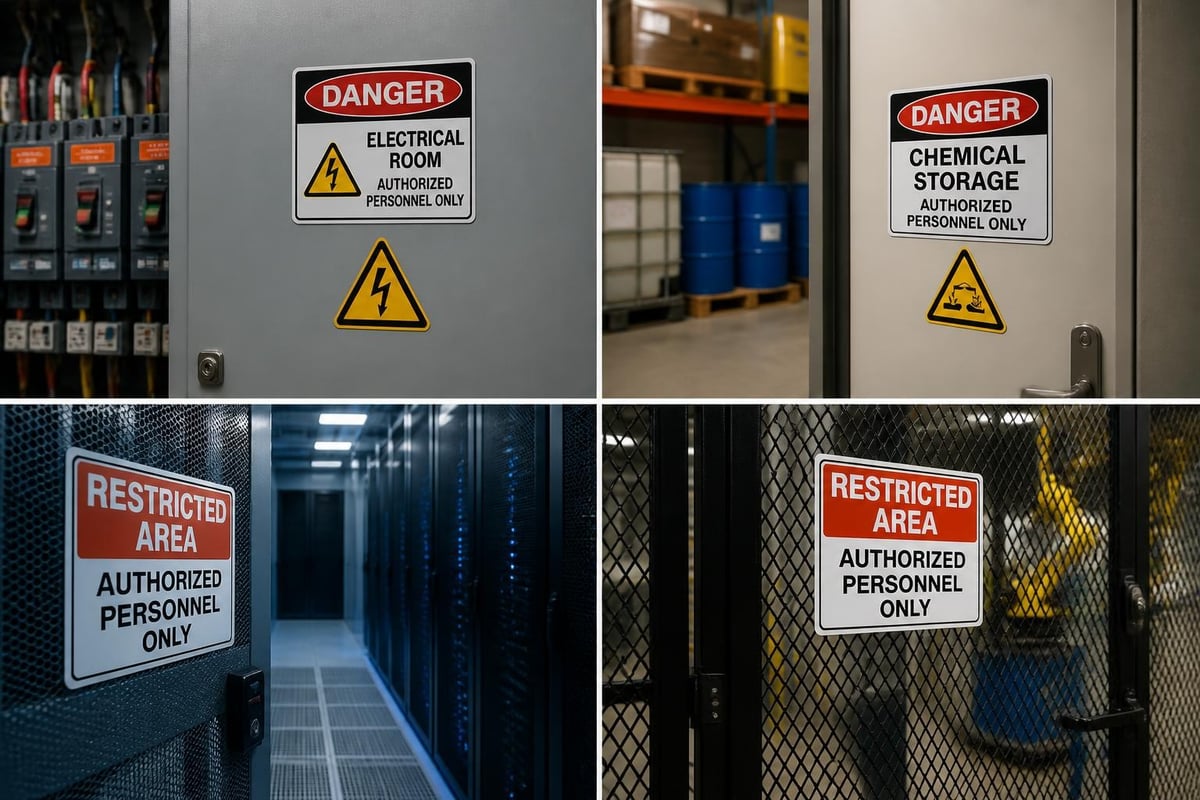
Different sectors adapt basic authorised access signage to meet specialised requirements. Electrical installations, for instance, commonly feature the wording "DANGER – HIGH VOLTAGE – AUTHORIZED PERSONNEL ONLY" with specific colour schemes and positioning requirements, as detailed in university electrical safety programmes.
Chemical facilities might combine the authorised personnel only message with hazard pictograms indicating specific substances. Data centres often add information about environmental controls or electronic device restrictions. Construction sites may include PPE requirements alongside access restrictions.
Regulatory Requirements and Compliance Considerations
Deploying an authorised personnel only sign involves more than simply purchasing and mounting signage. Organisations must consider multiple regulatory frameworks, industry standards, and legal obligations that govern workplace safety communication.
UK Health and Safety Regulations
The Health and Safety (Safety Signs and Signals) Regulations 1996 establish requirements for safety signage throughout British workplaces. These regulations mandate that employers use safety signs where risks cannot be adequately controlled through other means. Prohibition signs, including authorised access restrictions, must conform to specific design standards regarding shape, colour, and symbology.
Key compliance points include:
- Risk assessment documentation: Identifying areas requiring access control
- Sign specification: Ensuring designs meet BS EN ISO 7010 or equivalent standards
- Placement strategy: Positioning signs at all entry points to restricted zones
- Maintenance protocols: Regular inspection and replacement of damaged signage
- Training integration: Ensuring workforce understands sign meanings and consequences
Organisations must remember that signs alone rarely satisfy legal obligations. The authorised personnel only sign works most effectively when integrated with physical access controls, training programmes, and supervision systems.
International Standards and Best Practices
Various international standards inform authorised access signage design and deployment. ANSI Z535 series standards provide comprehensive guidance on safety colour codes, environmental facility signs, and product safety information. ISO 7010 establishes globally recognised safety symbols that transcend language barriers.
Government research on workplace safety symbols highlights ongoing efforts to improve comprehension across diverse populations. These studies emphasise that effective signage combines recognisable symbols with clear text, accommodating both visual and textual processing.
Strategic Placement and Visibility Optimisation
The effectiveness of any authorised personnel only sign depends substantially on proper positioning, ensuring maximum visibility whilst avoiding visual clutter. Strategic placement requires careful consideration of traffic patterns, sight lines, and environmental conditions.
Location Selection Principles
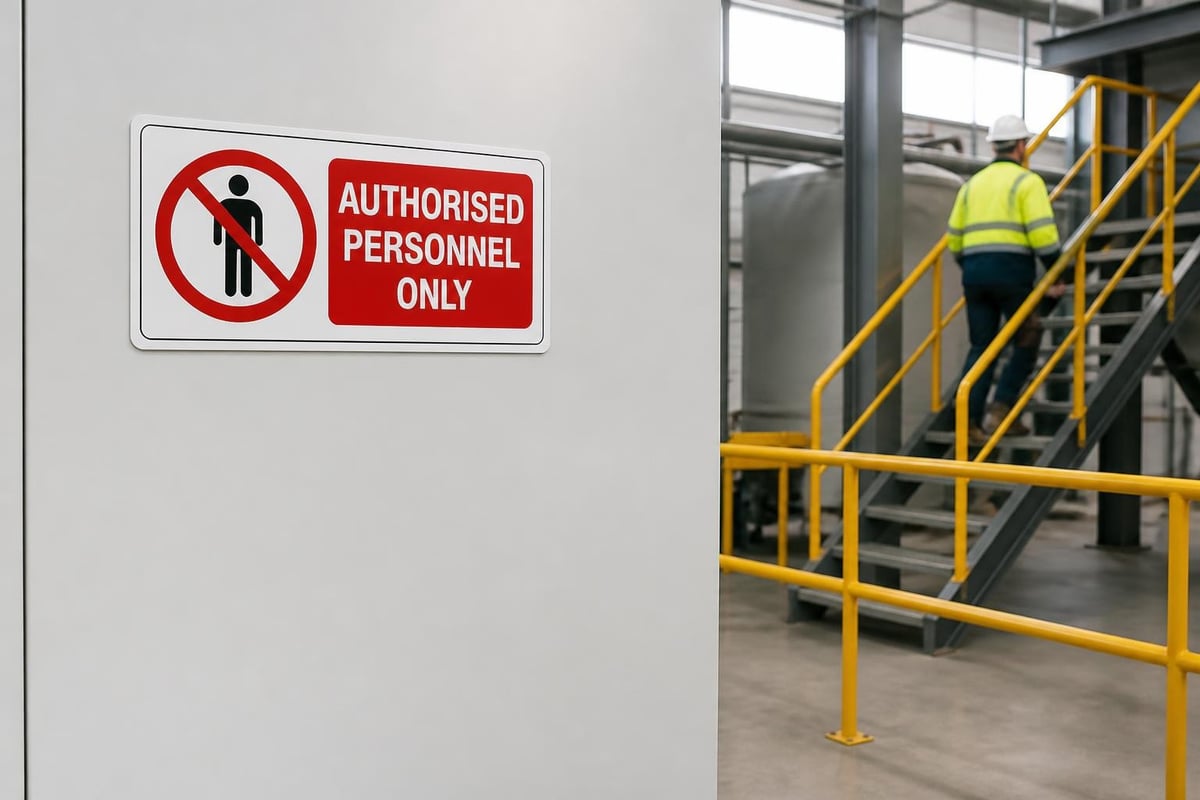
Position access restriction signage at decision points where individuals can observe and respond before entering controlled areas. Mounting signs directly on doors, at corridor intersections, and at pathway entrances provides optimal notification. In large facilities with multiple access routes, ensure every potential entry point features appropriate signage.
Height and viewing angle considerations:
- Mount signs at eye level (approximately 1.5 to 1.8 metres from ground level)
- Ensure unobstructed sight lines from approach paths
- Angle signs perpendicular to primary viewing directions
- Avoid positions where machinery, vehicles, or stored materials could block visibility
Outdoor installations require additional weatherproofing and may benefit from reflective materials or illumination for low-light visibility. The authorised personnel only sign positioned at construction site entrances should withstand rain, sun exposure, and potential impacts from equipment.
Combining Physical and Visual Barriers
Signage achieves maximum effectiveness when paired with complementary access control measures. Physical barriers such as fencing, locked doors, or turnstiles reinforce the message conveyed by authorised access signs. This layered approach addresses both intentional violations and accidental entries by distracted individuals.
Consider implementing:
- Primary signage: Large, prominent signs at main approach routes
- Secondary reminders: Smaller signs at intermediate checkpoints
- Point-of-entry warnings: Signs directly on doors, gates, or barriers
- Floor markings: Painted lines or tape indicating restricted zone boundaries
- Audible warnings: Alarms or announcements for sensitive areas
The combination of an authorised personnel only sign with locked access and surveillance systems creates redundant protection layers appropriate for high-security or high-hazard environments.
Material Selection and Durability Factors
Choosing appropriate materials for authorised personnel only signage directly impacts longevity, visibility, and compliance sustainability. Environmental conditions, cleaning protocols, and exposure to chemicals or extreme temperatures all influence material performance.
Common Sign Materials
| Material | Advantages | Best Applications | Lifespan |
|---|---|---|---|
| Rigid plastic (PVC) | Cost-effective, lightweight, weather-resistant | General indoor/outdoor use | 5-7 years |
| Aluminium | Durable, professional appearance, fire-resistant | Industrial environments | 10-15 years |
| Self-adhesive vinyl | Easy installation, conformable to surfaces | Temporary or smooth surfaces | 2-5 years |
| Dibond/composite | High-end finish, excellent durability | Permanent installations | 15+ years |
| Photoluminescent | Visibility during power failures | Emergency access areas | 10+ years |
Manufacturing facilities with heavy machinery vibration benefit from sturdy aluminium authorised personnel only signs that resist warping. Chemical plants require materials that withstand corrosive atmosphere exposure. Temporary construction projects might justify economical vinyl options.
Environmental Resistance Requirements
Outdoor signage faces particular challenges from weather exposure, UV radiation, and temperature fluctuations. Quality exterior-grade materials prevent fading, cracking, and delamination that compromise both appearance and legibility. Anti-graffiti coatings protect signs in public-facing areas whilst simplifying maintenance.
Indoor environments present distinct challenges. High-humidity areas like swimming pool mechanical rooms or humid industrial processes require moisture-resistant materials. Clean rooms demand signage that tolerates frequent chemical disinfection without degradation.
Customisation Options and Supplementary Information
Whilst standard authorised personnel only signs provide essential access restriction messaging, many situations benefit from customised content that addresses specific hazards, protocols, or organisational requirements. Tailoring signage improves relevance and comprehension amongst target audiences.
Adding Context-Specific Details
Generic access restriction messaging sometimes fails to communicate why restrictions exist or what consequences unauthorised entry might trigger. Enhanced signage incorporates supplementary information:
- Hazard descriptions: "High voltage electrical equipment" or "Toxic chemical storage"
- Required qualifications: "Confined space entry certification required"
- PPE specifications: "Hard hat, safety glasses, and steel-toe boots mandatory"
- Contact information: Emergency numbers or site manager details
- Penalty notices: Disciplinary or legal consequences for violations
This additional context transforms the authorised personnel only sign from a simple prohibition into an educational tool that informs decision-making and reinforces safety culture.
Multi-Language Considerations
Diverse workforces with non-native English speakers benefit from multilingual signage that ensures universal comprehension. Combining English text with additional languages spoken by significant workforce segments demonstrates inclusive safety practices whilst improving compliance rates.
Symbol-based communication offers language-independent alternatives. ISO 7010 symbols provide internationally recognised imagery that communicates restrictions without textual content. Combining symbols with concise text in multiple languages creates maximally accessible signage.
Integration with Access Control Systems
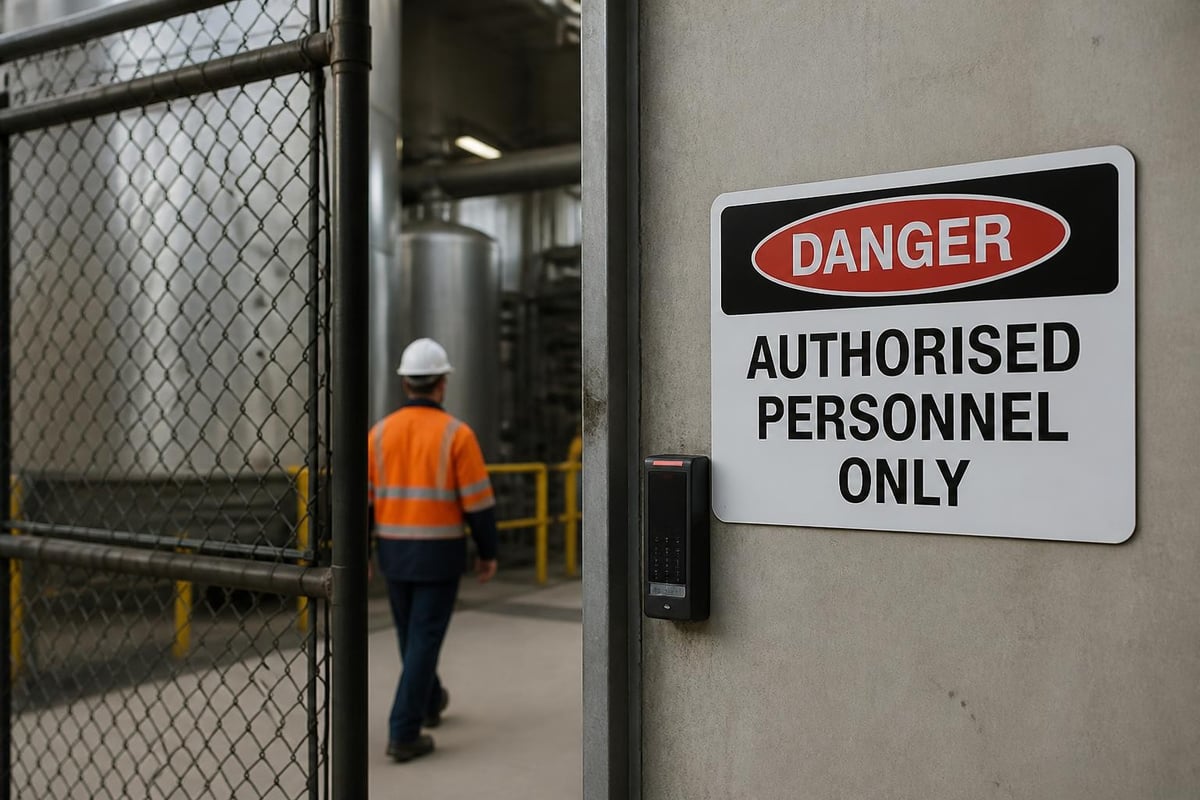
Modern workplace security increasingly relies on electronic access control systems that authenticate individuals before permitting entry. The authorised personnel only sign serves as the visible component of these integrated systems, working alongside electronic credentials and monitoring technology.
Physical and Digital Coordination
Effective access control combines traditional signage with:
- Card readers or biometric scanners: Verifying individual authorisation
- Electronic locks: Preventing unauthorised physical entry
- Surveillance cameras: Recording access attempts and monitoring compliance
- Access logs: Documenting who entered restricted areas and when
- Alarm systems: Alerting security when unauthorised access occurs
The authorised personnel only sign positioned beside card readers clearly indicates that electronic authentication precedes entry. This visible coordination helps visitors and new employees understand access procedures immediately upon approach.
Visitor Management Protocols
Facilities that accommodate visitors, contractors, or temporary workers require clear protocols for escorted access to restricted areas. Signage should indicate whether unescorted visitor entry is absolutely prohibited or whether accompanied access remains permissible under supervision.
Supplementary signs might read "Authorised Personnel Only – Visitors Must Sign In" or "Restricted Area – Escort Required Beyond This Point". These variations provide specific guidance that reduces confusion and improves compliance amongst individuals unfamiliar with facility layouts.
Training and Enforcement Strategies
Signage alone rarely achieves complete access control compliance. Comprehensive training programmes and consistent enforcement mechanisms ensure that authorised personnel only signs function as intended within broader safety management systems.
Workforce Education Components
New employee orientation should explicitly address restricted access areas, explaining:
- Locations of all authorised access zones throughout the facility
- Specific hazards or security concerns justifying restrictions
- Procedures for obtaining necessary authorisation or training
- Consequences for unauthorised entry attempts
- Proper responses when observing violations
Regular refresher training maintains awareness and reinforces the importance of respecting access restrictions. Including the authorised personnel only sign in visual training materials helps employees recognise and respond appropriately to these indicators throughout their daily work.
Consistent Consequence Application
Clear, consistently applied consequences for unauthorised entry violations demonstrate organisational commitment to access control. Progressive discipline policies might begin with verbal warnings for first offences, escalating to written warnings, suspension, and termination for repeated violations.
Effective enforcement requires:
- Documented policies clearly stating consequences
- Fair application across all organisational levels
- Investigation of violations to determine intent and circumstances
- Corrective training when violations result from misunderstanding
- Recognition of consistent compliance in performance evaluations
Maintenance and Replacement Schedules
Even the highest-quality authorised personnel only sign eventually degrades through environmental exposure, physical damage, or simple aging. Systematic inspection and replacement programmes maintain signage effectiveness and regulatory compliance.
Regular Inspection Protocols
Incorporate signage inspection into broader facility maintenance routines. Monthly or quarterly reviews should assess:
- Visibility: Checking for obstructions, fading, or poor lighting
- Physical condition: Identifying cracks, corrosion, or mounting failures
- Message accuracy: Ensuring information remains current and relevant
- Compliance: Verifying continued alignment with regulations and standards
- Positioning: Confirming signs remain properly located after facility changes
Document inspection findings and remedial actions to demonstrate due diligence and maintain compliance records. Photographic evidence proves particularly valuable for tracking condition changes over time.
Proactive Replacement Planning
Rather than waiting for complete sign failure, establish replacement schedules based on material lifespan expectations and observed degradation patterns. Budget for periodic sign refreshment as routine operational expenses rather than unexpected emergency costs.
Consider replacing all authorised personnel only signs simultaneously during facility renovations or when updating broader safety signage systems. This approach ensures visual consistency whilst simplifying procurement and installation logistics.
Effective deployment of authorised personnel only signs requires balancing regulatory compliance, practical visibility, and integration with broader access control systems. By selecting appropriate materials, positioning signs strategically, and supporting physical signage with training and enforcement, organisations create robust restricted access protocols that protect both personnel and assets. SafetySignsForSale provides comprehensive authorised access signage solutions alongside expert guidance on selection, customisation, and compliance requirements, ensuring your facility maintains the highest safety and security standards across all restricted areas.