


Signage Construction Site: Essential Guide for 2026
Effective signage on a construction site serves as the first line of defence against workplace accidents, protecting workers, visitors, and the general public from potential hazards. The strategic deployment of safety signage throughout a construction site requires careful planning, adherence to regulatory standards, and ongoing maintenance to ensure visibility and compliance. Whether you're managing a small residential project or a large-scale commercial development, understanding the complexities of signage construction site requirements is essential for creating a safe working environment whilst meeting legal obligations.
Understanding Regulatory Requirements for Construction Site Signage
Construction site signage must comply with multiple layers of regulation, from international standards to local authority requirements. In the United Kingdom, the Health and Safety Executive provides comprehensive guidance on selecting and positioning safety signs in accordance with the Safety Signs and Signals Regulations 1996. These regulations implement the European directive on minimum requirements for safety signs at work.
Signage construction site compliance extends beyond simply mounting signs on fences. The technical requirements for signboards specify material durability, colour specifications, and placement considerations that directly impact sign effectiveness. Signs must remain legible in various weather conditions, withstand physical wear, and maintain their visibility throughout the project duration.
Key Regulatory Categories
Different types of signage construction site applications fall under distinct regulatory frameworks:
- Temporary traffic control devices must meet highway authority standards
- Workplace safety signs comply with HSE guidance and BS 5499 specifications
- Fire safety signage requires conformity with fire regulations and building codes
- Environmental and hazard warnings need clear communication of specific risks
- Mandatory instruction signs must display required actions using standardised symbols
Understanding which standards apply to each sign category helps procurement teams source compliant products and avoid costly replacements or enforcement notices.
Essential Sign Types for Construction Sites
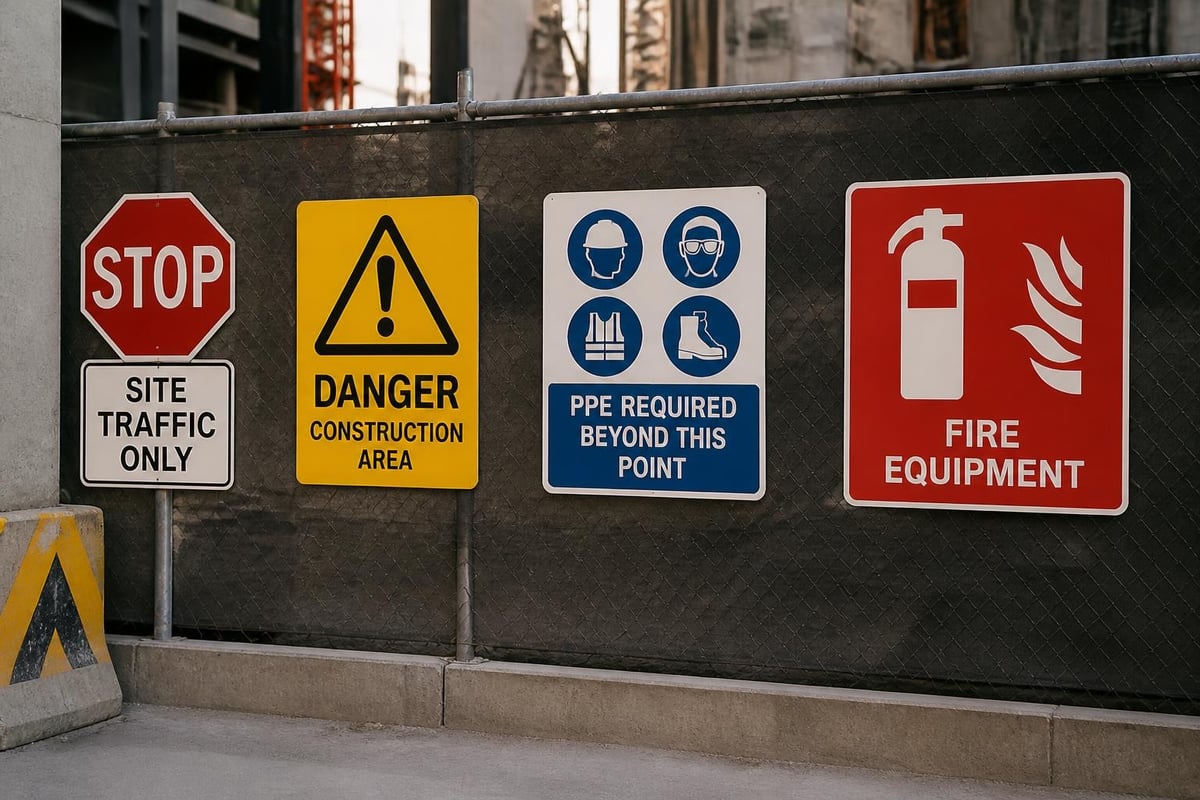
A comprehensive signage construction site programme includes multiple sign categories, each serving distinct safety functions. Warning signs alert workers and visitors to specific hazards such as overhead loads, excavations, or electrical installations. These triangular yellow signs with black borders and symbols provide instant visual recognition of danger zones.
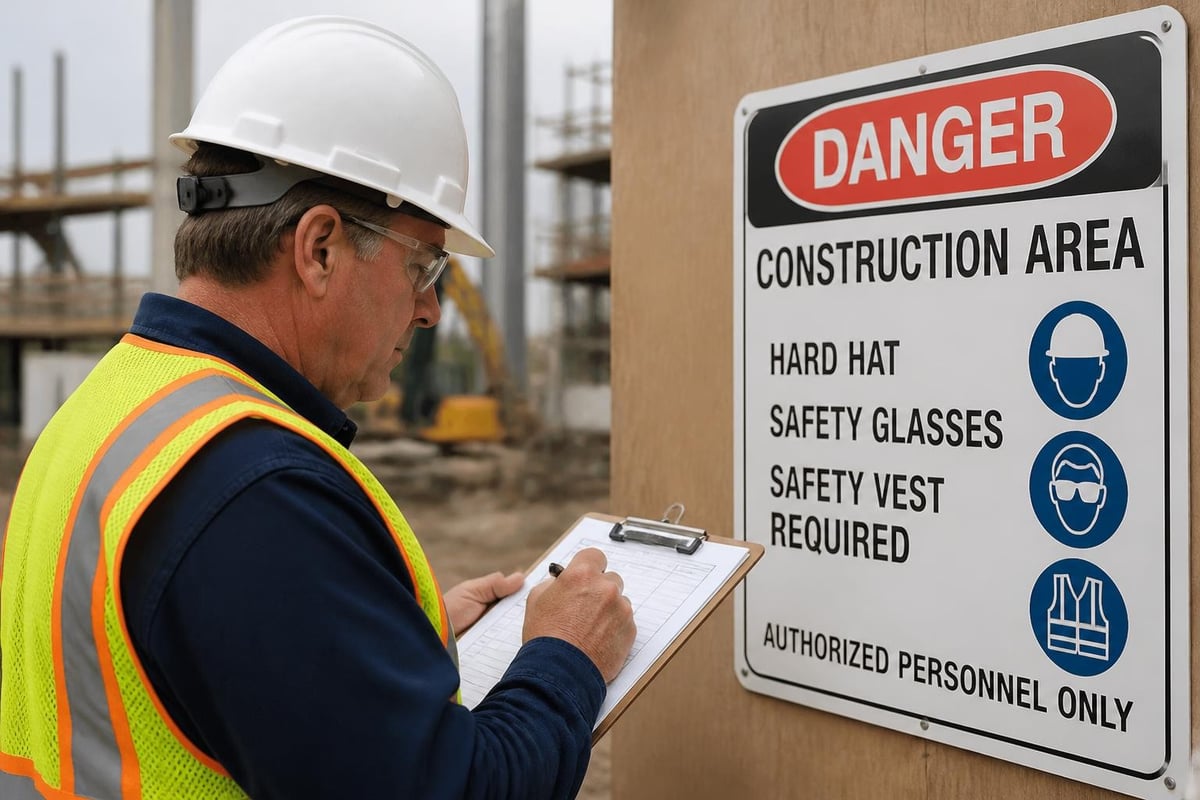
Mandatory signs communicate required actions, typically featuring white symbols on blue circular backgrounds. On construction sites, these include personal protective equipment requirements such as hard hat areas, safety footwear zones, and high-visibility clothing mandates. Proper placement of mandatory signs at access points ensures everyone entering the site understands protective equipment obligations before encountering hazards.
Prohibition and Information Signage
| Sign Type | Purpose | Common Applications | Placement Priority |
|---|---|---|---|
| Prohibition | Prevent dangerous actions | No smoking, no unauthorised access, no mobile phones | Entry points, restricted zones |
| Information | Provide guidance | First aid locations, assembly points, site offices | Strategic navigation points |
| Fire Fighting | Indicate equipment locations | Extinguishers, hose reels, emergency exits | Throughout site per fire plan |
| Directional | Guide movement | Pedestrian routes, vehicle routes, emergency exits | Route intersections, decision points |
Prohibition signage uses red circular borders with diagonal lines to clearly communicate forbidden activities. On construction sites, these prevent smoking near flammable materials, restrict unauthorised access to dangerous areas, and prohibit mobile phone use near sensitive operations. Prohibitory signs must be positioned where the prohibited action is most likely to occur.
Fire safety signage construction site requirements demand particular attention due to the elevated fire risks associated with construction activities. Fire fighting signs must clearly indicate the location of extinguishers, emergency equipment, and evacuation routes, with consideration for potential obstructions as the site develops.
Temporary Traffic Control Signage
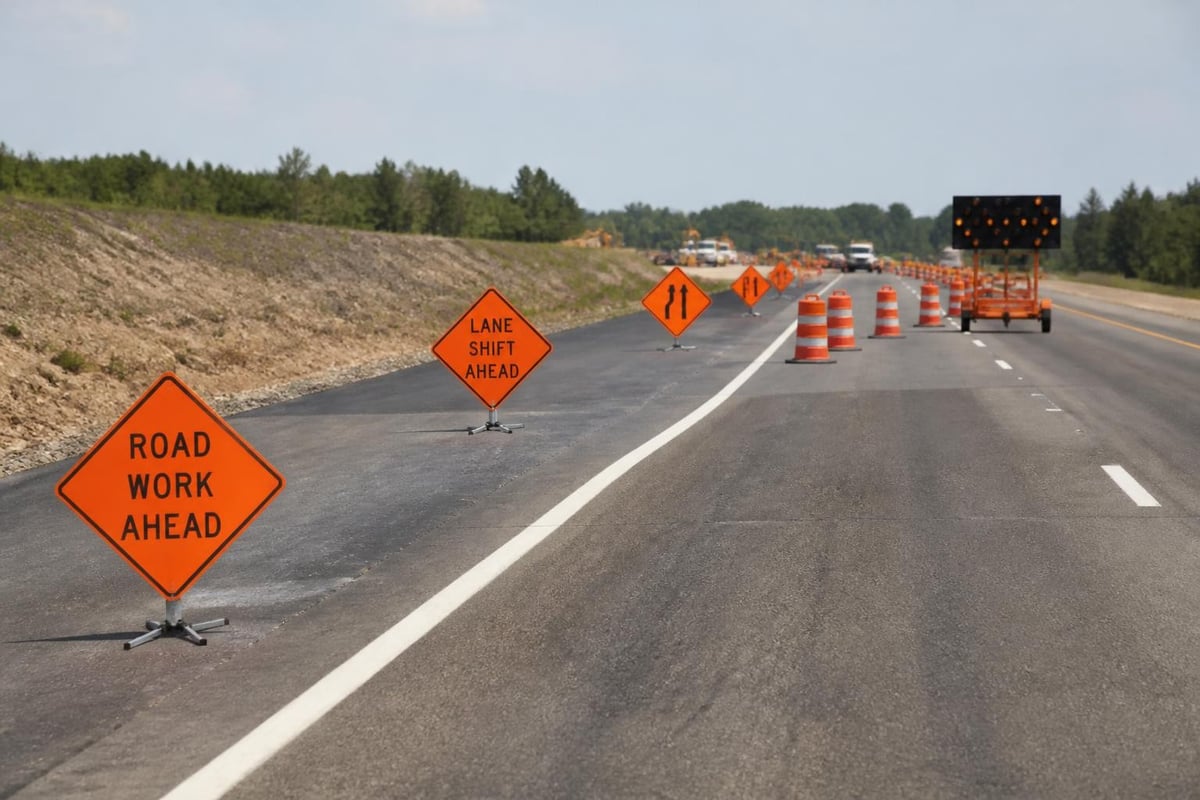
Construction sites interfacing with public roads or highways require robust temporary traffic control measures. In the United States, the Manual on Uniform Traffic Control Devices provides detailed specifications for work zone signage, including size requirements, mounting heights, and retroreflectivity standards that ensure visibility during night-time operations.
Work zone signage construction site deployment follows a sequential pattern: advance warning signs alert approaching traffic, transition signs guide drivers around the work area, and activity signs protect the immediate work space. Each sign must be positioned at prescribed distances based on road speed limits and sight-line calculations.
Traffic Control Sign Selection Criteria
Choosing appropriate traffic control signage requires assessment of multiple factors:
- Road classification and traffic volume
- Posted speed limits and typical traffic speeds
- Work zone duration (short-term, intermediate, or long-term)
- Daylight versus night-time operations
- Weather exposure and environmental conditions
The Federal Highway Administration's work zone resources offer detailed guidance on implementing traffic control plans that protect both workers and road users. These publications include case studies demonstrating effective signage construction site strategies across different project types.
State-level authorities often supplement federal guidance with region-specific requirements. For example, Caltrans provides comprehensive work zone guidance addressing California's unique traffic patterns and environmental conditions, whilst Washington State DOT offers detailed technical specifications for temporary traffic control implementation.
Material Selection and Durability Considerations
Signage construction site effectiveness depends heavily on material quality and environmental resistance. Outdoor construction signs must withstand temperature fluctuations, precipitation, wind loading, and ultraviolet degradation whilst maintaining legibility throughout the project duration. Material selection directly impacts both initial costs and lifecycle expenses.
Aluminium composite panels offer excellent durability for permanent and semi-permanent installations. These lightweight materials resist corrosion, maintain dimensional stability, and accept high-quality graphics that remain vibrant for extended periods. For shorter-duration projects, corrugated plastic sheets provide cost-effective solutions with adequate weather resistance.
Reflectivity and Visibility Standards
Construction sites operating during darkness or low-visibility conditions require retroreflective signage that remains visible when illuminated by vehicle headlights. Research on traffic sign condition assessment explores measurement techniques for evaluating both daytime colour contrast and night-time retroreflectivity performance.
Retroreflective sheeting classifications range from engineering grade (suitable for low-speed environments) to diamond grade (required for high-speed motorways). Signage construction site applications typically specify engineer grade or high-intensity sheeting, balancing visibility requirements against budget constraints.
| Material Type | Typical Lifespan | Weather Resistance | Cost Factor | Best Applications |
|---|---|---|---|---|
| Aluminium composite | 7-10 years | Excellent | High | Permanent site signage |
| Corrugated plastic | 1-3 years | Good | Low | Temporary project signs |
| Vinyl on dibond | 5-7 years | Very good | Medium-high | Semi-permanent installations |
| Self-adhesive vinyl | 3-5 years | Moderate | Low-medium | Indoor and protected locations |
Photoluminescent signs serve specific applications where electrical power supply is unavailable or unreliable. These signs absorb ambient light and glow in darkness, providing emergency egress guidance without requiring battery backup or electrical connections.
Strategic Placement and Mounting Systems
Effective signage construction site deployment requires strategic positioning that ensures maximum visibility whilst avoiding obstruction as work progresses. Signs must be mounted at appropriate heights-typically between 1.5 and 2.0 metres for pedestrian viewing-and oriented perpendicular to the primary viewing direction to maximise legibility.
Mounting systems must withstand site conditions without creating additional hazards. Temporary fencing provides convenient mounting points for perimeter signage, whilst free-standing posts or A-frame supports suit locations lacking fixed structures. All mounting hardware must be secure enough to prevent wind displacement yet allow for repositioning as site conditions evolve.
Zone-Based Signage Planning
Dividing construction sites into distinct safety zones helps ensure comprehensive signage coverage:
- Perimeter zone: Unauthorised access warnings, project information, contractor details
- Access control points: Mandatory PPE requirements, visitor reporting procedures, induction reminders
- Active work areas: Specific hazard warnings, lifting operations notices, confined space alerts
- Circulation routes: Pedestrian pathways, vehicle routes, speed limits, one-way systems
- Welfare facilities: First aid locations, assembly points, emergency contact information
This structured approach prevents both over-signage (which reduces individual sign impact) and dangerous gaps in hazard communication. Regular site walkthroughs verify that signage remains appropriate as construction activities progress through different phases.
Maintenance and Inspection Protocols
Signage construction site effectiveness deteriorates without regular maintenance. Wind, rain, dust, and construction debris progressively reduce sign visibility, whilst physical damage from materials handling or vehicle contact may render signs completely illegible. Establishing formal inspection schedules prevents gradual degradation from compromising safety communications.
Weekly inspections should verify that all signs remain:
- Securely mounted and properly oriented
- Free from obstruction by materials, equipment, or vegetation
- Legible with clean surfaces and intact graphics
- Positioned appropriately for current site activities
- Compliant with updated regulatory requirements
Damaged or deteriorated signs require immediate replacement rather than temporary repair. A faded warning sign or partially obscured mandatory instruction fails its fundamental purpose and may contribute to incidents. Maintaining an inventory of replacement signs enables rapid response to damage or vandalism.
Integration with Site Safety Management Systems
Modern signage construction site programmes integrate with broader safety management approaches, complementing toolbox talks, safety inductions, and hazard assessments. Signs reinforce verbal communications and provide continuous reminders of safety requirements, particularly valuable in multi-contractor environments where workforce composition changes frequently.
Digital safety management platforms increasingly include signage auditing features, allowing safety officers to photograph signs during inspections, tag locations using GPS coordinates, and track maintenance histories. This documentation proves valuable during safety audits and provides evidence of due diligence in regulatory compliance.
Coordination with Personal Protective Equipment Requirements
Site signage must align with PPE policies to avoid confusion and ensure workers understand protection requirements. Personal protective equipment specifications should match the hazards indicated by warning signage, creating clear cause-and-effect relationships between identified dangers and required controls.
For example, areas marked with hearing protection mandatory signs should correspond to noise assessments identifying hazardous exposure levels, whilst respiratory protection zones need clear demarcation matching air quality monitoring results. This coherence between signage, hazard assessment, and protective equipment reinforces safety culture.
Specialised Signage for Specific Construction Hazards
Different construction activities generate unique hazards requiring specialised signage construction site solutions. Excavation work demands clear marking of open trenches, underground services, and exclusion zones around mechanical plant. Lifting operations need warning signs indicating overhead hazards, load suspension areas, and exclusion radii around mobile cranes.
Working at height introduces requirements for fall hazard warnings, safety harness zones, and fragile roof indicators. Electrical installations require voltage warnings, isolation point identification, and danger notices on distribution equipment. Each hazard category benefits from standardised signage that workers across different sites recognise immediately.
Chemical hazards on construction sites require COSHH-compliant labelling integrated with site signage systems. Storage areas for flammable liquids, corrosive substances, or toxic materials need clear marking using appropriate hazard symbols and emergency response information. Coordinating these product-specific warnings with general site signage prevents information overload whilst ensuring critical safety data remains accessible.
Confined Space Entry Signage
Confined spaces on construction sites-including tanks, excavations, sewers, and plant rooms-require specific entry control signage:
- Confined space identification notices
- Entry permit requirements
- Atmospheric testing mandates
- Emergency rescue procedures
- Authorised personnel restrictions
These signs prevent unauthorised entry whilst ensuring trained personnel understand entry protocols and associated hazards. First aid equipment locations near confined space operations should be clearly indicated to facilitate rapid emergency response.
Multilingual and Pictorial Communication
Construction sites employing multilingual workforces benefit from pictorial signage construction site systems that transcend language barriers. International safety symbols, standardised through ISO 7010 and similar frameworks, provide universally recognisable hazard communication. The ANSI Z535 standards specify safety sign formats and symbol usage that ensure consistent interpretation regardless of linguistic background.
Combining pictograms with text in multiple languages accommodates diverse workforces whilst maintaining design clarity. However, excessive text reduces legibility and slows comprehension, particularly in emergency situations. Priority should be given to clear, simple graphics supplemented by concise text in languages most relevant to the workforce demographic.
Digital and Dynamic Signage Solutions
Whilst traditional static signage construction site applications remain predominant, digital display technologies offer advantages for specific applications. Variable message signs at site entrances can display real-time safety statistics, changing hazard alerts, or daily safety priorities. LED matrix boards provide high visibility for speed limit enforcement in active construction zones interfacing with public traffic.
Battery-powered digital signs eliminate electrical installation requirements, making them suitable for remote locations or temporary installations. Solar panels extend operational duration, reducing maintenance requirements. However, digital solutions introduce considerations around weather protection, vandalism resistance, and backup systems to prevent display failures during critical periods.
Cost-Benefit Analysis of Quality Signage Investment
Budget-conscious project managers sometimes view signage construction site expenditure as discretionary rather than essential. However, comprehensive analysis reveals that quality signage represents cost-effective risk mitigation. The direct costs of workplace incidents-including production delays, investigation requirements, and potential enforcement action-far exceed signage investment.
Insurance implications also favour robust signage programmes. Demonstrable compliance with safety signage requirements may reduce premium costs or influence claim outcomes following incidents. Documentation of signage specifications, installation records, and maintenance schedules provides valuable evidence of safety culture during regulatory inspections or legal proceedings.
| Investment Area | Initial Cost | Lifecycle Benefit | Risk Mitigation Value |
|---|---|---|---|
| Quality materials | Higher | Extended replacement intervals | Maintained visibility |
| Professional installation | Moderate | Proper positioning and security | Regulatory compliance |
| Regular maintenance | Ongoing | Sustained effectiveness | Incident prevention |
| Documentation systems | Low-moderate | Audit trail and compliance evidence | Legal protection |
Seasonal and Environmental Adaptations
Signage construction site effectiveness varies with seasonal conditions. Winter operations may require enhanced retroreflectivity to compensate for reduced daylight hours, whilst summer conditions can accelerate UV degradation of graphics and substrate materials. Projects spanning multiple seasons benefit from periodic signage reviews ensuring continued appropriateness.
Extreme weather events-high winds, heavy snow, or intense rainfall-may necessitate temporary signage adjustments or reinforcement. Monitoring weather forecasts enables proactive measures such as additional mounting security or temporary removal of lightweight signs vulnerable to wind damage. Post-storm inspections verify that signage remains intact and properly positioned.
Dust and debris generated by construction activities progressively obscure signage surfaces. High-traffic vehicle routes generate particular challenges, with fine particles settling on vertical surfaces and reducing contrast. Regular cleaning schedules using appropriate methods (avoiding abrasive materials that damage graphics) maintain legibility throughout the project lifecycle.
Training and Workforce Awareness
Even perfectly designed and positioned signage construction site systems fail if workers don't understand their meanings or habitually ignore them. Site inductions must include comprehensive signage familiarisation, explaining the significance of different sign types, colours, and symbols. Interactive training approaches-asking workers to identify and interpret signs during site tours-improve retention compared to passive presentations.
Reinforcement through toolbox talks and safety briefings maintains awareness. Discussing recent incidents involving signage (whether near-misses or actual events) demonstrates real-world consequences and reinforces the importance of heeding safety communications. Creating a culture where workers actively look for and respond to signage transforms signs from passive elements into active safety tools.
Contractor and Visitor Management
Temporary workers, subcontractors, and site visitors present particular challenges for signage construction site effectiveness. These individuals may lack familiarity with site-specific layouts or have limited exposure to construction safety protocols. Enhanced signage at entry points-including site rules, emergency procedures, and key contact information-provides essential orientation for short-duration visitors.
Visitor escort procedures should include signage awareness, with escorts drawing attention to relevant warnings and mandatory requirements encountered during site tours. Documentation of visitor briefings creates accountability and demonstrates duty of care compliance.
Emerging Technologies and Future Developments
Construction industry digitalisation increasingly influences signage construction site approaches. Augmented reality applications overlaying digital safety information on physical environments offer potential for enhanced hazard communication, whilst IoT-enabled sensors could trigger dynamic signage responses to changing conditions such as detected gas leaks or structural movements.
QR codes on physical signs provide links to detailed safety information, equipment operating instructions, or emergency procedures accessible via smartphone. This hybrid approach maintains immediate visual communication through traditional signage whilst offering depth of information impractical for physical signs. However, reliance on personal devices creates potential gaps for workers without smartphones or in areas lacking mobile coverage.
Building Information Modelling (BIM) integration enables signage planning during design phases, with virtual walkthroughs identifying optimal sign positions before construction commences. This proactive approach prevents afterthought installations and ensures comprehensive coverage from project outset. As-built models incorporating actual signage locations provide valuable documentation for facility handover and future maintenance.
Implementing comprehensive signage construction site programmes requires balancing regulatory compliance, practical effectiveness, and budget constraints whilst maintaining focus on the fundamental objective: protecting everyone who enters the construction environment. Whether you're equipping a new development or upgrading existing site safety measures, SafetySignsForSale offers an extensive range of compliant safety signage, PPE, and safety equipment designed to meet the demanding requirements of construction environments. Our products combine durability with clarity, ensuring your safety communications remain effective throughout your project duration whilst meeting all relevant regulatory standards.