


Warning Signs: Essential Guide for Workplace Safety 2026
Warning signs serve as the first line of defence in preventing accidents, injuries, and potentially fatal incidents across workplaces, roads, and public spaces. These vital communication tools transcend language barriers, delivering critical safety information through standardised symbols, colours, and text that alert people to hazards before they encounter them. Understanding the different types of warning signs, their applications, and the specific indicators they communicate is essential for maintaining compliance with health and safety regulations whilst creating genuinely protective environments for employees, visitors, and the public.
The Fundamental Categories of Safety Warning Signs
Warning signs encompass several distinct categories, each designed to address specific types of hazards and risks. The classification system helps ensure that individuals can quickly identify the nature and severity of potential dangers in their environment.
Physical Hazard Warnings
Physical hazard warning signs alert people to immediate dangers such as falling objects, low clearances, uneven surfaces, or sharp edges. These signs typically feature a yellow background with black text and symbols, following international standards that make them instantly recognisable regardless of location.
Common physical hazard warnings include:
- Overhead hazards indicating low beams, hanging equipment, or crane operations
- Slipping hazards marking wet floors, icy surfaces, or oil spills
- Tripping hazards identifying uneven ground, cables, or protruding objects
- Crushing hazards near heavy machinery, hydraulic equipment, or moving parts
- Sharp object warnings in areas with exposed blades, metal edges, or broken materials
The effectiveness of these warning signs depends heavily on their placement. Positioning them at eye level and at decision points where people can still take preventative action maximises their protective value.
Chemical and Environmental Warnings
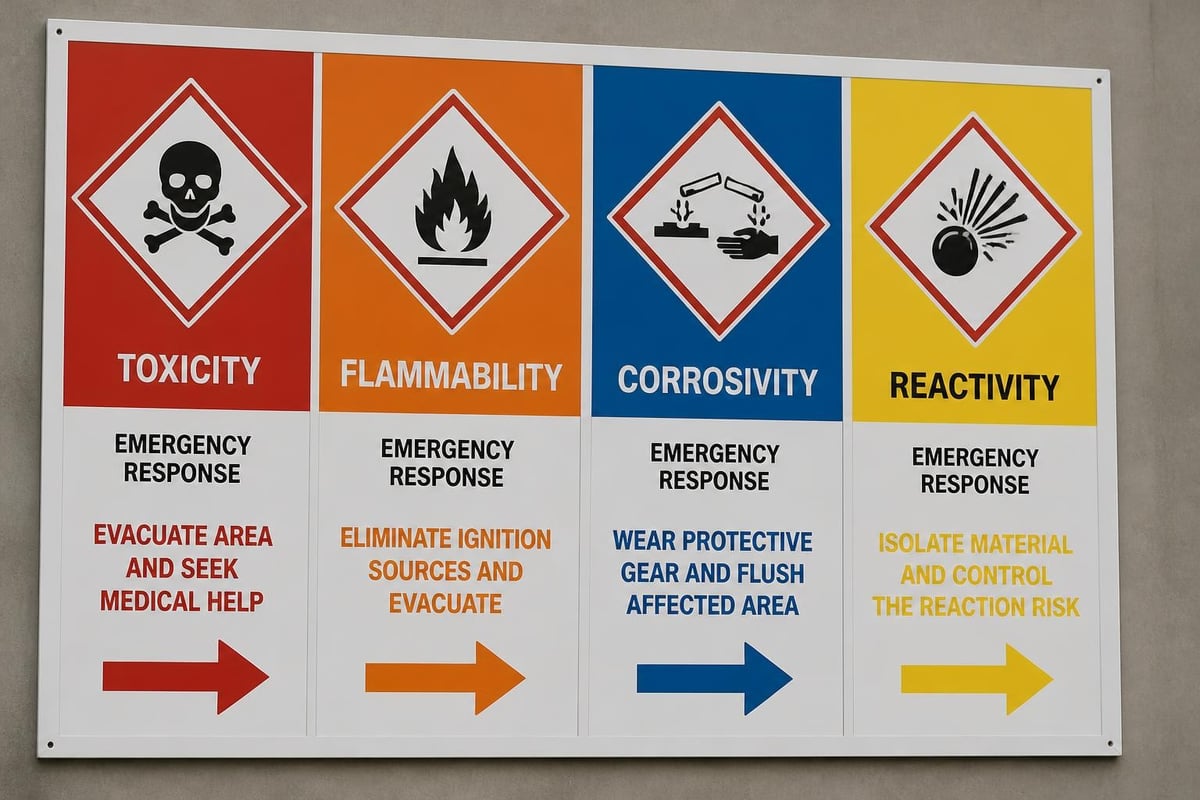
Chemical warning signs communicate the presence of hazardous substances, extreme temperatures, or dangerous atmospheric conditions. These warnings require immediate recognition because exposure can cause serious injury or death within seconds or minutes.
| Hazard Type | Standard Colour | Common Symbols | Required Information |
|---|---|---|---|
| Toxic chemicals | Yellow/Black | Skull & crossbones | Substance name, protective equipment |
| Flammable materials | Yellow/Black | Flame symbol | Flash point, storage requirements |
| Corrosive substances | Yellow/Black | Liquid on hand/surface | pH level, emergency procedures |
| Extreme temperature | Yellow/Black | Thermometer | Temperature range, contact hazards |
Environmental warning signs extend beyond chemical hazards to include radiation, biological hazards, confined spaces, and areas with oxygen deficiency. Each requires specific signage that complies with regulatory standards whilst providing actionable information for safe navigation.
Traffic and Road Warning Signs in the Modern Context
The Manual on Uniform Traffic Control Devices establishes the standards for all traffic control devices installed on public roads, streets, and highways throughout the United States. Warning signs in this context serve to alert drivers to unexpected conditions or hazards ahead.
Recent Updates to Traffic Warning Standards
The FHWA's phased release of 11th Edition sign specifications introduced significant updates to warning sign design and implementation in March 2025. These changes reflect evolving traffic patterns, new vehicle technologies, and improved understanding of driver behaviour and perception.
Traffic warning signs operate on a simple principle: provide advance notice of conditions requiring speed reduction, directional changes, or heightened attention. The standardised diamond shape immediately signals "caution" to drivers, even before they process the specific symbol or message.
Key traffic warning categories include:
- Alignment warnings for curves, turns, and changes in road direction
- Intersection warnings alerting to crossroads, merges, and traffic signals ahead
- Advance warnings for stop signs, yield conditions, and right-of-way changes
- Roadway condition warnings indicating narrow bridges, uneven pavement, or surface hazards
- Pedestrian and bicycle warnings marking crossing zones and shared-use areas
The effectiveness of traffic warning signs depends on visibility distance, message clarity, and driver comprehension time. Placement calculations account for typical travel speeds and required stopping distances.
Workplace Equipment and Machinery Warnings
Industrial environments present unique hazards requiring specialised warning signs that address machine-specific risks. These warnings must communicate the nature of the danger, the severity of potential injury, and any required precautions.
Machinery Hazard Communication
Equipment warning signs follow a hierarchical approach that distinguishes between different risk levels: Where a hazard also requires protective gear, our guide to PPE signs explains how to mark the equipment that must be worn.
- DANGER signs indicate imminent hazards likely to cause death or serious injury
- WARNING signs alert to potential hazards that could cause death or serious injury
- CAUTION signs identify hazards that may cause minor or moderate injury
This three-tier system ensures that workers can quickly assess risk levels and respond appropriately. The signs must remain visible during operation and maintenance, positioned where they're most likely to be seen before someone enters the hazard zone.
Modern machinery warnings increasingly incorporate pictograms that transcend language barriers. These visual representations show specific actions to avoid (reaching into moving parts, wearing loose clothing) and required protective equipment (hearing protection, safety glasses, steel-toed boots).
Electrical and Energy Source Warnings
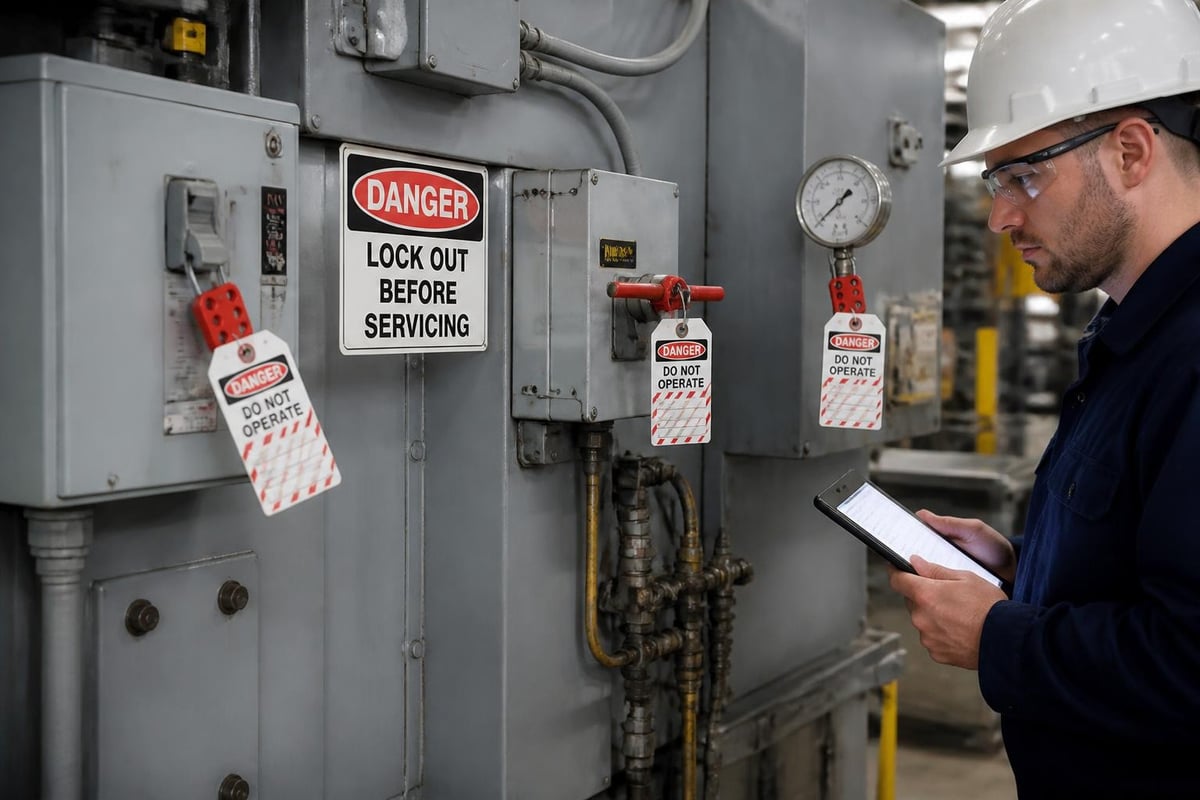
Electrical hazards represent a significant category within workplace warning signs. High voltage warnings, arc flash boundaries, and lockout/tagout notifications protect workers from electrocution, burns, and blast injuries.
Electrical warning signs must specify:
- Voltage levels and energy sources
- Required standoff distances
- Personal protective equipment ratings
- Authorised personnel restrictions
- Emergency shutdown procedures
Energy isolation warnings extend beyond electrical systems to include pneumatic, hydraulic, mechanical, thermal, and stored energy sources. Comprehensive warning programmes address all potential energy releases during maintenance and servicing operations.
Digital Security and Cybersecurity Warning Signs
The concept of warning signs extends into the digital realm, where indicators of potential security threats require recognition and response just as physical hazards do. Understanding these digital warning signs has become essential for protecting organisational assets and personal information.
Identifying Phishing and Social Engineering Indicators
The CISA phishing guidance materials outline critical warning signs that help individuals identify suspicious communications and potential security threats. These digital warning signs parallel physical safety signs in their protective function.
Common phishing warning signs include:
- Unexpected urgency creating artificial time pressure for immediate action
- Sender address anomalies with slight misspellings or unfamiliar domains
- Generic greetings lacking personalisation or specific account details
- Suspicious links where hover-over URLs don't match displayed text
- Attachment warnings unexpected files, especially executable formats
- Request for credentials asking for passwords, PINs, or security questions
Organisations should implement visual indicators and system warnings that alert users to potentially dangerous actions. Browser warnings, email filtering tags, and authentication prompts all serve as digital equivalents to physical warning signs.
Network and System Security Indicators
Beyond phishing attempts, numerous technical warning signs indicate potential security compromises or system vulnerabilities:
| Warning Type | Indicators | Recommended Response |
|---|---|---|
| System performance | Unexplained slowdowns, crashes, pop-ups | Malware scan, system review |
| Account activity | Unknown logins, changed settings, sent items | Password change, security audit |
| Network behaviour | Unusual traffic, unauthorised connections | Network analysis, access review |
| File system changes | Modified permissions, new executables | File integrity check, restore from backup |
Training staff to recognise these digital warning signs creates a human firewall that complements technical security measures. Regular awareness programmes and simulated phishing exercises reinforce recognition skills.
Health and Medical Warning Signs
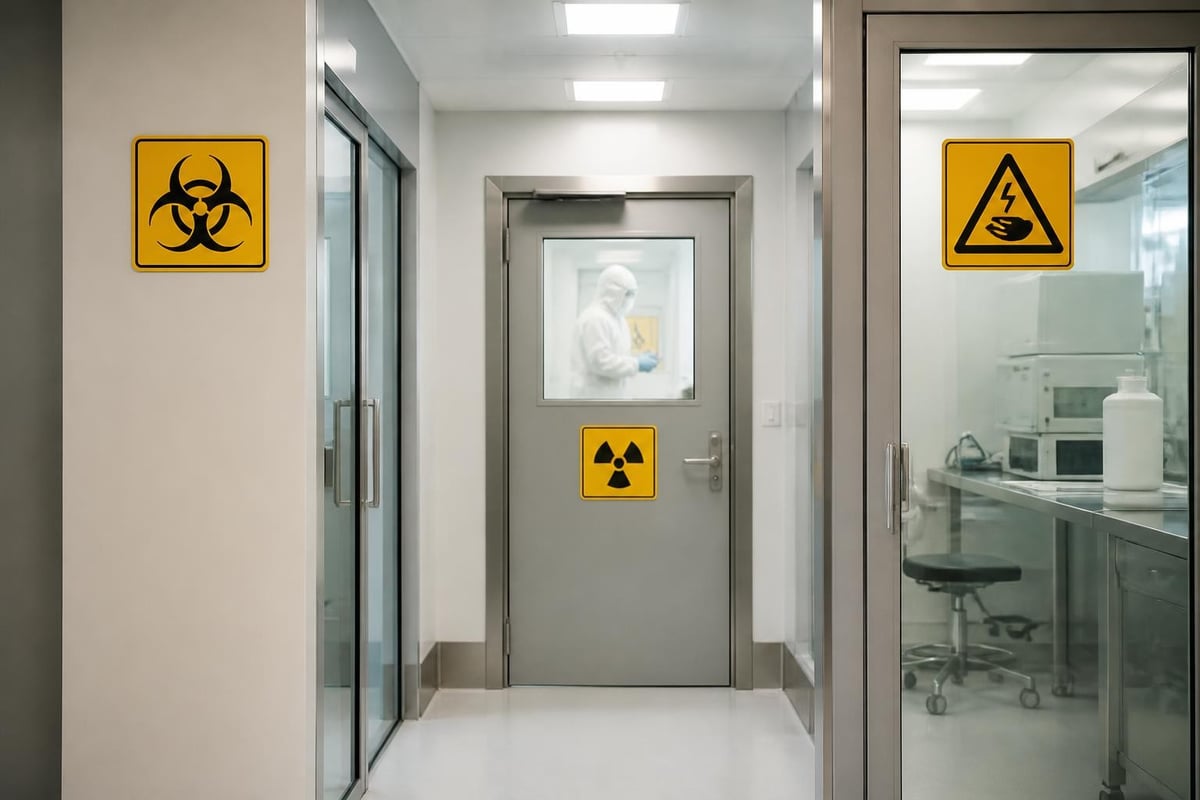
Healthcare facilities, laboratories, and first aid stations require specialised warning signs that communicate biological hazards, radiation risks, and medical equipment dangers. These signs protect both healthcare workers and patients from exposure to infectious agents and harmful substances.
Biohazard and Infection Control Warnings
Biohazard warning signs indicate the presence of biological agents that pose threats to human health. The distinctive trefoil symbol in fluorescent orange or red communicates universal danger regardless of language proficiency.
Biohazard warnings must specify:
- Containment level (BSL-1 through BSL-4)
- Agent type (bacterial, viral, fungal, prion)
- Transmission route (airborne, contact, bloodborne)
- Required precautions (PPE, decontamination procedures)
- Emergency contacts for exposure incidents
Medical facilities layer multiple warning systems to create redundancy and ensure that hazards are recognised at every access point. Colour-coded zones, barrier warnings, and posted protocols work together to prevent unauthorised access and accidental exposure.
Radiation and Imaging Equipment Warnings
Radiation warning signs protect against ionising radiation exposure from medical imaging equipment, cancer treatment devices, and diagnostic tools. The magenta trefoil on yellow background provides instant recognition of radiation hazards.
These warnings communicate exposure risks through specific terminology:
- Radiation Area indicates detectable radiation levels
- High Radiation Area marks zones exceeding specified dose rates
- Very High Radiation Area designates areas with extreme exposure risk
- Airborne Radioactivity Area warns of potential inhalation hazards
Magnetic resonance imaging (MRI) facilities require unique warning signs addressing powerful magnetic fields that can turn ferromagnetic objects into dangerous projectiles. These warnings must clearly communicate exclusion zones for individuals with pacemakers, implants, and any metal objects.
Construction and Temporary Hazard Warnings
Construction sites present constantly changing hazard profiles requiring flexible warning systems that adapt to evolving conditions. Temporary warning signs must be as effective as permanent installations whilst accommodating site modifications and progress.
Site-Specific Hazard Communication
Construction warning signs address hazards unique to building, demolition, excavation, and infrastructure work:
- Excavation warnings marking trenches, pits, and underground work
- Overhead work alerts identifying crane operations, material lifts, and scaffolding
- Demolition hazards warning of structural instability, falling debris, and controlled explosions
- Heavy equipment zones designating areas with active machinery and vehicle traffic
- Confined space entry marking tanks, silos, manholes, and restricted access points
The temporary nature of construction hazards requires daily hazard assessments and corresponding signage updates. What's safe today may present life-threatening risks tomorrow as work progresses and site conditions change.
Public Protection in Construction Zones
Construction activities that affect public spaces or roadways require warning signs that communicate hazards to people unfamiliar with the site. Pedestrian walkway warnings, traffic pattern changes, and noise/dust advisories help protect the public whilst work continues.
Effective construction warning programmes integrate multiple sign types:
- Advance warning signs alerting to upcoming construction zones
- Regulatory signs establishing speed limits and access restrictions
- Channelising devices guiding traffic and pedestrian flow
- Informational signs explaining work scope and duration
- Hazard-specific warnings addressing site-specific dangers
Environmental and Natural Hazard Warnings
Warning signs for environmental hazards protect people from natural dangers including wildlife, geological instabilities, weather conditions, and terrain characteristics. These signs prove particularly important in remote locations where emergency response times may be extended.
Wildlife and Natural Threat Indicators
Areas with dangerous wildlife require warning signs that specify the threat type, risk level, and recommended precautions. Bear warnings in wilderness areas, snake caution signs in desert regions, and crocodile alerts near waterways all serve protective functions.
Environmental warning signs address diverse natural hazards:
| Hazard Category | Specific Warnings | Safety Information |
|---|---|---|
| Geological | Rockfall zones, unstable cliffs, earthquake areas | Safe distances, evacuation routes |
| Weather | Lightning risk, flash flood zones, avalanche paths | Shelter locations, seasonal timing |
| Water | Rip currents, undertows, submerged hazards | Safe swimming areas, depth markers |
| Terrain | Steep grades, loose surfaces, hidden drops | Alternative routes, required equipment |
These warnings often include seasonal variations, as hazard severity changes throughout the year. Ice warnings become critical in winter months, whilst wildfire risk signs gain importance during dry seasons.
Fire Safety and Emergency Warning Systems
Fire warning signs constitute a critical category of safety signage, communicating both fire hazards and emergency response information. These signs must remain visible under normal conditions and during smoke-filled emergencies.
Fire Hazard Classification Warnings
Different materials and processes present varying fire risks requiring specific warning approaches. Flammable liquid storage, combustible dust areas, oxidising agent locations, and high fire load zones all demand appropriate signage.
Fire warning signs specify:
- Fire class (A, B, C, D, K) indicating fuel type
- Storage requirements for flammable materials
- Ignition source prohibitions (no smoking, no open flames, no spark-producing equipment)
- Suppression system types and activation methods
- Evacuation routes from high-hazard areas
Modern fire warning systems integrate with building automation, using illuminated signs that activate during emergencies and guide people toward safe exits even when power fails.
Emergency Equipment and Exit Indicators
Warning signs that mark emergency equipment locations serve dual purposes: preventing obstruction and ensuring rapid access during critical situations. Fire extinguisher signs, emergency shower markers, eyewash station indicators, and emergency exit signs all fall into this category.
These signs must comply with photoluminescent requirements ensuring visibility during power outages. The glow-in-the-dark materials absorb ambient light and emit visible illumination for extended periods, guiding people to safety when normal lighting fails.
Implementing Effective Warning Sign Programmes
Creating comprehensive warning sign systems requires systematic assessment, strategic placement, regular maintenance, and ongoing training. Organisations must treat warning signs as active safety controls rather than passive decorations.
Risk Assessment and Sign Selection
Effective warning programmes begin with thorough hazard identification. This process examines every work area, activity, and process to identify potential dangers requiring communication through signage.
The assessment should answer key questions:
- What hazards exist in this location?
- Who might be exposed to these hazards?
- What is the severity of potential harm?
- How familiar are exposed individuals with these hazards?
- What preventative actions can warning signs prompt?
Sign selection follows assessment findings, matching warning types to hazard characteristics, audience knowledge, and environmental conditions. Indoor signs may use different materials than outdoor installations exposed to weather and UV degradation.
Placement Strategy and Visibility Optimisation
Warning sign effectiveness depends heavily on placement decisions. Signs positioned too late provide insufficient reaction time, whilst premature warnings may be forgotten before reaching the hazard zone.
Optimal placement considers:
- Viewing distance ensuring readability from approach angles
- Decision points where people can still take protective action
- Lighting conditions throughout daily and seasonal variations
- Obstruction potential from equipment, vehicles, or stored materials
- Multiple exposures reinforcing warnings at critical intervals
Signs should be positioned at consistent heights, typically between 1.5 and 2 metres for pedestrian areas, with adjustments for vehicle-focused warnings placed at driver eye level.
Maintenance and Inspection Protocols
Warning signs deteriorate over time through weather exposure, physical damage, and material degradation. Faded colours, obscured text, and damaged substrates compromise sign effectiveness and create liability concerns.
Regular inspection schedules should address:
- Legibility assessment checking that text and symbols remain clear
- Physical condition identifying cracks, bends, or mounting failures
- Reflectivity testing for signs requiring nighttime visibility
- Photoluminescent verification ensuring emergency signs maintain glow properties
- Relevance review confirming signs still match current hazards
Replacement cycles vary by sign type and exposure conditions, but annual comprehensive reviews with quarterly spot-checks provide baseline maintenance frequencies.
Training and Awareness Development
Warning signs only protect people who understand their meaning and respond appropriately. Comprehensive training programmes ensure that employees, visitors, and contractors recognise warning signs and take required precautions.
Employee Onboarding and Continuing Education
New employee orientation should include facility-wide sign tours identifying critical warnings and explaining required responses. This initial training creates foundational awareness that continuing education reinforces.
Effective training programmes cover:
- Sign interpretation explaining symbols, colours, and text hierarchies
- Hazard characteristics describing the specific dangers each sign addresses
- Required responses detailing protective actions and equipment use
- Reporting procedures for damaged, missing, or confusing signs
- Consequence awareness illustrating real incidents that occurred when warnings were ignored
Training delivery methods should match workforce characteristics. Multilingual workforces require translated materials, whilst high-turnover environments benefit from brief, focused refreshers rather than lengthy annual sessions.
Visitor and Contractor Briefings
Temporary workers and visitors lack the accumulated knowledge that regular employees develop through repeated exposure. Targeted briefings must quickly communicate essential warning information without overwhelming newcomers.
Contractor induction programmes should:
- Highlight area-specific hazards relevant to their work scope
- Explain facility-specific warning sign conventions and symbols
- Demonstrate required personal protective equipment for marked zones
- Establish communication protocols for questions or concerns
- Confirm understanding through verbal or written acknowledgement
Visitor management systems can incorporate digital displays showing relevant warning signs along planned routes, preparing guests for conditions they'll encounter.
Recognising and responding to warning signs-whether physical, digital, or environmental-forms the foundation of effective safety management across all industries. By implementing comprehensive warning sign programmes that combine proper selection, strategic placement, regular maintenance, and thorough training, organisations create protective environments that prevent incidents before they occur. SafetySignsForSale provides the complete range of warning signs, safety equipment, and protective supplies necessary to build robust safety systems that protect your people, comply with regulations, and demonstrate your commitment to workplace wellbeing.