



Fire Warden Signage: Essential Guide for 2026
Fire safety preparedness depends on clear communication, designated responsibilities, and instant recognition of key personnel during emergencies. Fire warden signage plays a critical role in establishing these elements, ensuring that every workplace has identifiable individuals trained to coordinate evacuation procedures, assist occupants, and liaise with emergency services. As regulatory frameworks continue to evolve in 2026, understanding the requirements, placement strategies, and best practices for fire warden identification has become essential for facilities managers, safety officers, and business owners committed to protecting their workforce.
Understanding Fire Warden Signage Requirements
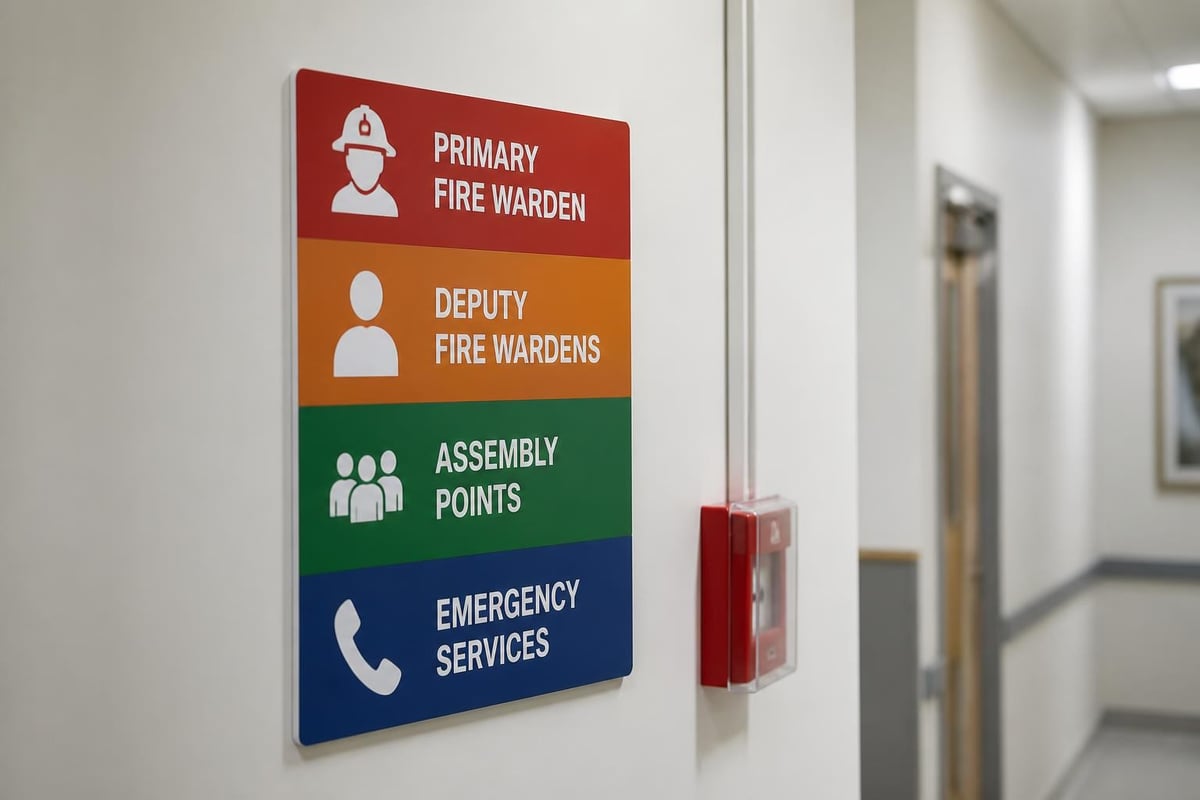
Fire warden signage encompasses various identification tools that designate trained personnel responsible for fire safety coordination. These signs typically include wall-mounted boards displaying fire warden names and contact details, high-visibility vests or badges worn during evacuations, and assembly point markers indicating where wardens should account for occupants.
The regulatory landscape governing fire warden signage draws from multiple frameworks. The Health and Safety Executive's guidance on safety signs provides comprehensive direction on visual communication standards, whilst fire safety risk assessments mandate clear identification of responsible persons. British Standards, particularly BS 5499 series, establish specifications for colour coding, symbols, and information hierarchy on emergency signage.
Core Components of Compliant Fire Warden Signage
Effective fire warden signage systems typically incorporate several distinct elements:
- Informational boards mounted near main entrances or high-traffic areas displaying current fire warden names, photographs, and contact extensions
- Personal identification including vests, armbands, or badges that make wardens immediately recognizable during evacuations
- Assembly point signs clearly marked with warden responsibilities and headcount procedures
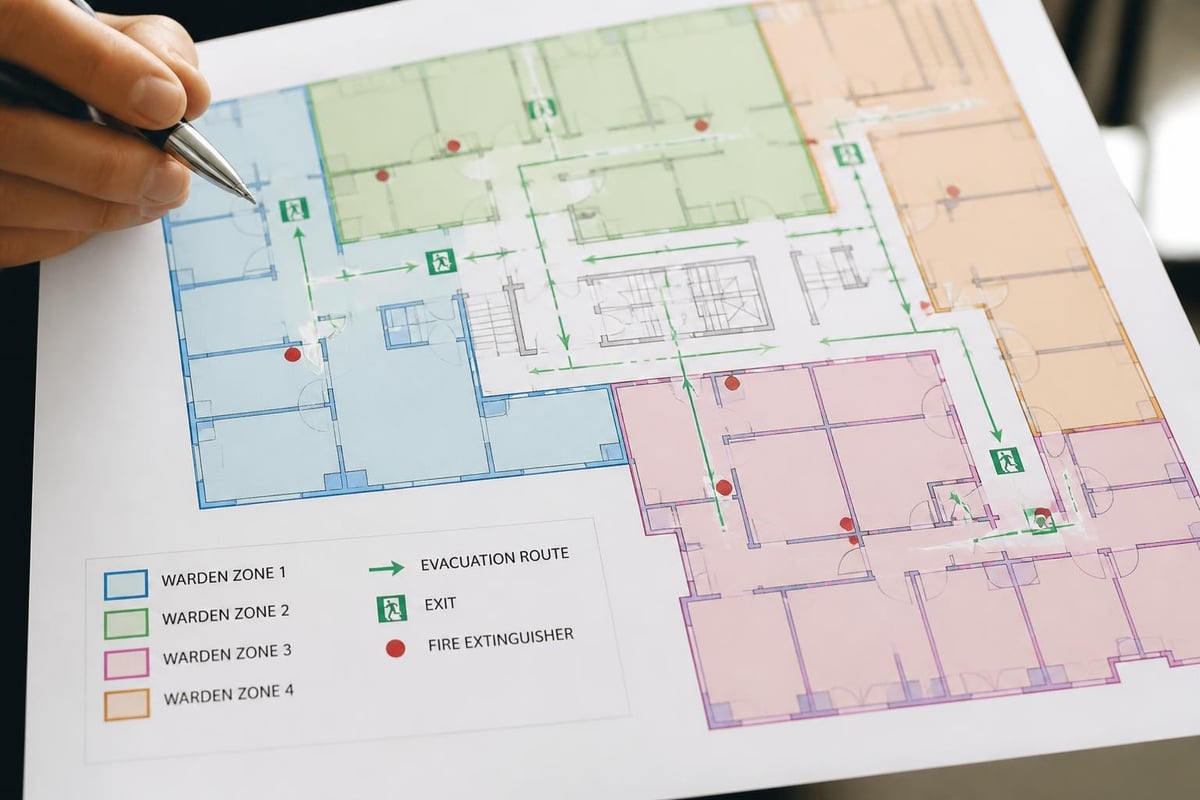
- Floor plan markers showing warden zones and areas of responsibility
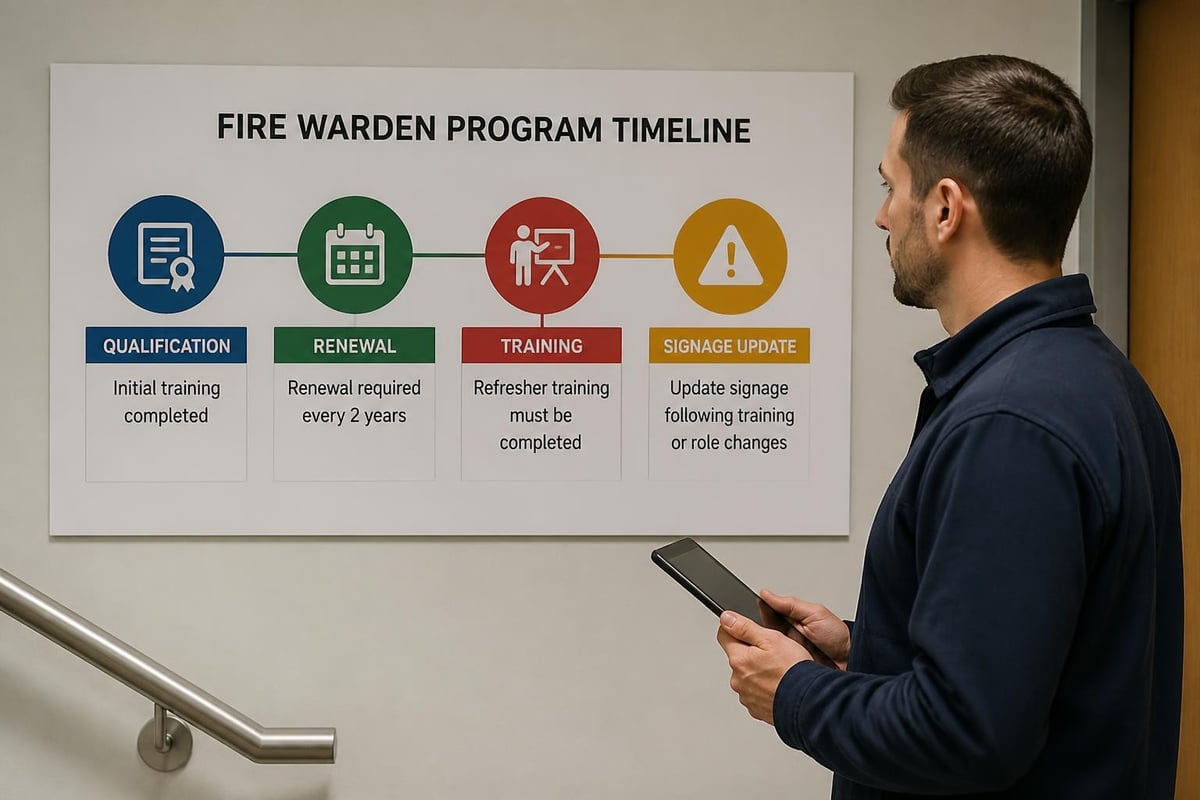
- Training certification displays documenting qualification dates and renewal requirements
The British Standards Institution's BS 5499 guidance offers detailed specifications for fire safety notice design, ensuring consistency across facilities. Compliance requires careful attention to visibility standards, particularly in low-light conditions where photoluminescent materials become essential.
Strategic Placement and Visibility Considerations
Positioning fire warden signage requires strategic thinking beyond mere regulatory compliance. Signs must be visible to all building occupants whilst remaining accessible for regular updates as personnel assignments change. The primary fire warden information board should occupy a prominent location near the main entrance, ensuring visitors and contractors immediately understand the emergency response structure.
Optimal Locations for Fire Warden Information Boards
Consider these high-impact positions when installing permanent fire warden signage:
- Reception areas where visitors first enter and can quickly identify emergency contacts
- Main corridors at decision points where evacuation routes diverge
- Departmental zones showing local fire wardens responsible for specific areas
- Assembly points displaying warden names and accountability procedures
- Stairwell entrances on each floor identifying the designated warden for that level
Visibility extends beyond physical placement. Fire safety risk assessments for offices emphasize that signage must remain legible from expected viewing distances, accounting for lighting conditions throughout the day and during power failures.
Modern facilities increasingly adopt dual-mode signage that combines standard illumination with photoluminescent properties. This approach ensures fire warden information remains visible during power outages, when occupants most need guidance. Photoluminescent signs offer particular advantages in windowless areas or buildings with limited emergency lighting coverage.
Design Standards and Material Selection
Fire warden signage must balance aesthetic integration with functional clarity. Design choices influence how quickly occupants locate information during stressful situations, making evidence-based selection crucial for effective emergency response.
| Design Element | Standard Requirement | Practical Consideration |
|---|---|---|
| Colour scheme | Green for safe condition information | High contrast with wall colours |
| Text height | Minimum 15mm for critical information | Larger sizing for longer viewing distances |
| Material durability | Weather-resistant for external assembly points | UV-stable for areas with natural light |
| Update mechanism | Accessible for personnel changes | Consider magnetic or sliding panels |
The material composition of fire warden signage affects longevity and maintenance requirements. Rigid plastics offer durability and weather resistance for external assembly point markers, whilst aluminium composite panels provide premium aesthetics for reception area displays. Self-adhesive vinyl remains popular for temporary installations or rental facilities requiring damage-free removal.
Information Architecture for Fire Warden Boards
Content structure significantly impacts usability during emergencies. Effective fire warden boards organize information hierarchically:
Primary level: Building name and emergency assembly point location in the largest, boldest text Secondary level: Fire warden names, photographs, and primary contact methods Tertiary level: Deputy warden information and alternative contacts Supplementary details: Training dates, evacuation procedure summaries, and emergency service numbers
Photography enhances recognition speed compared to text-only listings. Including headshots of fire wardens enables occupants to identify responsible personnel quickly, particularly valuable in larger organizations where employees may not know all colleagues by name. Images should be updated regularly to reflect current appearance and personnel changes.
Integration with Broader Fire Safety Systems
Fire warden signage functions most effectively when integrated within comprehensive fire safety frameworks. Isolated signs provide limited value without supporting infrastructure, training programmes, and regular maintenance schedules.
The connection between fire warden signage and other safety communications creates synergistic effectiveness. Fire fighting signs indicating equipment locations should reference fire warden responsibilities for equipment inspection. General informational signs can direct occupants to consult fire warden boards for specific emergency procedures.
Coordinating with Emergency Equipment
Fire wardens require ready access to emergency equipment, making coordinated signage placement essential. Linking fire warden identification boards with equipment locations streamlines emergency response:
- Position fire warden boards near fire extinguisher cabinets to reinforce responsibility for monthly checks
- Include equipment location maps on fire warden information displays
- Ensure warden vest storage is clearly marked and easily accessible
- Cross-reference assembly point signs with nearby first aid equipment locations
This integrated approach ensures fire wardens can quickly locate necessary equipment whilst maintaining clear lines of sight to their designated zones. Equipment signage should indicate the responsible fire warden for that area, creating accountability and simplifying maintenance tracking.
Personal Identification During Evacuations
Whilst static fire warden signage establishes responsibility structure, personal identification becomes paramount during actual evacuations. High-visibility vests, helmets, or armbands enable occupants to locate assistance quickly in potentially chaotic situations.
The design of personal fire warden identification must balance immediate recognition with practical wearability. Fluorescent colours-typically orange or yellow-provide optimal visibility in various lighting conditions. Reflective strips enhance detection in smoke-filled environments or poorly lit areas. Text should clearly state "FIRE WARDEN" in capital letters visible from at least 10 metres.
Selection Criteria for Personal Fire Warden Gear
| Item Type | Key Features | Usage Scenario |
|---|---|---|
| High-visibility vests | Adjustable sizing, retroreflective strips, large text | Multi-floor buildings, outdoor assembly |
| Armbands | Quick-don design, elastic retention, washable | Smaller facilities, seated events |
| Helmets with markers | Hard hat compatibility, clip-on identification | Industrial settings, construction sites |
| Badge holders | Lanyard attachment, clear plastic protection | Office environments, retail spaces |
Personal protective equipment considerations intersect with fire warden identification in industrial environments. Fire wardens in facilities requiring PPE compliance must ensure their identification remains visible over safety clothing. Vest sizing should accommodate hard hats, safety glasses, and other mandatory equipment without obscuring the fire warden designation.
Maintenance and Update Protocols
Fire warden signage requires regular maintenance to ensure accuracy and functionality. Outdated information undermines emergency response effectiveness and may create liability issues if evacuations proceed based on incorrect personnel assignments.
Establish quarterly review cycles to verify fire warden board accuracy. Personnel changes, reorganizations, and training certification renewals all necessitate signage updates. Designate a specific individual-typically the health and safety manager-with responsibility for maintaining current information across all fire warden displays.
Systematic Maintenance Checklist
Implement these routine checks to maintain fire warden signage effectiveness:
- Monthly visual inspection: Verify sign visibility, lighting function, and physical condition
- Quarterly content review: Confirm personnel details remain current and contact information accurate
- Bi-annual training verification: Update certification dates and ensure all listed wardens maintain valid training
- Annual comprehensive audit: Assess placement effectiveness, readability standards, and compliance with current regulations
- Post-incident evaluation: Review signage performance after drills or actual emergencies
Documentation of maintenance activities demonstrates due diligence in regulatory compliance whilst creating records useful for continuous improvement. Photograph all fire warden signage annually to track deterioration, document upgrades, and maintain historical records of safety infrastructure investments.
Accessibility and Inclusive Design
Fire warden signage must serve all building occupants, including those with visual, cognitive, or mobility impairments. Inclusive design principles ensure emergency information reaches everyone who might need assistance during evacuations.
Tactile elements enhance accessibility for visually impaired occupants. Raised lettering or Braille additions to fire warden boards enable independent information access. The ADA guidance on accessible signage provides valuable frameworks applicable beyond US contexts, offering evidence-based mounting heights and tactile character specifications.
Colour contrast ratios deserve particular attention. Whilst green backgrounds suit standard fire safety signage, ensuring sufficient contrast between text and background improves readability for colour-blind individuals and those with reduced visual acuity. Aim for contrast ratios of at least 4.5:1 for standard text and 3:1 for large-scale text exceeding 18 points.
Personal Emergency Evacuation Plans (PEEPs) Integration
Fire warden signage should reference support procedures for occupants requiring evacuation assistance. Display PEEP contact information alongside fire warden details, clarifying responsibilities for assisting individuals with:
- Mobility limitations requiring evacuation chairs or refuge area coordination
- Visual impairments necessitating verbal guidance and physical assistance
- Hearing impairments requiring visual alerts and direct communication
- Cognitive disabilities benefiting from familiar warden contacts and simplified instructions
Clear assignment of PEEP responsibilities prevents confusion during emergencies. Designate specific fire wardens for PEEP coordination, identifying them both on informational boards and through distinctive personal identification markers that differentiate these specialized roles.
Multi-Site and Complex Facility Considerations
Organizations operating multiple buildings or complex facilities face unique fire warden signage challenges. Standardization across sites enables staff transfers without retraining whilst supporting corporate safety culture consistency.
Develop organization-wide templates for fire warden boards that maintain consistent layout, colour schemes, and information hierarchy. This standardization helps employees immediately recognize fire warden information regardless of which facility they visit. Include site-specific customization fields for local personnel details whilst preserving overall design coherence.
Large facilities may require zone-based fire warden systems with hierarchical coordination structures. Primary fire wardens oversee entire buildings or major sections, whilst secondary wardens manage specific floors or departments. Signage must clearly communicate this hierarchy, helping occupants understand who to contact for different scenarios.
Zone Identification Systems
Implement colour-coded or numbered zone systems to clarify fire warden responsibilities:
| Zone Identifier | Coverage Area | Primary Warden Display Location | Deputy Warden Backup |
|---|---|---|---|
| Zone 1 (Blue) | Ground floor, reception | Main entrance board | Rear fire exit |
| Zone 2 (Green) | First floor, offices | Stairwell A landing | Department notice boards |
| Zone 3 (Yellow) | Second floor, operations | Stairwell B landing | Break room entrance |
| Zone 4 (Red) | Basement, storage | Goods entrance | Service lift lobby |
Zone-based systems simplify large-building evacuations by establishing clear accountability boundaries. During evacuations, each fire warden reports their zone status to the chief fire warden at the assembly point, streamlining headcount procedures and enabling rapid identification of any missing occupants.
Training Documentation and Certification Display
Fire warden signage should demonstrate training compliance, reassuring occupants that designated personnel possess necessary qualifications. Including training dates and certification details on fire warden boards reinforces professionalism whilst supporting regulatory documentation requirements.
Display formats might include:
- Training completion dates with renewal schedules
- Certifying organization logos or accreditation marks
- Specialization indicators (e.g., first aid trained, evacuation chair certified)
- Drill participation records demonstrating practical experience
Transparency regarding fire warden qualifications builds occupant confidence in emergency response capabilities. Visitors to facilities can immediately assess whether fire safety provisions meet professional standards, whilst employees gain reassurance that their safety depends on properly trained individuals.
Regular training refreshers should trigger signage updates. When fire wardens complete recertification courses, update boards within one week to maintain accuracy. This discipline ensures all displayed information reflects current qualifications, preventing outdated certifications from undermining credibility.
Cost-Effective Implementation Strategies
Budget constraints need not compromise fire warden signage effectiveness. Strategic investment in quality materials for permanent installations, combined with economical solutions for frequently updated elements, optimizes return on safety expenditure.
Consider modular board designs with replaceable information panels. Initial investment in durable frames pays long-term dividends when personnel changes require only inexpensive panel replacements rather than complete sign replacement. Magnetic backing systems, clear pocket holders, and slide-in rails all facilitate cost-effective updates.
Digital displays offer emerging alternatives for dynamic fire warden information. Electronic boards enable instant updates across multiple locations from centralized management systems. However, ensure backup power supplies maintain display functionality during electrical failures, or supplement digital displays with printed emergency fallback information.
Budget Allocation Framework
Prioritize spending based on visibility impact and update frequency:
- High-priority permanent locations (main entrances, assembly points): Premium materials, professional installation
- Medium-traffic areas (floor landings, departmental zones): Standard commercial-grade signage
- Personal identification equipment: Durable high-visibility gear for all designated wardens
- Backup and replacement stock: Maintain 20% surplus capacity for rapid replacements
- Update materials: Pre-printed templates or digital systems enabling quick personnel changes
Bulk purchasing through established suppliers like SafetySignsForSale reduces per-unit costs whilst ensuring consistent quality across installations. Establish preferred supplier relationships enabling rapid replacement orders when unexpected damage or expansion requirements arise.
Industry-Specific Applications
Fire warden signage requirements vary significantly across different operational environments. Manufacturing facilities face different challenges than office buildings, whilst retail spaces demand distinct approaches from educational institutions.
Industrial environments require robust fire warden signage resistant to dust, chemicals, and physical impacts. Laminated or fully sealed signs prevent contamination whilst maintaining legibility. Position boards away from high-traffic machinery zones but visible from production floor vantage points. Fire wardens in these settings often require additional PPE compatibility in their identification gear.
Retail operations must balance fire warden visibility with customer-facing aesthetics. Discrete yet compliant signage near staff areas combined with high-visibility personal identification during evacuations maintains professional appearance whilst ensuring safety. Consider retractable or fold-away fire warden boards that deploy during emergencies.
Healthcare facilities demand specialized considerations for patient evacuation coordination. Fire warden signage should integrate with patient movement procedures, clearly identifying personnel trained in medical evacuation protocols and equipment operation. Cross-reference fire warden boards with first aid equipment locations and emergency medical supply stations.
Educational institutions require age-appropriate fire warden identification. Primary schools benefit from friendly, non-threatening signage designs, whilst universities need systems accommodating transient populations and multiple building occupancies. Consider student ambassador programmes where trained student fire wardens assist permanent staff during evacuations.
Technology Integration and Future Developments
Modern fire warden signage increasingly incorporates technological enhancements that improve functionality and information access. QR codes on fire warden boards enable smartphone users to access detailed evacuation procedures, multilingual instructions, or video demonstrations of proper assembly point procedures.
Real-time status indicators show fire warden availability. LED displays or digital badges indicate when designated wardens are on-site versus absent, automatically directing occupants to deputy wardens when primaries are unavailable. Integration with building access control systems automates this tracking, reducing manual update requirements.
Mobile applications complement physical fire warden signage by providing instant communication channels between wardens and building management during evacuations. Push notifications alert all wardens simultaneously when alarms activate, whilst GPS tracking helps chief wardens locate their team members during large-facility evacuations. However, physical signage remains essential as technology backups cannot be guaranteed during emergencies affecting power and communications infrastructure.
Fire warden signage represents far more than regulatory compliance; it establishes the foundation for effective emergency response through clear communication and designated accountability. From strategic placement and inclusive design to integration with broader safety systems, every element contributes to protecting building occupants during critical moments. Whether you're upgrading existing installations or implementing fire warden signage for the first time, SafetySignsForSale provides comprehensive solutions including compliant fire safety signage, personal identification equipment, and expert guidance tailored to your facility's specific requirements.