


LPG Signage: Essential Guide for Compliance and Safety
Liquefied petroleum gas (LPG) remains one of the most widely used fuel sources across residential, commercial, and industrial settings. With its versatility and efficiency comes a critical responsibility: ensuring that all storage, handling, and distribution points are properly marked with appropriate lpg signage. Effective signage not only fulfils regulatory obligations but also serves as the first line of defence in preventing accidents, protecting personnel, and safeguarding property. Understanding the requirements, standards, and best practices surrounding lpg signage is essential for businesses, facility managers, and safety officers who handle this flammable substance.
Regulatory Framework for LPG Signage
The legal landscape governing lpg signage varies across jurisdictions, yet common principles underpin most regulatory frameworks. In the United Kingdom, HSE guidance on LPG storage and handling establishes clear expectations for hazard identification, zoning requirements, and appropriate warning systems. These regulations demand that facilities assess risks associated with bulk storage, indoor installations, and outdoor cylinder storage, then implement corresponding signage protocols.
Key regulatory requirements include:
- Mandatory hazard warning signs at all LPG storage locations
- Clear identification of emergency shut-off points
- Prohibition notices restricting smoking and naked flames
- Distance markers indicating safe separation zones
- Capacity and pressure information displays
European Union standards complement national regulations, with EU Regulation 2016/1829 specifying container marking requirements and the precise placement of 'LPG' stickers on cylinders and storage vessels. This harmonisation ensures consistency across member states whilst allowing individual nations to impose stricter controls where necessary.

International Standards and Their Application
The Global Harmonised System (GHS) provides a framework for chemical hazard communication that extends to LPG signage. This system standardises pictograms, signal words, and hazard statements, enabling workers and emergency responders to recognise dangers regardless of language barriers. For businesses operating across multiple territories, adherence to GHS principles ensures baseline compliance whilst simplifying inventory management of warning signs.
Countries such as Australia have developed specific guidance addressing cylinder safety, with WorkSafe Victoria issuing alerts about unsafe and illegal LPG cylinders that emphasise proper labelling and public awareness. These practical regulatory approaches demonstrate how signage serves both legal compliance and community protection objectives.
Types of LPG Signage Required
Effective lpg signage encompasses multiple categories, each serving distinct safety functions. The comprehensive approach ensures that all stakeholders-from trained operators to occasional visitors-receive appropriate warnings and instructions.
| Signage Type | Purpose | Typical Placement | Regulatory Basis |
|---|---|---|---|
| Hazard Warning | Identify flammable substance | Storage tanks, cylinder compounds | GHS, SANS, BS standards |
| Prohibition | Prevent ignition sources | Entry points, 5m perimeter | National fire regulations |
| Emergency Information | Guide incident response | Control panels, exits | HSE guidelines |
| Mandatory Action | Enforce safety procedures | Filling stations, valve areas | Industry codes of practice |
Warning and Hazard Identification Signs
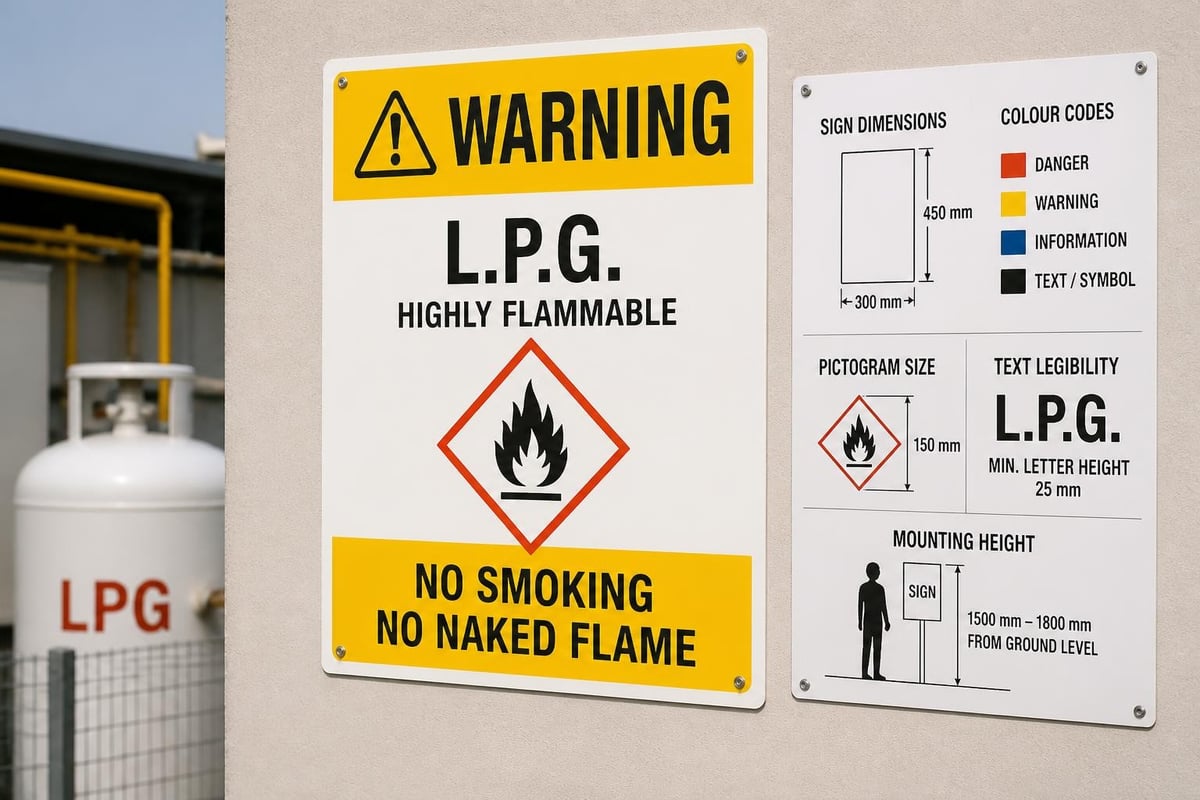
Warning signs constitute the most recognisable category of lpg signage. These prominently display the flame pictogram alongside clear text such as "HIGHLY FLAMMABLE LPG" or "DANGER: LIQUEFIED PETROLEUM GAS". The distinctive triangular format with yellow background and black border ensures immediate visual recognition, even in poor lighting conditions.
Businesses should position these warning signs at every storage location, including:
- Main cylinder storage compounds
- Individual bottle storage cages
- Bulk tank installations
- Vehicle-mounted LPG systems
- Distribution manifold points
Modern lpg signage often incorporates photoluminescent materials that remain visible during power failures or smoke-filled conditions. This enhancement proves particularly valuable in emergency scenarios when conventional lighting may fail.
Prohibition and Restriction Signs
Prohibition notices form an equally critical component of comprehensive lpg signage strategies. These circular red signs with diagonal bars communicate actions that must not be undertaken within LPG zones. The GOV.UK guidance on LPG management emphasises the importance of clearly marked no-smoking zones and restricted access areas.
Essential prohibition signs include:
- No smoking within 5 metres
- No naked flames or ignition sources
- No unauthorised access
- No mobile phone usage (in certain high-risk zones)
- No parking (within designated safety distances)
Facilities handling LPG should complement these with prohibitory signs that specify exact distances and consequences, enhancing both compliance and accountability.
Design Specifications and Visibility Standards
The effectiveness of lpg signage depends heavily on proper design execution. Regulatory standards prescribe minimum dimensions, colour specifications, and viewing distances to ensure signs fulfil their protective function under various conditions.
Size and Placement Considerations
Sign dimensions must correlate with viewing distance and environmental factors. A cylinder storage compound requiring visibility from 20 metres demands substantially larger signage than a small indoor installation viewed from 3 metres. Industry guidelines suggest minimum text heights of 25mm for every 5 metres of viewing distance, though more conservative approaches often specify larger dimensions for critical safety messages.
Mounting height represents another crucial variable. Signs positioned too low become obscured by equipment or vehicles, whilst those placed excessively high may escape notice during routine activities. The optimal range typically falls between 1.5 and 2.5 metres from ground level, ensuring visibility for standing adults whilst remaining accessible for maintenance and replacement.
Material Selection for Durability
The harsh environments surrounding LPG installations demand robust signage materials capable of withstanding weather exposure, chemical contact, and physical wear. Material selection directly influences lifecycle costs and ongoing compliance.
| Material | Advantages | Typical Lifespan | Best Applications |
|---|---|---|---|
| Aluminium | Weather-resistant, rigid | 10-15 years | Outdoor bulk storage |
| Rigid plastic | Lightweight, chemical-resistant | 7-10 years | Indoor facilities |
| Self-adhesive vinyl | Low cost, easy application | 3-5 years | Temporary installations |
| Photoluminescent acrylic | Glow-in-dark capability | 8-12 years | Emergency routes |
Quality lpg signage utilises UV-resistant inks and protective laminates that prevent fading and degradation. Suppliers like SafetySignsForSale offer photoluminescent signs specifically engineered for hazardous environments, combining regulatory compliance with extended service life.
Reflective and Illuminated Options
Facilities operating around-the-clock or in poorly lit areas benefit from reflective or illuminated lpg signage. Reflective materials incorporate micro-prismatic technology that returns light to its source, making signs visible to vehicle operators and personnel carrying torches. Illuminated signs, whether internally lit or externally floodlit, ensure continuous visibility regardless of ambient conditions.
The choice between these technologies depends on risk assessment outcomes, operational patterns, and budget constraints. High-traffic commercial installations typically justify the investment in illuminated systems, whilst smaller facilities achieve adequate safety with quality reflective materials.
Implementation and Maintenance Programmes
Installing lpg signage represents merely the first step in a comprehensive safety strategy. Ongoing maintenance, periodic audits, and systematic updates ensure continued effectiveness and regulatory compliance.
Installation Best Practices
Proper installation maximises sign longevity and effectiveness. Key considerations include:
- Surface preparation: Clean, dry mounting surfaces free from oil, dust, or loose paint
- Fixing methods: Appropriate for substrate (drilling into masonry, riveting to metal, adhesive for smooth surfaces)
- Weather protection: Additional sealing at edges for outdoor installations
- Sight-line verification: Testing visibility from multiple approach angles
- Documentation: Recording sign locations, installation dates, and responsible personnel
Many organisations integrate lpg signage installation into broader facility safety upgrades, coordinating with fire-fighting signs and mandatory signs to create coherent visual safety systems.
Inspection and Replacement Schedules
Establishing regular inspection protocols prevents signage degradation from compromising safety. Monthly visual checks identify obvious damage or detachment, whilst quarterly detailed inspections assess colour fastness, legibility, and structural integrity. Annual audits should verify continued regulatory compliance as standards evolve.
Inspection checklist for lpg signage:
- Physical condition (cracks, warping, delamination)
- Colour retention and contrast
- Text and pictogram legibility
- Secure mounting with no loose fixings
- Appropriate positioning (not obscured by equipment or vegetation)
- Alignment with current regulations
- Presence of all required signs per risk assessment
Damaged or faded signs require immediate replacement to maintain legal compliance and practical effectiveness. Forward-thinking organisations maintain small inventories of critical lpg signage to enable rapid response when deficiencies are identified.
Integration with Emergency Response Systems
LPG signage forms an integral component of broader emergency preparedness frameworks. Effective integration ensures that warning signs, emergency procedures, and response resources function cohesively during incidents.
Emergency Procedure Notices
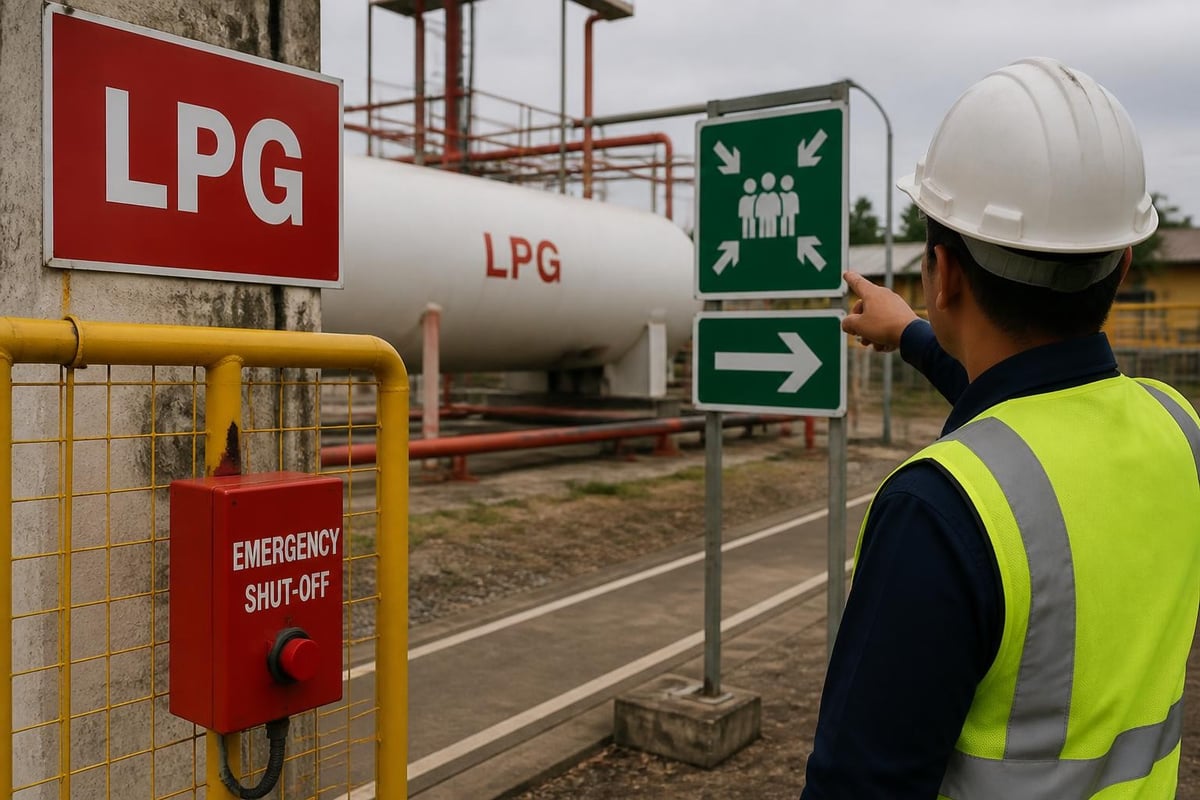
Beyond standard hazard warnings, comprehensive lpg signage includes detailed emergency response instructions positioned at strategic control points. These notices should specify:
- Emergency shut-off valve locations and operation methods
- Contact numbers for emergency services and facility management
- Initial response actions (evacuation triggers, isolation procedures)
- Assembly point locations
- Relevant Material Safety Data Sheet (MSDS) reference numbers
Organisations benefit from coordinating these emergency notices with general informational signs that guide routine operations, creating layered information systems serving both normal and crisis situations.
Coordination with Fire Safety Equipment
LPG installations typically require proximity to appropriate fire suppression resources. Clear signage indicating the location of fire extinguishers suitable for LPG fires (typically dry powder or CO₂ types) ensures rapid response capability. Directional arrows and distance information help unfamiliar personnel locate equipment quickly during high-stress scenarios.
The relationship between lpg signage and fire safety systems extends to automatic detection and suppression installations. Signs must identify gas detection sensor locations, alarm activation points, and automatic isolation valve positions, enabling emergency responders to assess system status and override controls when necessary.
Training and Awareness Programmes
Even the most comprehensive lpg signage proves ineffective without adequate personnel training. Organisations must ensure all workers understand sign meanings, recognise hazard levels, and know appropriate responses to warnings encountered.
Induction and Ongoing Education
New employee inductions should include specific modules covering lpg signage interpretation. These sessions explain:
- Standard pictogram meanings and colour coding systems
- Distance requirements specified on prohibition signs
- Actions required by mandatory signs
- Emergency response procedures indicated by informational signs
- Reporting mechanisms for damaged or missing signage
Annual refresher training reinforces this knowledge whilst updating personnel on regulatory changes or facility modifications affecting signage. Interactive approaches, including site walks identifying actual signs and discussing scenarios, enhance retention compared to classroom-only methods.
Contractor and Visitor Management
Temporary workers, contractors, and visitors require targeted briefings addressing lpg signage, as they lack the familiarity developed by permanent staff. Simplified induction materials highlighting critical signs and absolute prohibitions provide essential protection for these transient populations.
Many facilities implement visual management systems where colour-coded access cards or badges indicate permitted zones, correlating with lpg signage to create intuitive boundary demarcation. This approach reduces reliance on text comprehension, benefiting multilingual workforces and literacy-diverse populations.
Special Considerations for Different Sectors
LPG applications vary dramatically across industries, creating sector-specific signage requirements beyond baseline regulatory demands. Tailoring lpg signage to operational contexts enhances both compliance and practical safety outcomes.
Industrial and Manufacturing Facilities
Heavy industrial sites often feature complex LPG distribution networks serving multiple processes. These environments demand comprehensive signage systems that:
- Identify individual pipeline contents and flow directions
- Specify pressure ratings and temperature limitations
- Mark valve isolation points for emergency shutdown
- Delineate ATEX zones with explosion risk classifications
- Indicate gas detection equipment locations and coverage areas
Integration with process control documentation ensures signage accuracy during plant modifications or expansions. Digital management systems tracking sign locations against piping and instrumentation diagrams prevent inconsistencies that could confuse emergency responders.
Commercial and Hospitality Applications
Restaurants, hotels, and catering businesses utilising LPG for cooking require signage addressing both occupational safety and public protection. Customer-facing areas demand discreet yet compliant warning signs that communicate hazards without creating alarm or aesthetic disruption.
Back-of-house cylinder storage must feature prominent lpg signage preventing inadvertent ignition sources, whilst ensuring delivery personnel can identify appropriate locations quickly. Many establishments benefit from bilingual signs accommodating diverse staff populations common in hospitality sectors.
Agricultural and Remote Installations
Farms and rural facilities present unique challenges for lpg signage implementation. Outdoor exposure intensifies weathering effects, demanding more durable materials and conservative replacement schedules. Remote locations may experience delayed emergency response, increasing the importance of comprehensive self-rescue information on signage.
Solar-powered illuminated signs offer practical solutions where electrical infrastructure proves limited or unreliable. These systems ensure continuous visibility whilst minimising installation complexity and ongoing energy costs.
Emerging Technologies and Future Developments
The lpg signage sector continues evolving, incorporating technological advances that enhance effectiveness whilst maintaining regulatory compliance. Smart signage systems represent the frontier of this development, though traditional approaches remain valid and widely applicable.
Digital and Smart Signage Solutions
Internet-connected digital displays enable dynamic lpg signage that adapts to changing conditions. These systems can:
- Display real-time gas concentration readings from detection systems
- Alter messaging based on operational status (filling, storage, maintenance)
- Integrate with facility access control to show authorised personnel lists
- Provide multilingual options selectable by users
- Log acknowledgements of warning messages for compliance documentation
Despite these capabilities, digital solutions face challenges including power requirements, maintenance complexity, and emergency reliability concerns. Most facilities employ hybrid approaches combining traditional permanent signs for critical warnings with digital displays for supplementary information.
Augmented Reality Applications
Emerging augmented reality (AR) technologies promise to revolutionise how personnel interact with lpg signage. AR-enabled devices can overlay additional information onto physical signs, providing:
- Detailed technical specifications and safety data
- Step-by-step emergency response procedures
- Maintenance history and inspection records
- Training modules triggered by sign recognition
- Real-time translation of text into user's preferred language
Whilst still nascent, these applications demonstrate significant potential for enhancing safety outcomes, particularly during complex emergency scenarios requiring rapid information access.
Procurement and Quality Assurance
Selecting appropriate lpg signage requires careful evaluation of suppliers, materials, and compliance credentials. Quality variations significantly impact both regulatory standing and practical effectiveness.
Supplier Selection Criteria
Organisations should assess potential signage suppliers against multiple factors:
| Criterion | Importance | Evaluation Method |
|---|---|---|
| Regulatory knowledge | Critical | Request compliance documentation and certification |
| Material quality | High | Review samples and material specifications |
| Customisation capability | Medium | Discuss specific requirements and review examples |
| Delivery reliability | High | Check references and lead time guarantees |
| After-sales support | Medium | Clarify warranty terms and replacement processes |
Established suppliers such as SafetySignsForSale maintain expertise across multiple signage categories, offering consolidated sourcing for organisations requiring safety signs spanning various applications beyond LPG-specific requirements.
Certification and Standards Compliance
Reputable lpg signage carries markings indicating compliance with relevant standards (BS, SANS, ISO, etc.). Purchasers should verify:
- Standards referenced in product specifications
- Independent testing certification where applicable
- Material origin and manufacturing quality systems
- Supplier's quality assurance processes
- Traceability of batches for recall purposes
Documentation proving compliance becomes essential during regulatory inspections and insurance assessments. Maintaining comprehensive procurement records demonstrates due diligence in safety equipment selection.
Cost-Benefit Analysis of Quality Signage
Initial procurement costs represent only one component of total lpg signage expenditure. Lifecycle cost analysis reveals that premium materials and professional installation often deliver superior value compared to budget alternatives.
Direct and Indirect Cost Factors
Direct costs include:
- Purchase price of signs
- Installation labour and materials
- Maintenance and inspection programmes
- Periodic replacement expenditure
Indirect costs encompass:
- Regulatory non-compliance penalties
- Insurance premium adjustments
- Accident investigation and remediation expenses
- Reputational damage from safety incidents
- Business interruption following serious events
Quality lpg signage reduces exposure to these indirect costs, frequently justifying higher upfront investment. A comprehensive facility signage upgrade costing £5,000 appears modest compared to potential penalties exceeding £20,000 for serious compliance breaches, before considering human costs of preventable accidents.
Return on Investment Calculations
Quantifying safety investments challenges traditional financial metrics, yet several approaches demonstrate value. Risk reduction modelling estimates probability decreases for various incident scenarios following signage improvements. Multiplying these probability reductions by potential consequence costs yields expected value calculations supporting investment decisions.
Insurance providers increasingly recognise quality safety systems through premium discounts. Organisations should engage insurers during signage procurement, potentially securing immediate cost recovery through reduced premiums whilst achieving improved protection.
Implementing comprehensive lpg signage addresses fundamental safety obligations whilst demonstrating organisational commitment to personnel welfare and regulatory compliance. The investment in quality warning systems, prohibition notices, and emergency information creates layered protection that serves both routine operations and crisis scenarios. Whether you operate industrial facilities, commercial kitchens, or agricultural installations, SafetySignsForSale provides the expertise and product range necessary to meet your LPG signage requirements whilst supporting broader safety objectives across fire equipment, PPE, and first aid systems. Contact our team today to discuss your specific needs and ensure your facility maintains the highest safety standards.