



Sign and Warning: Essential Guide for Workplace Safety
Effective communication of hazards remains the cornerstone of any comprehensive workplace safety programme. Every day, workers across manufacturing facilities, construction sites, warehouses, and commercial premises rely on clear visual indicators to navigate potential dangers and make informed decisions about their safety. The strategic implementation of sign and warning systems creates a critical layer of protection that complements training, engineering controls, and administrative procedures. Understanding how to select, position, and maintain these essential safety tools directly impacts incident rates, regulatory compliance, and overall organisational risk management.
Understanding the Fundamental Difference Between Signs and Warnings
Safety signage serves multiple functions within the workplace environment, yet many organisations fail to recognise the distinct purposes of informational signs versus active warnings. A sign typically provides general information, direction, or instruction that remains constant regardless of immediate circumstances. These include exit markers, first aid station locations, and mandatory personal protective equipment zones. Conversely, a warning communicates time-sensitive information about specific hazards that could cause immediate harm if workers fail to take appropriate precautions.
Classification Systems for Workplace Safety Signage
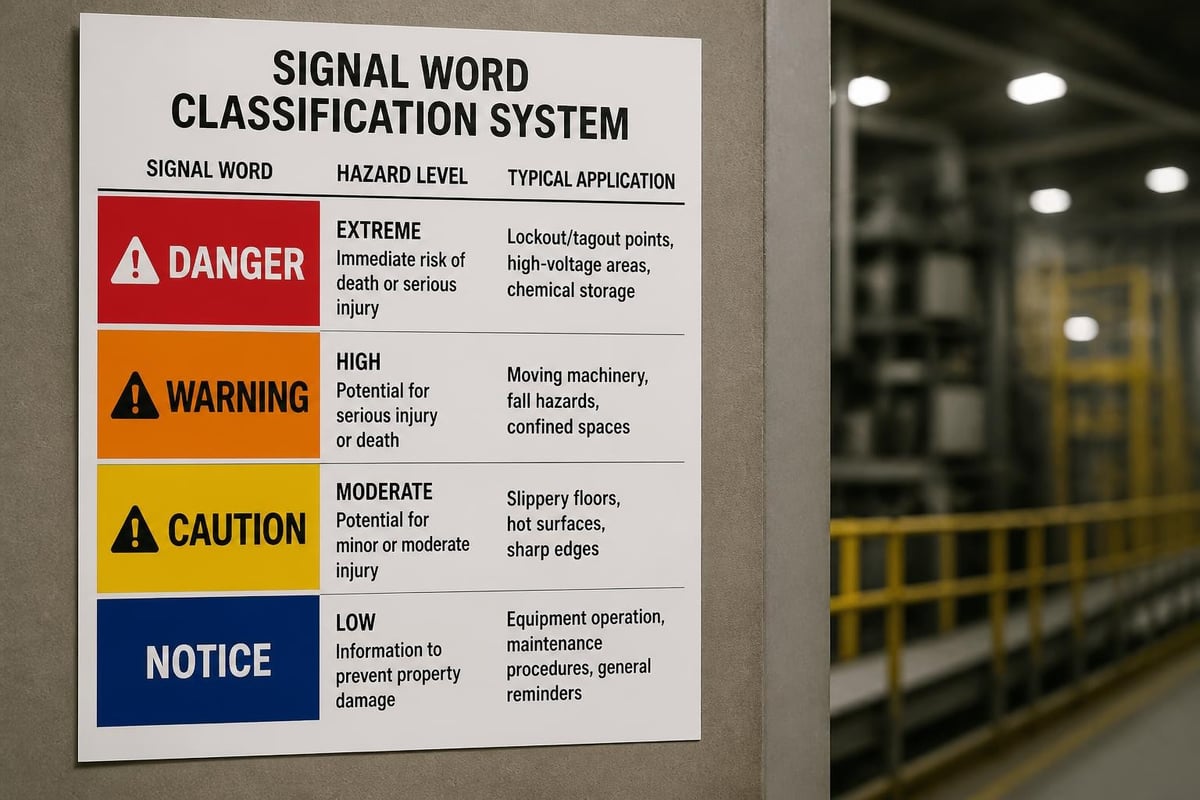
Modern safety standards employ hierarchical classification systems that help organisations determine which type of sign and warning to deploy in specific situations. The internationally recognised ANSI Z535 series establishes colour-coded categories that communicate hazard severity at a glance.
| Signal Word | Colour Scheme | Hazard Level | Typical Applications |
|---|---|---|---|
| DANGER | Red/Black/White | Immediate threat of death or serious injury | High-voltage equipment, confined spaces, fall hazards |
| WARNING | Orange/Black | Potential for death or serious injury | Moving machinery, chemical exposure, elevated work areas |
| CAUTION | Yellow/Black | Minor to moderate injury risk | Wet floors, low headroom, trip hazards |
| NOTICE | Blue/White | Property damage or information | Operating instructions, housekeeping requirements |
The UK Health and Safety Executive provides comprehensive guidance on selecting appropriate signage under the Safety Signs and Signals Regulations, which mandate specific formats for prohibition, warning, mandatory action, and safe condition signs.
Regulatory Frameworks Governing Sign and Warning Implementation
Compliance with safety signage regulations varies significantly across jurisdictions, industries, and facility types. In the United Kingdom, the Health and Safety (Safety Signs and Signals) Regulations 1996 transpose European Directive 92/58/EEC into domestic law, creating legally binding requirements for employers. These regulations specify when safety signs must be used, which designs meet legal standards, and how organisations should maintain signage systems over time.
Key Regulatory Requirements
Understanding your legal obligations prevents costly citations whilst protecting your workforce from preventable injuries. The following elements form the foundation of compliant sign and warning programmes:
- Risk assessment: Employers must conduct systematic evaluations to identify where residual hazards require signage after implementing engineering and administrative controls
- Standardised symbols: Pictograms must conform to ISO 7010 standards, ensuring universal recognition across multilingual workforces
- Appropriate positioning: Signs must be placed where workers can see them before encountering hazards, with adequate illumination and unobstructed sightlines
- Regular maintenance: Damaged, faded, or obscured signage must be promptly replaced to maintain effectiveness
- Worker training: Employees require instruction on the meaning of different sign types and expected responses to warnings
Manufacturing facilities face additional requirements under the Provision and Use of Work Equipment Regulations (PUWER), which mandate specific machine guarding labels and operational warnings. Construction sites must comply with the Construction (Design and Management) Regulations, incorporating temporary signage as site conditions evolve.
Psychological Principles Behind Effective Warning Design
The effectiveness of any sign and warning system depends not merely on regulatory compliance but on how human beings perceive, process, and respond to visual information under workplace conditions. Cognitive psychology research reveals that workers often experience "warning fatigue" when exposed to excessive or poorly designed signage, leading to habituation and reduced compliance over time.
Optimising Visual Hierarchy and Information Architecture
Successful warning design balances competing demands for attention, comprehension, and behavioural motivation. Research published in Frontiers in Communication examines risk communication effectiveness from regulatory and ethnographic perspectives, providing evidence-based insights for safety professionals.
Critical design elements include:
- Signal word prominence: The hazard level indicator must be immediately visible from the worker's approach angle
- Pictogram clarity: Symbolic representations should communicate hazards without requiring text interpretation, accommodating literacy variations
- Concise messaging: Consequences and avoidance instructions must be brief enough for rapid comprehension during normal workflow
- Colour psychology: Standardised colour associations leverage pre-existing mental models that trigger appropriate caution responses
| Design Factor | Poor Practice | Best Practice |
|---|---|---|
| Text density | Paragraph-length explanations | Maximum 3-4 short bullet points |
| Font selection | Decorative or serif typefaces | Sans-serif fonts sized for viewing distance |
| Contrast ratio | Low contrast (yellow on white) | High contrast (black on yellow, white on red) |
| Pictogram detail | Complex illustrations | Simple, bold symbols with clear boundaries |
The strategic placement of sign and warning elements within the worker's natural line of sight significantly increases compliance rates compared to signage positioned in peripheral locations.

Industry-Specific Sign and Warning Applications
Different operational environments present unique hazard profiles that demand tailored signage strategies. A comprehensive safety programme recognises these distinctions and implements appropriate solutions for each context.
Manufacturing and Industrial Facilities
Production environments typically combine permanent hazards from fixed equipment with dynamic risks from material handling, chemical processes, and workflow patterns. Machine guarding requires point-of-operation warnings that specify pinch points, rotating components, and emergency stop locations. Chemical storage areas demand multiple sign and warning types, including hazard identification placards, mandatory PPE notices, and emergency response instructions.
Warehouses and distribution centres face particular challenges with mobile equipment, creating the need for pedestrian walkway demarcation, forklift traffic zones, and overhead load warnings. Floor-mounted signs and suspended banners provide redundant communication channels that accommodate varying worker sight lines throughout the facility.
Construction and Temporary Work Sites
Construction environments change daily as projects progress through different phases, requiring flexible signage systems that adapt to evolving conditions. Temporary sign and warning installations must withstand outdoor weather exposure whilst remaining easily relocatable as work zones shift. The Federal Highway Administration's Manual on Uniform Traffic Control Devices establishes standards for road work zones and traffic control that apply to construction sites affecting public rights-of-way.
Excavation warnings, overhead hazard indicators, and confined space entry signs represent critical applications where temporary signage directly prevents fatalities. Scaffolding erection requires load capacity placards, inspection status tags, and access restriction notices at each entry point.
Commercial and Public-Access Facilities
Retail environments, office buildings, and hospitality venues must balance safety communication with aesthetic considerations and customer experience. Slip hazard warnings in public areas require immediate deployment when cleaning operations create temporary risks. Emergency evacuation signage must remain visible under normal lighting conditions whilst incorporating photoluminescent materials for power failure scenarios.
Material Selection and Durability Considerations
The longevity and effectiveness of any sign and warning system depends heavily on choosing appropriate substrate materials, printing methods, and protective coatings for specific environmental conditions. Outdoor applications face UV exposure, temperature fluctuations, and moisture infiltration that rapidly degrade unsuitable materials.
Matching Materials to Environmental Demands
Different installation locations require specific material properties:
- Aluminium composite: Ideal for permanent exterior signage, offering weather resistance and rigidity without excessive weight
- Rigid plastic (PVC, polycarbonate): Cost-effective for interior applications with moderate durability requirements
- Self-adhesive vinyl: Suitable for smooth surfaces and temporary installations, available in photoluminescent formulations
- Corrosion-resistant steel: Essential for harsh chemical environments and extreme temperature applications
- Magnetic backing: Enables repositionable warnings on ferrous surfaces in manufacturing settings
The printing technology employed significantly affects fade resistance and expected service life. Screen printing provides superior UV stability for high-volume production, whilst digital printing offers customisation flexibility for specialised applications. Lamination or clear-coat protection extends outdoor service life by preventing moisture penetration and abrasion damage.
Strategic Placement for Maximum Effectiveness
Even perfectly designed sign and warning elements fail to protect workers when positioned incorrectly. Placement strategy must account for approach vectors, decision points, and the physical distance required for hazard avoidance after warning recognition.
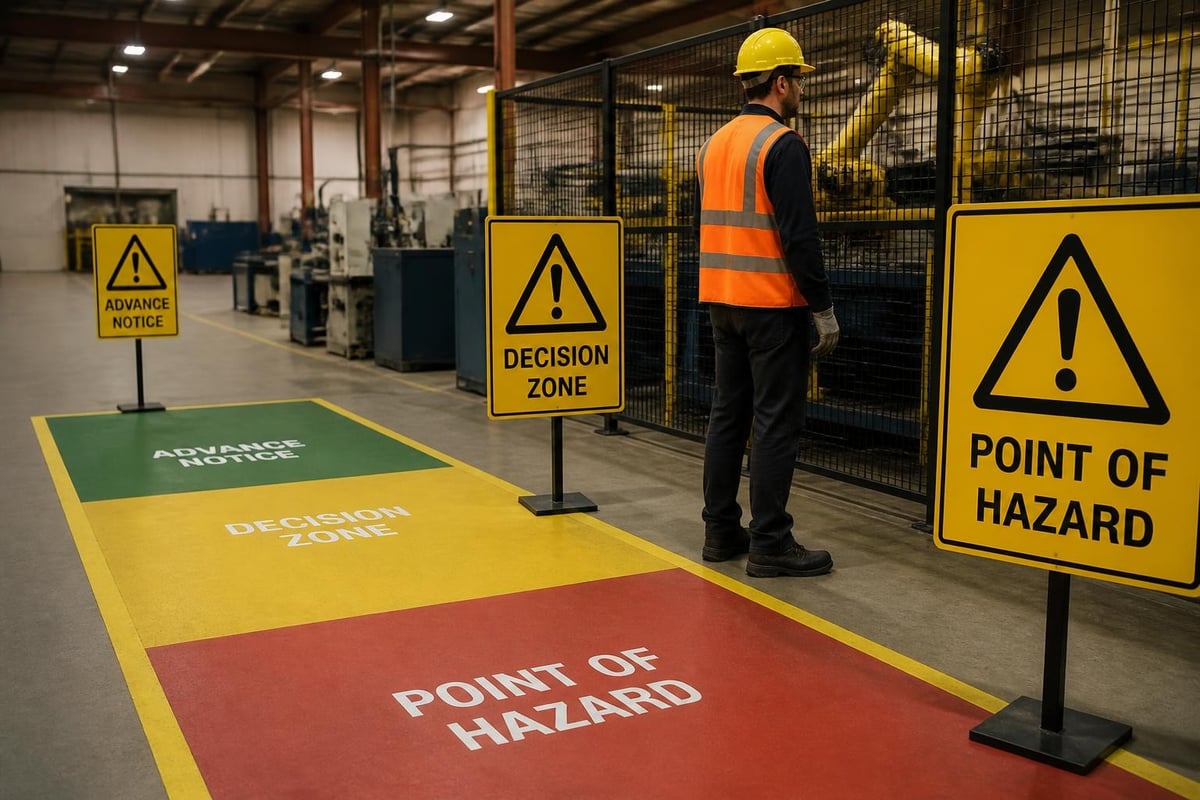
The Three-Zone Placement Model
Effective warning systems employ layered communication at increasing proximity to hazards:
- Advance notice zone (15-25 metres): Initial awareness signage alerts workers to upcoming hazard areas, allowing route planning and PPE preparation
- Decision zone (5-10 metres): Detailed warnings communicate specific hazards and required precautions before workers commit to entry
- Point of hazard (immediate proximity): Final reminders and specific instructions appear at the location where protective actions must occur
Height positioning follows ergonomic principles, typically placing primary signage at 1.5 to 2 metres above finished floor level to align with average eye height for standing workers. Low-mounted supplementary signs address hazards in areas where workers crouch, kneel, or operate seated equipment.
Maintenance, Auditing, and Continuous Improvement
Sign and warning systems deteriorate over time through physical damage, environmental exposure, and organisational changes that render existing signage obsolete. Proactive maintenance programmes preserve effectiveness whilst demonstrating due diligence during regulatory inspections.
Implementing Systematic Inspection Protocols
Monthly walk-through audits should assess the following criteria:
| Inspection Category | Evaluation Criteria | Corrective Action Threshold |
|---|---|---|
| Physical condition | Surface damage, fading, delamination | Visible deterioration affecting legibility |
| Positioning | Obstructions, viewing angle, illumination | Any impediment to clear visibility |
| Relevance | Current hazards, process changes | Signage no longer matches actual conditions |
| Compliance | Regulatory updates, standard revisions | Non-conformance with current requirements |
Digital photography during inspections creates dated records demonstrating compliance efforts and tracking deterioration rates for budgeting purposes. Many organisations implement barcode or QR code systems that link physical signs to maintenance databases, enabling scheduled replacement before failures occur.
Integration with Comprehensive Safety Management Systems
Whilst sign and warning elements provide essential hazard communication, they function most effectively as components within broader safety management frameworks. The hierarchy of controls establishes that engineering solutions and administrative procedures should address hazards before relying on warnings and personal protective equipment.
Coordinating Multiple Safety Layers
Successful organisations integrate signage with complementary safety measures:
- Standard operating procedures: Written protocols reference specific warning locations and required responses
- Job hazard analyses: Risk assessments identify where new sign and warning installations become necessary
- Incident investigations: Accident reviews often reveal signage gaps or effectiveness issues requiring remediation
- Competency-based training: Initial and refresher training emphasises sign recognition and expected worker responses
- Behavioural safety observations: Supervisors monitor whether workers notice and comply with posted warnings
Studies on warning label effectiveness in digital environments provide insights applicable to workplace settings, particularly regarding attention capture and sustained compliance over repeated exposures. This research highlights the importance of periodic sign refreshment and varied presentation formats to combat habituation effects.
Emerging Technologies and Future Developments
Innovation in safety communication continues advancing beyond traditional static signage. Dynamic warning systems incorporate sensors, active illumination, and real-time hazard detection to provide context-sensitive alerts that activate only when specific conditions exist.
LED-illuminated signs with motion sensors eliminate warning fatigue by remaining dark until workers approach hazardous areas, then activating to capture attention. Proximity detection systems trigger audible alerts in high-noise environments where visual warnings alone may prove insufficient. Augmented reality applications overlay contextual safety information onto worker field-of-view through smart glasses, though widespread adoption remains limited by cost and technological maturity.
The progression toward connected workplace technologies enables centralised monitoring of safety sign integrity, with smart signs reporting damage, vandalism, or power failures to facility management systems. These developments promise enhanced reliability whilst creating data streams that support continuous improvement analytics.
Cost-Benefit Analysis of Comprehensive Signage Programmes
Organisations frequently question the return on investment for extensive sign and warning systems, particularly when upgrading from minimal compliance to best-practice standards. Financial justification extends beyond direct cost avoidance from prevented incidents to encompass insurance premium reductions, enhanced regulatory standing, and improved worker morale.
Quantifying the Business Case
Direct costs include initial procurement, installation labour, and ongoing replacement cycles. A typical industrial facility might invest £5,000 to £15,000 in comprehensive signage coverage, with annual maintenance representing 10 to 15 percent of initial outlay. Compare these figures against the average workplace injury cost of £7,000 to £50,000 when accounting for lost productivity, investigation time, potential litigation, and reputational damage.
Insurance underwriters increasingly scrutinise safety management systems during policy renewals, with demonstrable commitment to hazard communication contributing to favourable premium calculations. Documentation of signage audits and maintenance records provides tangible evidence of risk mitigation efforts that support legal defences in negligence claims.
Customisation Versus Standardisation Trade-offs
Whilst regulatory requirements mandate specific formats for certain sign and warning types, organisations face decisions regarding how much customisation serves their unique operational needs. Generic warning signs offer cost advantages through volume production and immediate availability, whilst custom signage can address facility-specific hazards with greater precision.
The optimal approach typically combines standardised regulatory-compliant signs for common hazards with custom solutions for unique equipment, processes, or site-specific conditions. Custom signage proves particularly valuable when standard warnings fail to adequately communicate complex hazards or when multilingual workforces require text in languages beyond typical off-the-shelf offerings.
Implementing effective sign and warning systems requires balancing regulatory compliance, human factors considerations, and operational practicality across diverse workplace environments. When your organisation commits to comprehensive hazard communication through properly selected, positioned, and maintained safety signage, you create measurable improvements in worker awareness and risk reduction. SafetySignsForSale provides the complete range of compliant safety signs, custom solutions, and expert guidance needed to build robust visual communication systems that protect your workforce whilst meeting all regulatory obligations.