


Sign for Warning: Complete Guide to Safety Signage
A sign for warning serves as the first line of defence against workplace accidents, road hazards, and environmental dangers. These critical safety tools communicate potential risks before they become actual incidents, protecting employees, visitors, and the general public from harm. Understanding how to select, position, and maintain effective warning signage is essential for any organisation committed to safety excellence. Whether you're managing a construction site, industrial facility, or commercial premises, the strategic deployment of warning signs can significantly reduce accident rates whilst ensuring regulatory compliance across multiple frameworks.
Understanding the Purpose of Warning Signs
Warning signs occupy a unique position in the hierarchy of safety controls. Unlike mandatory or prohibition signs that dictate specific actions, a sign for warning alerts people to potential hazards without necessarily prescribing exact behaviour. This distinction is crucial for risk management strategies.
The effectiveness of warning signage depends on several interconnected factors. Research published in the Safety Human Factors review demonstrates that warning comprehension follows a three-stage model: attention capture, comprehension of the message, and compliance with the implied instruction. Each stage presents opportunities for failure if signs are poorly designed or incorrectly deployed.
Key Functions of Warning Signage
Warning signs fulfil multiple critical functions within safety management systems:
- Risk communication – conveying the nature and severity of specific hazards
- Behavioural modification – encouraging caution and heightened awareness
- Legal compliance – meeting statutory obligations under health and safety regulations
- Liability protection – demonstrating reasonable precautions have been taken
- Temporary hazard notification – alerting people to changing or non-permanent risks
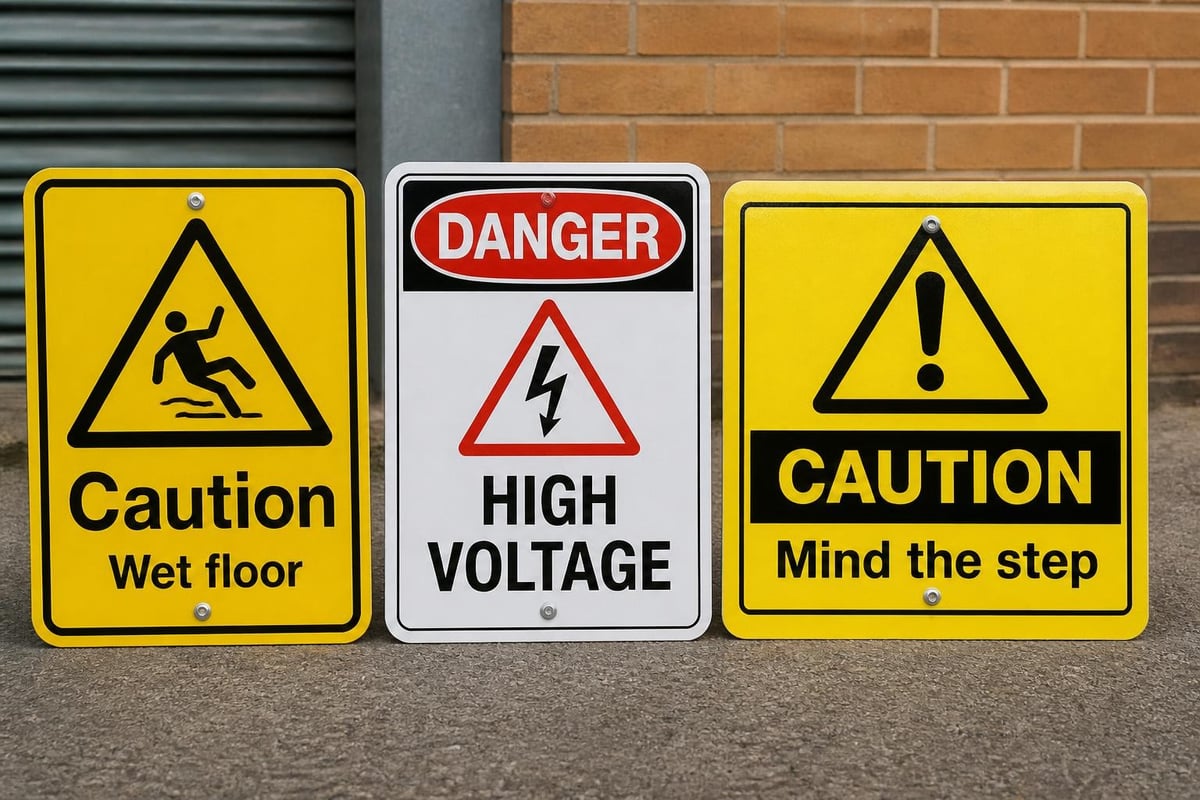
The visual design of warning signs typically employs standardised colour schemes and symbols. Yellow triangles with black borders represent the international standard for warning signage, ensuring instant recognition regardless of language barriers or literacy levels.

Types of Warning Signs Across Industries
Different environments demand specific categories of warning signage. A comprehensive sign for warning strategy recognises these variations and deploys appropriate solutions for each context.
Industrial and Workplace Warning Signs
Manufacturing facilities, warehouses, and industrial sites require extensive warning signage to address machinery hazards, chemical exposures, and environmental dangers. Common examples include:
- High voltage electricity warnings
- Moving machinery and pinch point alerts
- Confined space entry warnings
- Hazardous substance notifications (COSHH compliance)
- Slippery surface and trip hazard signs
- Overhead load and falling object warnings
Each sign must comply with HSE guidance on safety signs and signals, which provides practical frameworks for selecting appropriate signage based on risk assessment outcomes.
Road and Traffic Warning Signs
Highway and road warning signage follows distinct protocols established by traffic authorities. The FHWA Manual on Uniform Traffic Control Devices sets comprehensive standards for road warning signs in the United States, whilst the UK follows its own regulatory framework.
Traffic warning signs typically address:
- Geometric warnings – curves, bends, junctions, and gradient changes
- Obstruction warnings – narrow bridges, width restrictions, low clearances
- Surface condition warnings – ice risk, loose chippings, uneven surfaces
- Pedestrian and crossing warnings – school zones, pedestrian crossings, shared spaces
- Temporary hazard warnings – roadworks, diversions, lane closures
| Warning Sign Type | Primary Purpose | Typical Placement Distance |
|---|---|---|
| Sharp bend ahead | Prepare for reduced visibility turn | 100-200 metres before hazard |
| Roadworks | Alert to temporary obstruction | 250-500 metres approach |
| Pedestrian crossing | Heighten awareness of vulnerable road users | 50-100 metres before crossing |
| Slippery road | Reduce speed in adverse conditions | At commencement of risk zone |
Construction and Temporary Warning Signs
Construction sites present dynamic hazard profiles requiring flexible warning sign strategies. A sign for warning on construction sites must address both worker safety and public protection where sites interface with public areas.
Temporary warning signage differs from permanent installations in several important respects. These signs must be:
Weather-resistant yet portable enough for rapid deployment and repositioning. Highly visible through reflective materials and bold colouring to overcome cluttered site environments. Specific to current phase activities rather than generic hazard descriptions.
Regulatory Compliance and Standards
Legal obligations surrounding warning signage vary by jurisdiction, industry sector, and specific hazard categories. Understanding these requirements prevents costly violations whilst ensuring genuine safety benefits.
UK Regulatory Framework
The Health and Safety (Safety Signs and Signals) Regulations 1996 implement EU Directive 92/58/EEC, establishing minimum requirements for workplace warning signs. These regulations mandate warning signage where risks cannot be adequately controlled through engineering solutions or safe systems of work alone.
Employers must ensure that:
- Warning signs are provided where significant residual risks remain
- Signs conform to British Standard specifications
- Employees receive adequate information and training about sign meanings
- Signs are maintained in clean, visible condition
- Obsolete or misleading signs are promptly removed
The HSE practical guidance document provides detailed specifications for compliant warning sign design, including minimum dimensions, colour specifications, and symbol requirements.
International Standards
ISO 7010 establishes globally recognised safety symbols, promoting consistent hazard communication across borders and languages. This standardisation proves particularly valuable for multinational operations and international construction projects.
Strategic Placement and Visibility
Even perfectly designed warning signs fail if positioned incorrectly. Strategic placement considers human factors, environmental conditions, and the specific nature of each hazard.
Placement Principles
Effective sign positioning follows evidence-based principles derived from human factors research:
- Advance warning – signs must appear with sufficient warning time for appropriate response
- Line of sight – unobstructed visibility from all approach directions
- Lighting conditions – adequate illumination or reflective properties for 24-hour visibility
- Height positioning – typically 1.5 to 2.0 metres for pedestrian environments
- Proximity to hazard – close enough for context whilst avoiding obscuring the danger itself
The MUTCD 11th Edition provides detailed guidance on traffic warning sign placement, including specific distance requirements based on road classification and speed limits.
Environmental Considerations
Warning sign effectiveness fluctuates with environmental variables. A sign for warning deployed in outdoor environments faces challenges absent in controlled indoor settings:
- Weather degradation – UV exposure, moisture, and temperature extremes affect material longevity
- Vegetation growth – seasonal foliage can obscure previously visible signage
- Lighting changes – natural light variations throughout day and seasons
- Visual clutter – competing stimuli in busy environments reduce attention capture
Regular site surveys identify deteriorating visibility before signs become ineffective. Quarterly inspections represent best practice for outdoor warning signage, whilst monthly checks suit high-traffic industrial environments.
Design Elements and Visual Hierarchy
Warning sign design balances multiple competing demands: instant recognition, message clarity, aesthetic acceptability, and durability. Successful designs achieve all simultaneously through careful attention to established principles.
Colour Psychology and Standardisation
Yellow remains the universal colour for warning signage, selected for its high visibility and psychological associations with caution. This standardisation across industries and nations ensures instant categorisation even when specific messages require closer reading.
| Design Element | Purpose | Standard Specification |
|---|---|---|
| Background colour | Primary attention capture | Yellow (BS 5252: 08 E 51) |
| Border and symbol | Contrast and definition | Black (BS 5252: 00 E 53) |
| Triangle shape | Warning category identification | Equilateral, point upward |
| Symbol size | Legibility at distance | Minimum 60% of sign height |
Symbol Selection and Text Integration
Pictographic symbols communicate hazards more effectively than text alone, particularly in multilingual workplaces or areas with varying literacy levels. However, supplementary text enhances comprehension for complex or site-specific warnings.
Best practice combines:
- Universal symbols conforming to ISO 7010 standards
- Concise supplementary text in appropriate languages
- Consistent typography with adequate spacing and contrast
- Logical information hierarchy prioritising critical elements
A sign for warning achieves optimal effectiveness when viewers immediately recognise the general hazard category from colour and shape, identify the specific danger through symbols, and gain detailed understanding through supporting text.
Maintenance and Lifecycle Management
Warning signs deteriorate through environmental exposure, vandalism, and simple ageing. Systematic maintenance programmes ensure continued effectiveness throughout their operational lifecycle.
Inspection Protocols
Structured inspection regimes identify problems before signs become illegible or misleading:
- Visual damage – cracks, warping, physical impacts affecting structural integrity
- Colour fading – UV degradation reducing contrast and visibility
- Obscuration – dirt, graffiti, or vegetation blocking message
- Secure mounting – loose fixings creating hazards or allowing sign displacement
- Relevance – hazard changes rendering signs obsolete or misleading
Documentation of inspection findings creates audit trails demonstrating due diligence whilst informing replacement schedules and budget planning.
Replacement Criteria
Clear replacement criteria prevent premature disposal whilst ensuring timely renewal:
- Illegible text or symbols at typical viewing distances
- Colour fading exceeding 30% of original specification
- Physical damage affecting more than 15% of sign surface
- Loose mounting unable to be securely refixed
- Obsolete warning no longer matching actual site hazards
Modern sign materials offer extended lifespans compared to traditional options. High-quality aluminium composite signs with UV-stable inks routinely provide 7-10 years of service in moderate outdoor conditions, whilst premium options incorporating reflective surfaces may justify their higher initial cost through extended functional life.

Integration with Comprehensive Safety Systems
Warning signs function most effectively as components within broader safety management frameworks rather than standalone interventions. This integrated approach recognises signage as one layer in the hierarchy of controls.
Hierarchy of Controls Context
Warning signs occupy the lower tiers of the traditional safety control hierarchy, below elimination, substitution, engineering controls, and administrative measures. This positioning reflects an important limitation: a sign for warning relies entirely on human compliance for effectiveness.
Consequently, warning signage should:
- Supplement rather than substitute for more effective controls
- Address residual risks remaining after higher-order interventions
- Support behavioural safety programmes through consistent messaging
- Integrate with training and induction processes
- Reinforce procedural requirements at point of need
Training and Communication
Warning signs deliver maximum value when workforce members understand their significance and receive training on appropriate responses. Effective programmes cover:
- Recognition of different sign categories and colour codes
- Interpretation of common symbols and pictograms
- Expected behaviours when encountering specific warnings
- Reporting procedures for damaged or missing signage
- Site-specific warning sign locations and their associated hazards
Induction processes should include warning sign familiarisation, whilst refresher training addresses changes to site layouts or new hazard introductions requiring additional signage.
Emerging Technologies and Future Developments
Warning signage continues evolving through technological innovation and improved understanding of human factors. Forward-thinking organisations monitor these developments to maintain competitive safety performance.
Digital and Interactive Warning Systems
Electronic warning signs offer capabilities impossible with static signage:
- Real-time hazard updates reflecting changing conditions
- Variable message display adapting to time, weather, or operational status
- Integration with sensors triggering warnings based on actual detected hazards
- Attention-capture enhancement through motion, illumination changes, or sound
- Data collection monitoring sign effectiveness and compliance rates
Whilst initial costs exceed traditional signage, digital solutions prove cost-effective in environments with frequently changing hazard profiles or where automated hazard detection systems already exist.
Photoluminescent and Smart Materials
Material science advances deliver warning signs with enhanced performance characteristics. Photoluminescent materials absorb ambient light and emit visible glow during power failures or darkness, ensuring continued warning provision when conventional illumination fails.
Smart materials respond to environmental triggers, potentially changing appearance based on temperature, moisture, or chemical exposure, providing dynamic warnings calibrated to actual rather than theoretical risk levels.
Sector-Specific Applications
Different industries face unique warning sign requirements reflecting their distinctive hazard profiles and operational contexts.
Healthcare and Laboratory Settings
Medical facilities require specialised warning signage addressing biological hazards, radiation risks, and chemical exposures. A sign for warning in healthcare settings must accommodate staff, patients, visitors, and contractors with varying technical knowledge.
Critical categories include:
- Biohazard warnings for infectious materials
- Radiation area demarcation
- Oxygen-enriched atmosphere alerts
- Laser hazard notifications
- Magnetic field warnings near MRI facilities
Chemical and Process Industries
Chemical processing, oil and gas, and pharmaceutical manufacturing demand extensive warning signage addressing multiple simultaneous hazards. These environments often require explosion-proof sign construction and materials resistant to chemical exposure.
Layered warning strategies employ general area warnings supplemented by specific hazard notifications at individual process units, creating graduated risk awareness as workers approach higher-danger zones.
Retail and Public Spaces
Customer-facing environments balance safety requirements against aesthetic considerations and customer experience. Warning signage in retail settings must protect visitors whilst avoiding excessive visual clutter or alarming presentations that might deter patronage.
Subtle yet effective approaches include floor-level warnings for steps and level changes, tastefully designed wet floor signs, and discrete height restriction notifications where necessary.
Effective warning signage combines regulatory compliance, human factors understanding, and strategic deployment to create genuinely protective safety systems. By selecting appropriate sign types, maintaining visibility through regular inspection, and integrating signage within comprehensive safety frameworks, organisations demonstrate genuine commitment to protecting people from harm. Whether you're upgrading existing signage or implementing warning systems for new facilities, SafetySignsForSale offers the extensive range of compliant, durable warning signs needed to meet your safety objectives across all operational environments.