


Exit Signage: Standards, Compliance & Best Practices
Exit signage represents one of the most critical components of any building's life safety infrastructure. These unassuming markers guide occupants to safety during emergencies, reduce panic in smoke-filled environments, and provide the visual cues necessary for rapid evacuation. Whether you're managing a commercial office, industrial facility, healthcare institution, or retail space, understanding the requirements and best practices for exit signage ensures both regulatory compliance and, more importantly, the protection of human life.
Regulatory Framework Governing Exit Signage
Building codes and safety standards establish comprehensive requirements for exit signage installation and performance. The NFPA Life Safety Code (NFPA 101) serves as the foundation for exit-sign regulations across numerous jurisdictions, specifying where signs must be placed, how they should be illuminated, and what performance characteristics they must meet.
National building codes typically mandate exit signage at every doorway leading directly to an egress route, at points where the direction of egress might be unclear, and along corridors at regular intervals. The specific spacing requirements vary by jurisdiction, but most codes require signs to be visible from any point along the escape route.
Accessibility Requirements
The 2010 ADA Standards for Accessible Design establish additional criteria ensuring exit signage serves all building occupants, including those with visual or cognitive impairments. These standards address tactile character requirements, mounting heights, and finish contrasts that make signs readable for people with varying abilities.
Key accessibility features include:
- Raised characters and Braille for tactile identification
- Specific mounting height ranges (typically 1,200mm to 1,500mm from floor to baseline)
- Non-glare finish requirements
- Colour contrast specifications between text and background
The U.S. Access Board provides extensive technical guidance on implementing these requirements, particularly for areas of refuge and accessible means of egress where signage plays a dual role in both wayfinding and identification of safe waiting areas.
Exit Signage Technologies and Materials
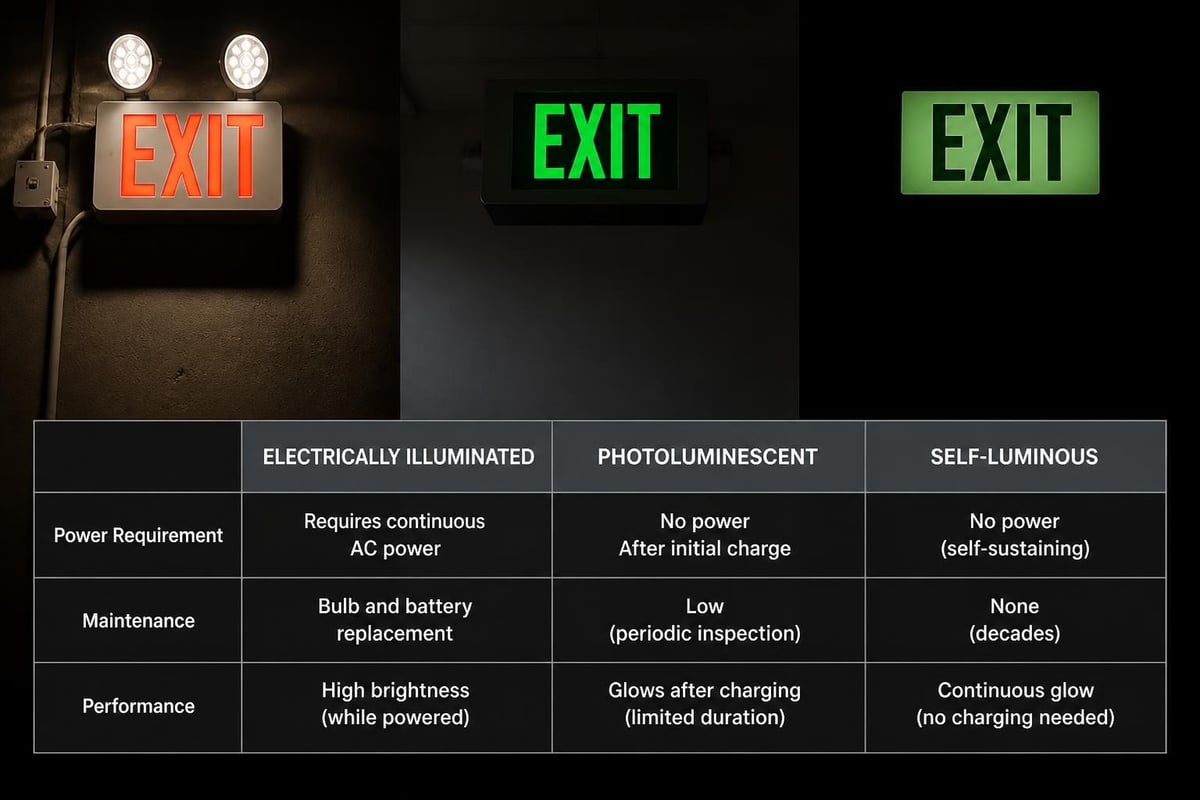
Modern exit signage employs various technologies, each offering distinct advantages depending on the application environment, power availability, and maintenance considerations.
Electrically Illuminated Signs
Traditional electrically powered exit signs remain the most common solution in commercial buildings. These signs use LED, incandescent, or fluorescent light sources to ensure visibility in both normal and emergency conditions. UL 924 testing and certification validates that these signs meet rigorous safety standards for emergency operation, including requirements for battery backup duration and self-diagnostic capabilities.
Modern LED exit signs offer significant advantages over older technologies:
- Energy efficiency reducing operational costs by up to 90% compared to incandescent alternatives
- Extended lifespan with typical LED arrays lasting 25 years or more
- Reduced maintenance minimizing lamp replacement and associated labour costs
- Improved reliability with solid-state components that resist vibration and thermal cycling
- Self-testing capabilities that automatically verify battery and lamp function
| Technology | Average Lifespan | Power Consumption | Maintenance Frequency | Initial Cost |
|---|---|---|---|---|
| LED | 25+ years | 2-5W | Minimal (5+ years) | Medium-High |
| Fluorescent | 5-10 years | 15-30W | Annual | Low-Medium |
| Incandescent | 1-2 years | 40-60W | Quarterly | Low |
Photoluminescent Exit Signs
Photoluminescent signs represent an increasingly popular alternative that requires no electrical power or batteries. These signs absorb ambient light and emit a visible glow for several hours in darkness, making them ideal for locations where power reliability is questionable or wiring is impractical.
The GSA P100 Facilities Standards provides detailed guidance on photoluminescent material applications, including minimum illumination levels required to charge the material and integration with emergency lighting systems. These standards have driven adoption in federal facilities and influenced commercial building practices.
Advantages of photoluminescent exit signage:
- Zero energy consumption during normal operation
- No batteries requiring periodic replacement
- Immune to power failures and electrical system damage
- Long service life (typically 10-25 years with proper charging light)
- Environmentally friendly with no hazardous materials
Self-Luminous Signs
Tritium-based self-luminous signs provide continuous illumination without electrical power, using radioactive gas sealed within glass tubes. While effective, regulatory requirements surrounding radioactive materials have limited their adoption, and many facilities are transitioning to LED or photoluminescent alternatives.
Installation Standards and Placement Criteria
Proper placement of exit signage directly impacts its effectiveness during emergencies. Codes specify mounting heights, viewing distances, and orientation requirements that ensure signs remain visible and comprehensible under adverse conditions.
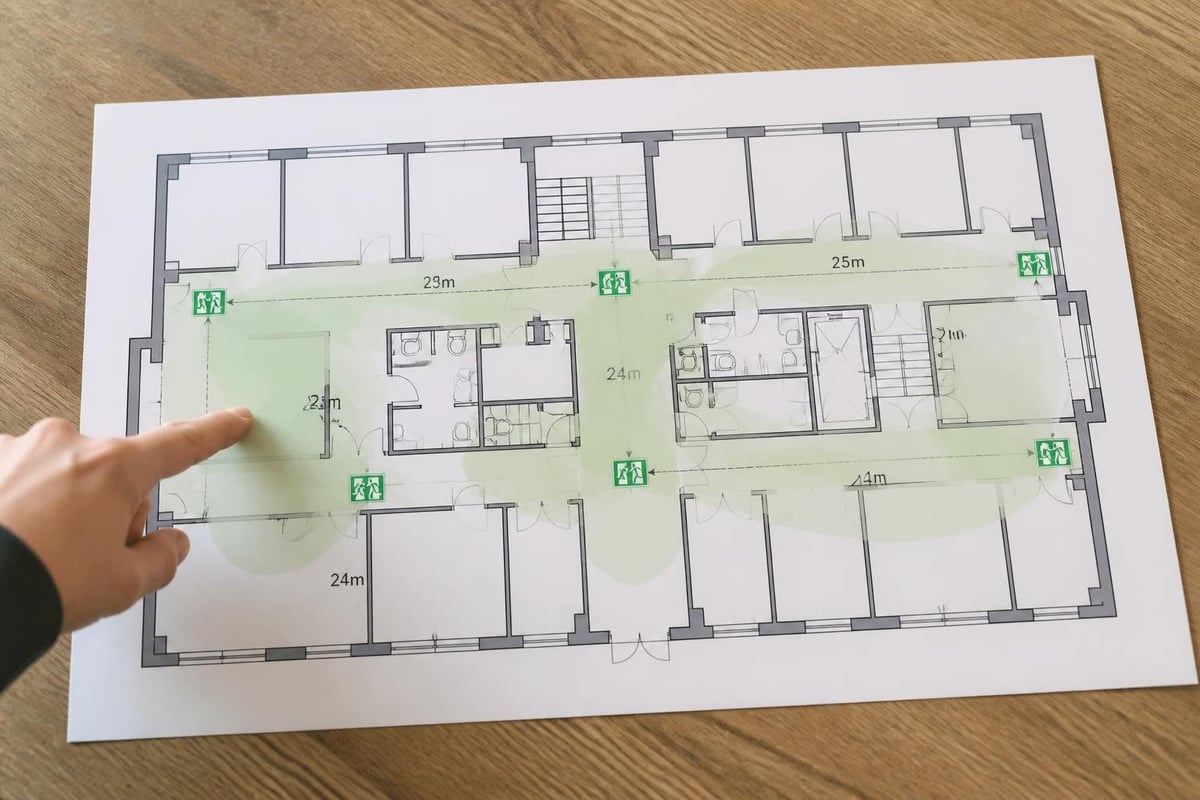
Exit signs must typically be mounted above the doorway or adjacent to it, positioned so that no point in the exit access is more than 30 metres from the nearest visible sign. In corridors, signs should be placed at intervals ensuring continuous visibility, accounting for smoke stratification that might obscure ceiling-mounted signs.
Directional Indicators
When the exit route requires occupants to change direction, directional exit signage becomes essential. These signs incorporate arrows or text indicating the direction of travel, preventing confusion at corridor intersections or where multiple doorways exist.
The International Building Code and NFPA 101 require directional indicators whenever the exit location might be unclear from a given vantage point. This includes:
- Corridor junctions and intersections
- Large open areas where multiple exits exist
- Locations where the direct path to an exit is obstructed
- Stairwell entries and discharge points
Maintenance and Testing Requirements
Exit signage reliability depends on systematic maintenance and testing programmes. Electrically illuminated signs require monthly visual inspections to verify that lamps are functioning and that battery backup systems activate properly during simulated power failures.
Monthly inspection checklist:
- Verify all lamps or LEDs are illuminated
- Test battery backup by interrupting power supply
- Confirm minimum 90-minute emergency operation duration
- Check for physical damage, discolouration, or obstruction
- Verify directional arrows point correctly
- Document findings and remedial actions
Annual testing should include comprehensive battery discharge tests and verification that self-testing systems (where installed) are functioning correctly. Many modern signs incorporate self-diagnostic features that automatically conduct these tests and provide visual indicators of system health.
Photoluminescent Sign Maintenance
While photoluminescent exit signage eliminates electrical maintenance, these signs require adequate ambient light levels to charge effectively. Regular monitoring ensures that charging illumination meets manufacturer specifications, typically requiring 54 lux for at least one hour before darkness.
Periodic cleaning maintains optimal luminance, as dust accumulation can reduce both charging efficiency and glow output. The safety signs surface should be cleaned with mild detergent and water, avoiding abrasive materials that might damage the photoluminescent coating.
Emerging Technologies and Standards
Recent developments in exit signage technology address both performance enhancements and alternative design approaches. UL 924A outlines requirements for emergency signs with alternative visual designs, providing a certification pathway for innovative solutions that maintain safety performance while offering improved aesthetics or functionality.
Dynamic exit signs represent one promising innovation, using electronically controlled displays to adapt directional guidance based on real-time conditions. These systems integrate with fire alarm and building management systems to redirect occupants away from hazardous areas, potentially reducing evacuation times and preventing movement toward danger.
Smart Building Integration
Modern exit signage increasingly interfaces with broader building safety systems, enabling coordinated emergency response. Integration capabilities include:
- Automated testing and reporting that logs compliance activities and alerts facility managers to failures
- Occupancy sensor integration that adjusts illumination levels based on space utilization
- Fire alarm system coordination ensuring signs remain visible when emergency lighting activates
- Building analytics tracking sign performance and predicting maintenance needs
Selection Criteria for Different Applications
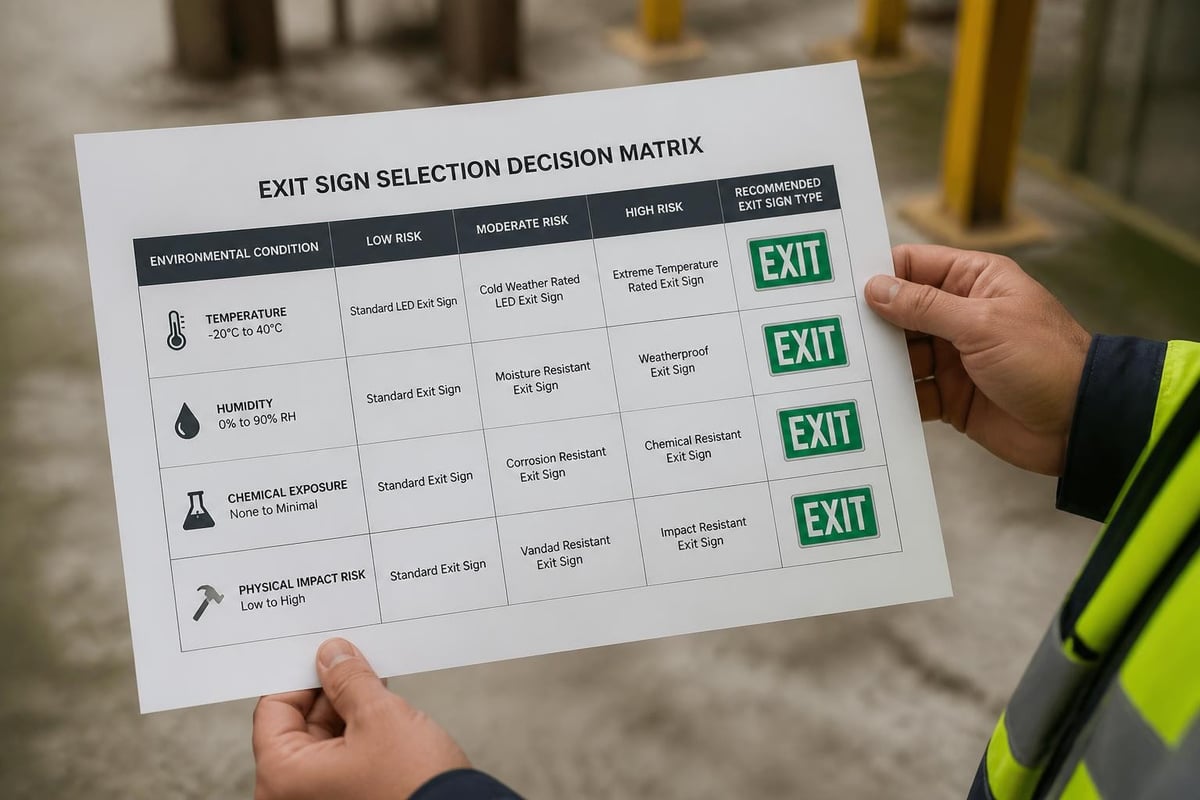
Choosing appropriate exit signage requires evaluating multiple factors including building type, occupancy classification, environmental conditions, and operational requirements. Industrial facilities face different challenges than office buildings, and healthcare institutions have unique needs distinct from retail environments.
| Application | Recommended Technology | Key Considerations | Special Requirements |
|---|---|---|---|
| Office Buildings | LED with battery backup | Energy efficiency, aesthetics | ADA compliance, minimal maintenance |
| Industrial Facilities | LED or photoluminescent | Harsh environments, power reliability | Explosion-proof where required |
| Healthcare | LED with extended battery | Life safety critical, 24/7 operation | Infection control finishes |
| Retail | LED, decorative options | Brand integration, code compliance | High-traffic durability |
| Warehouses | Photoluminescent or LED | High ceilings, vehicle traffic | Impact resistance |
Environmental Considerations
Extreme temperatures, high humidity, chemical exposure, and physical impact risk all influence exit signage selection. Manufacturing facilities using corrosive chemicals require signs with specialized coatings or housings that resist degradation. Cold storage warehouses demand signs rated for sub-zero operation, whilst outdoor or semi-enclosed spaces need weatherproof enclosures meeting appropriate ingress protection ratings.
Fire-fighting signs often coexist with exit signage in egress routes, and coordination between these safety marking systems ensures comprehensive wayfinding during emergencies. Both sign types should use consistent mounting heights and visibility criteria to create an integrated safety communication system.
Cost Considerations and Return on Investment
Initial procurement costs represent only a portion of total exit signage ownership expenses. A comprehensive financial analysis accounts for installation labour, ongoing energy consumption, routine maintenance, periodic testing, and eventual replacement.
LED exit signs typically command higher initial prices than traditional alternatives but deliver substantial long-term savings through reduced energy consumption and maintenance requirements. A typical LED sign consuming 3 watts costs approximately £2 annually to operate, whilst a fluorescent equivalent at 20 watts costs roughly £13 annually. Over a 25-year service life, this difference compounds significantly, particularly in facilities with hundreds of exit signs.
Photoluminescent signs eliminate energy costs entirely whilst reducing maintenance labour, though they require adequate ambient lighting infrastructure to charge effectively. Facilities with 24-hour lighting or robust emergency illumination systems find these signs particularly cost-effective.
Lifecycle Analysis
Five-year total cost comparison (per sign):
- LED Exit Sign: £180 initial + £10 energy + £50 maintenance = £240 total
- Fluorescent Exit Sign: £60 initial + £65 energy + £200 maintenance = £325 total
- Photoluminescent Sign: £120 initial + £0 energy + £25 maintenance = £145 total
These figures demonstrate why many facility managers now specify LED or photoluminescent technologies for new construction and renovation projects, despite higher upfront investment.
Compliance Verification and Documentation
Maintaining comprehensive documentation of exit signage installation, testing, and maintenance activities provides essential evidence of regulatory compliance whilst supporting liability management. Building owners and facility managers should retain records including:
- Initial installation certificates and as-built drawings showing sign locations
- Product specifications and certification documents (UL listings, photometric data)
- Monthly inspection logs with tester signatures and findings
- Annual test reports including battery discharge test results
- Maintenance records documenting lamp replacements and repairs
- Modification history when egress routes or sign locations change
Regular compliance audits verify that installed exit signage meets current code requirements, particularly important in older buildings where regulations may have changed since original construction. These audits often identify deficiencies including signs that have become obstructed, directional indicators that no longer align with current egress routes, or equipment that has exceeded its service life.
Third-Party Verification
Many jurisdictions require periodic inspection by qualified third parties, such as fire safety professionals or building officials. These inspections validate not only the physical presence of exit signage but also proper operation, adequate illumination levels, and compliance with accessibility requirements. General informational signs supporting egress routes should also be reviewed during these inspections to ensure comprehensive wayfinding systems.
Training and Occupant Awareness
Even the most sophisticated exit signage system proves ineffective if building occupants don't understand its function or ignore its guidance during emergencies. Regular evacuation drills reinforce the importance of following exit signs rather than retracing entry routes, a common error that can lead to entrapment.
Training programmes should address:
- The meaning and purpose of different exit sign types and configurations
- Why occupants should follow exit signs rather than familiar paths
- How battery-powered signs continue operating during power failures
- The role of photoluminescent materials in smoke-filled environments
- Procedures for reporting damaged or non-functioning exit signage
New employee orientation should include basic information about egress routes and exit signage locations, whilst periodic refresher training maintains awareness amongst long-term staff. Visitor management procedures might include brief orientation to exit locations, particularly in complex facilities where egress routes aren't immediately obvious.
Specialized Applications and Unique Requirements
Certain building types present unique exit signage challenges requiring specialized solutions. High-rise buildings must address smoke movement patterns that can obscure ceiling-mounted signs, often necessitating additional low-level path marking to maintain visibility. Assembly occupancies with theatrical lighting need signs that remain visible under varying ambient light conditions without creating distraction during performances.
Healthcare facilities face particular challenges balancing life safety requirements with patient care considerations. Exit signs in patient rooms must be visible yet not so bright as to disturb sleep, whilst signs in operating theatres and imaging suites must be compatible with medical equipment and procedures. Many healthcare facilities specify signs with dimming capabilities or specialized filters that maintain code-required illumination whilst minimizing light pollution.
Specialized exit signage applications:
- Marine environments: Corrosion-resistant materials and sealed housings protecting against salt spray
- Explosion-hazard locations: Intrinsically safe designs approved for classified areas
- Nuclear facilities: Radiation-resistant materials and components maintaining function after exposure
- Data centres: Signs compatible with electromagnetic interference requirements
- Clean rooms: Smooth surfaces and materials compatible with stringent contamination controls
Each specialized application demands careful product selection ensuring exit signage meets both life safety codes and industry-specific requirements. Working with knowledgeable suppliers helps identify appropriate solutions whilst avoiding costly specification errors.
Exit signage represents a fundamental element of comprehensive building safety, protecting lives through clear, reliable egress guidance during emergencies. Understanding regulatory requirements, selecting appropriate technologies, implementing proper installation practices, and maintaining systematic testing programmes ensures your facility meets code obligations whilst providing optimal occupant protection. Whether you're outfitting a new construction project, upgrading aging infrastructure, or simply ensuring ongoing compliance, SafetySignsForSale offers the expertise and product range to meet your exit signage needs across all applications and industries.