


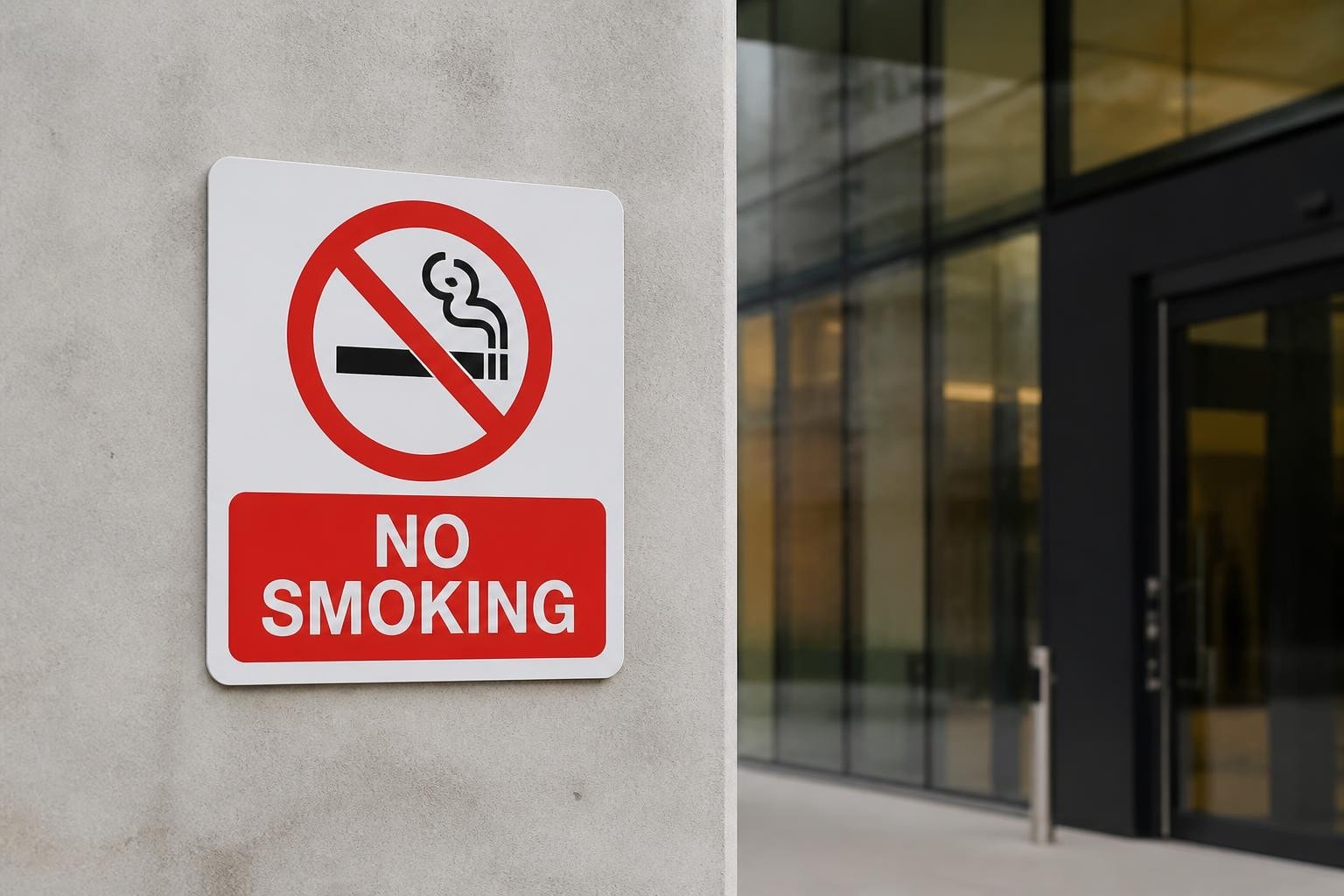
No Smoking Sign: Comprehensive Guide for 2026
The no smoking sign remains one of the most recognisable safety symbols worldwide, serving as a critical component of workplace health and safety programmes. Whether you manage a hospital, educational facility, corporate office, or industrial site, understanding the proper implementation of no smoking signage is essential for regulatory compliance, protecting public health, and creating safer environments for employees and visitors alike. This comprehensive guide explores the legal requirements, strategic placement, material options, and best practices that ensure your smoke-free policies are effectively communicated and enforced.
Legal Requirements and Regulatory Standards
Understanding the legislative framework surrounding no smoking sign requirements is fundamental for compliance. In South Africa, the Tobacco Products Control Amendment Act establishes strict obligations for property owners and employers to designate smoke-free areas and communicate these restrictions clearly.
The regulations specify that a no smoking sign must meet particular design criteria to ensure instant recognition. Size requirements typically mandate minimum dimensions to guarantee visibility from appropriate distances, whilst colour specifications follow international standards utilising red prohibition circles with black symbols on white backgrounds.
Mandatory Display Locations
Compliance requires strategic placement at specific locations:
- All building entrances and exits
- Reception areas and public waiting rooms
- Enclosed workspaces and meeting rooms
- Areas within 10 metres of doorways
- Food preparation and dining facilities
- Healthcare facilities and patient care areas
Legal penalties for non-compliance can be substantial. Employers face potential fines, whilst repeated violations may result in prosecution. Beyond financial consequences, inadequate signage exposes organisations to liability claims from employees or visitors affected by secondhand smoke exposure.
Design Elements and Symbol Recognition
The effectiveness of any no smoking sign depends heavily on its visual design and immediate comprehensibility. International standardisation ensures that these signs communicate universally, regardless of language barriers or literacy levels.
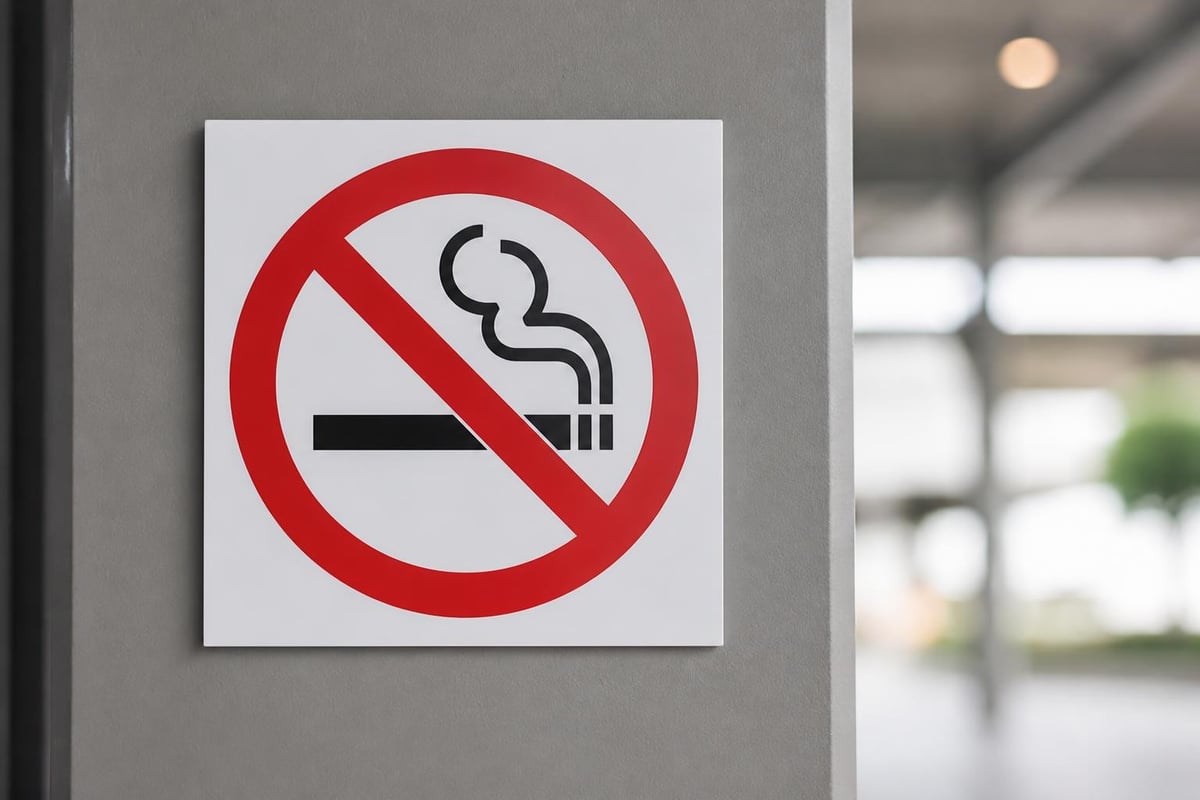
The ISO 7010 standard defines the recognised prohibition symbol: a lit cigarette enclosed within a red circle with a diagonal line. This simple yet powerful graphic transcends cultural boundaries and achieves instant recognition rates exceeding 95% across diverse populations.
Typography and Messaging Clarity
Beyond the symbol, text elements strengthen comprehension and legal enforceability:
| Element | Purpose | Best Practice |
|---|---|---|
| Primary message | Clear prohibition | "No Smoking" in bold, sans-serif font |
| Secondary text | Legal reference | Act citation, penalty information |
| Multi-language | Inclusive communication | Local languages plus English |
| Contact details | Enforcement support | Reporting hotline or manager details |
Font size must be proportional to viewing distance. A sign intended for viewing from 5 metres requires substantially larger text than one positioned at eye level in a confined space. Sans-serif typefaces such as Helvetica or Arial ensure optimal legibility under various lighting conditions.
Strategic Placement and Visibility Optimisation
Merely installing a no smoking sign fulfils only the minimum legal obligation. Strategic placement determines whether your smoke-free policy achieves genuine compliance or becomes ignored wallpaper.
Primary consideration centres on sight lines and approach angles. Position signs where they capture attention before individuals reach prohibited areas. Entrance placements should be visible to approaching pedestrians and drivers alike, accounting for different angles of approach.
Height and Mounting Specifications
Installation height significantly impacts effectiveness:
- Standard eye level: 1.5 to 1.8 metres for pedestrian traffic
- Vehicle-oriented: 2 to 3 metres for car park entrances
- Overhead mounting: Suspended signs in high-traffic areas
- Ground-level markers: Floor decals at building thresholds
- Multi-level placement: Combining wall and ceiling mounts for maximum coverage
Research published in peer-reviewed studies examining campus tobacco policies demonstrates that visibility alone doesn't guarantee compliance. Repetition and strategic clustering prove more effective than sparse distribution.
Environmental factors demand consideration. Outdoor installations face weathering, sun glare, and obstructions from vegetation or seasonal decorations. Regular audits identify compromised visibility requiring repositioning or supplementary signage.
Material Selection for Different Environments
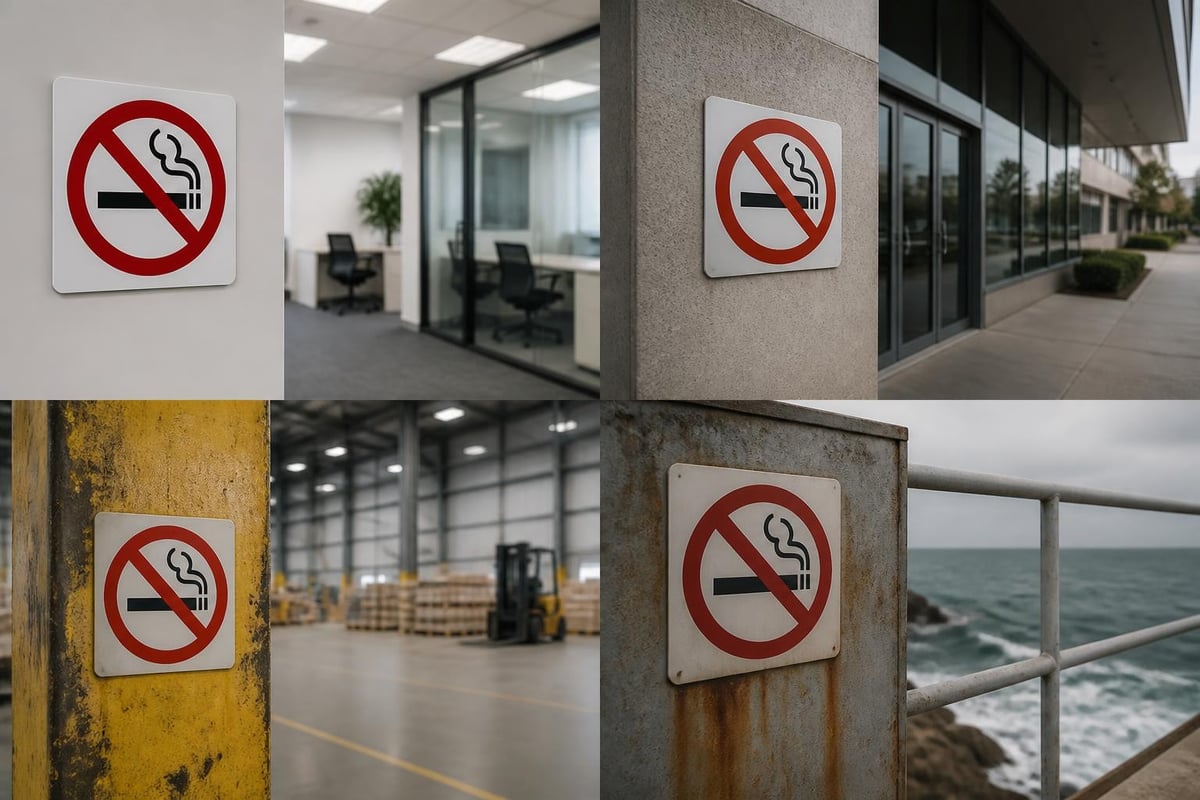
The durability and longevity of your no smoking sign depends entirely on matching materials to environmental conditions. Indoor installations have vastly different requirements compared to outdoor or industrial settings.
Indoor Applications
Interior environments typically allow lighter-weight, cost-effective materials:
- Self-adhesive vinyl: Economical, suitable for smooth surfaces, 3-5 year lifespan
- Rigid plastic: Lightweight yet durable, ideal for wall mounting
- Acrylic panels: Premium appearance, scratch-resistant, professional settings
- Photoluminescent materials: Glow-in-dark capability for emergency evacuation routes
Indoor signs rarely contend with UV degradation or moisture exposure, allowing broader material choices focused on aesthetics and cost efficiency.
Outdoor and Industrial Settings
External installations demand robust materials engineered for environmental challenges:
| Material | Weather Resistance | Expected Lifespan | Best Use Case |
|---|---|---|---|
| Aluminium composite | Excellent | 7-10 years | Building exteriors, car parks |
| Dibond | Superior | 10+ years | Permanent installations |
| Galvanised steel | Outstanding | 10-15 years | Industrial zones, corrosive environments |
| Weatherproof vinyl | Good | 3-5 years | Temporary or seasonal applications |
Anti-graffiti coatings extend lifespan in vandalism-prone areas, whilst UV-stabilised inks prevent fading in direct sunlight. Coastal installations require corrosion-resistant fixings to prevent deterioration from salt spray.
Healthcare and Educational Facilities
Specialised environments such as hospitals, clinics, schools, and universities require heightened attention to smoke-free signage. These settings serve vulnerable populations and demand comprehensive coverage that extends beyond minimum legal requirements.
The Victoria State Government's smoke-free hospital guidelines provide practical templates demonstrating how major health systems implement signage programmes. Their approach combines perimeter boundary signs, entrance notifications, and internal reminders creating layered reinforcement.
Educational Campus Considerations
Schools and universities face unique challenges balancing policy enforcement with educational messaging. Implementation research on smoke-free campus policies reveals that signage works most effectively when integrated with broader communication strategies including ambassadors and staged rollouts.
Educational settings benefit from incorporating explanatory messaging beyond simple prohibition. A no smoking sign can include QR codes linking to cessation resources or health information, transforming passive enforcement into active health promotion.
The WHO toolkit for tobacco-free schools offers sample messaging and signage language specifically developed for educational contexts. These resources balance authority with age-appropriate communication, particularly important for secondary schools and campuses.
Vaping and Electronic Cigarette Considerations
Modern no smoking sign implementations must address the proliferation of electronic cigarettes and vaping devices. Traditional smoking symbols may not clearly communicate prohibitions on these newer products, creating enforcement ambiguities.
Progressive approaches update signage to explicitly include vaping devices through:
- Updated graphics showing both cigarettes and e-cigarettes
- Text clarifications: "No Smoking or Vaping"
- Separate complementary signs addressing electronic devices
- Combined prohibition symbols covering all tobacco and nicotine products
Regulatory developments increasingly treat vaping identically to traditional smoking for workplace policy purposes. Organisations implementing smoke-free environments should future-proof their signage investment by selecting designs that encompass all nicotine delivery systems.
Multi-Format Prohibition Messaging
Comprehensive smoke-free policies benefit from varied sign formats addressing different compliance aspects:
- General prohibition: Standard no smoking sign at entrances
- Designated distance: "Smoke-Free Zone - 10 Metre Radius" perimeter markers
- Vehicle restrictions: "No Smoking in Company Vehicles" dashboard decals
- Temporal restrictions: "Smoking Permitted After Hours Only" if applicable
- Directional guidance: "Designated Smoking Area 50m →" wayfinding
This multi-layered approach removes ambiguity whilst providing clear guidance for compliant behaviour where permitted.
Maintenance and Compliance Auditing
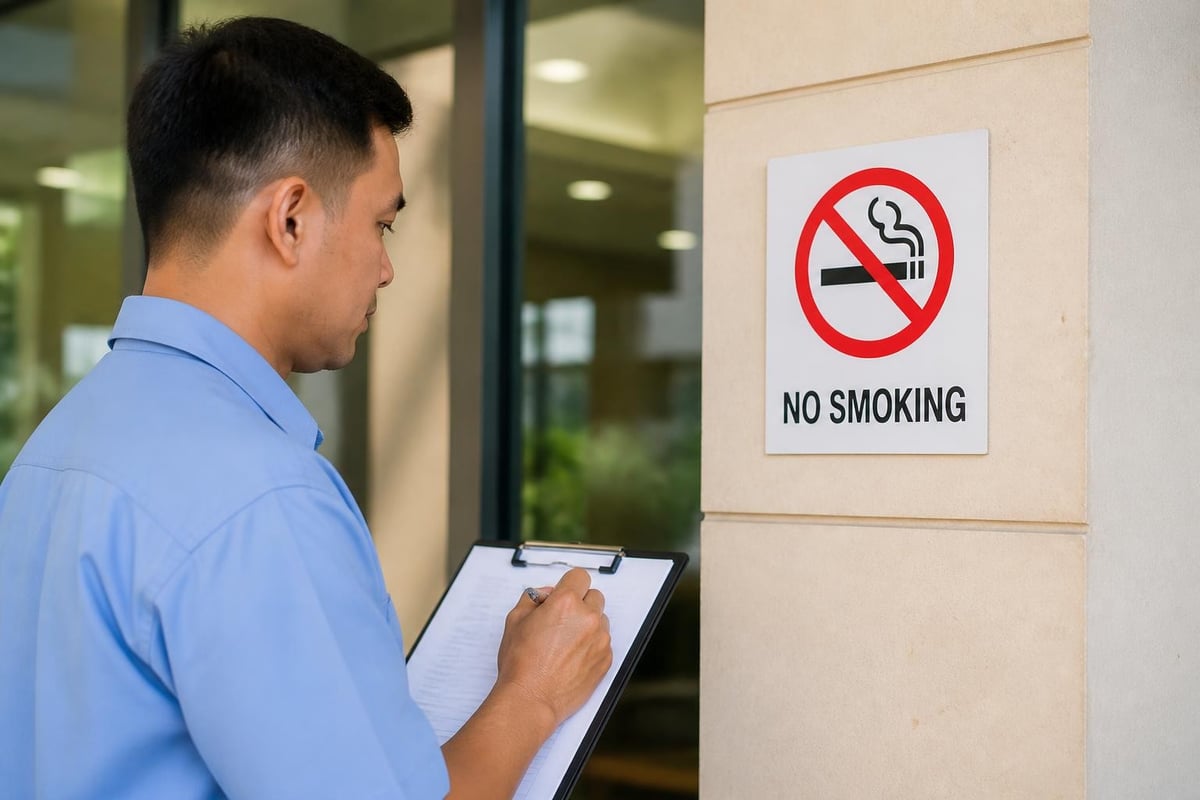
Installing a no smoking sign represents the beginning, not the conclusion, of an effective smoke-free programme. Regular maintenance and systematic auditing ensure continued compliance and effectiveness.
Quarterly inspections should assess:
- Physical condition (fading, damage, vandalism)
- Visibility (obstructions, lighting, vegetation growth)
- Relevance (policy changes, new building areas)
- Completeness (coverage gaps, new risk areas)
Damaged or faded signs undermine policy credibility. A worn no smoking sign signals neglected enforcement, potentially encouraging non-compliance. Prompt replacement demonstrates organisational commitment to health and safety standards.
Documentation and Record Keeping
Maintaining comprehensive records supports both compliance verification and continuous improvement:
| Record Type | Contents | Retention Period | Purpose |
|---|---|---|---|
| Installation log | Locations, dates, specifications | Permanent | Compliance evidence |
| Inspection reports | Condition assessments, photos | 5 years | Maintenance planning |
| Replacement history | Damaged/replaced signs | 3 years | Budget forecasting |
| Compliance incidents | Violations, enforcement actions | 7 years | Policy effectiveness |
Documentation proves particularly valuable during regulatory inspections or incident investigations. Detailed records demonstrate due diligence and systematic approach to smoke-free policy implementation.
Cost-Benefit Analysis and Budget Planning
Organisations often question the investment required for comprehensive no smoking sign coverage. Understanding both direct costs and broader benefits informs appropriate budget allocation.
Direct costs include:
- Sign materials and manufacturing
- Installation labour and fixings
- Ongoing maintenance and replacements
- Compliance auditing systems
These tangible expenses are readily quantifiable. A typical office building might invest £500-£1,500 initially, with annual maintenance costs of £100-£300.
Quantifiable Benefits
The return on investment extends far beyond compliance avoidance:
- Reduced cleaning costs: Elimination of cigarette waste and smoke residue
- Lower fire risk: Decreased probability of smoking-related fires
- Health cost savings: Reduced secondhand smoke exposure health impacts
- Insurance premiums: Potential reductions for smoke-free workplaces
- Productivity gains: Fewer smoking breaks, improved air quality
Research consistently demonstrates that comprehensive smoke-free policies, properly communicated through effective signage, generate substantial long-term savings exceeding initial investments by considerable margins.
Integration with Broader Safety Signage Systems
A no smoking sign functions most effectively as part of an integrated safety communication system rather than an isolated element. Cohesive visual language and systematic placement strategies create comprehensive safety environments.
Complementary Safety Signage
Smoke-free environments often coincide with other safety requirements:
- Fire safety equipment indicators
- Emergency exit and assembly point markers
- First aid facility locations
- Personal protective equipment requirements
- Hazardous materials warnings
Consistent design language across all safety signage enhances recognition and compliance. When every safety sign shares similar formatting, colour schemes, and mounting approaches, observers develop pattern recognition that improves overall safety awareness.
Hierarchy planning ensures critical messages receive appropriate prominence. High-priority warnings, including the no smoking sign in high-risk areas such as fuel storage or oxygen-enriched environments, deserve larger formats and multiple redundant installations.
Cultural Sensitivity and International Standards
Organisations operating across multiple regions or serving diverse populations must consider cultural variations in how smoking prohibitions are perceived and communicated.
The WHO's freedom from tobacco guide addresses global implementation approaches, recognising that whilst the prohibition symbol maintains universal recognition, supporting messaging benefits from cultural adaptation.
Multi-Language Implementations
Workplaces employing diverse linguistic communities strengthen compliance through inclusive communication:
- Primary language (English in South African context)
- Major regional languages (Afrikaans, isiZulu, etc.)
- Pictographic symbols for universal comprehension
- Simplified text for non-native speakers
- Cultural consultation on messaging tone
Symbol-first design ensures that even without textual comprehension, the prohibition remains clear. Text serves to reinforce and clarify rather than communicate the primary message.
Enforcement Strategies and Policy Support
Even the most visible and well-designed no smoking sign achieves limited effectiveness without consistent enforcement. Signage supports policy implementation but cannot replace active management commitment.
Effective enforcement combines several elements:
- Clear consequences: Published penalties for violations
- Consistent application: Non-discriminatory enforcement
- Supportive resources: Cessation programme access
- Positive reinforcement: Recognition for compliance
- Leadership modelling: Management adherence
The most successful smoke-free workplaces position the no smoking sign within a broader culture of health promotion rather than punitive restriction. When smoking cessation support accompanies prohibition, compliance improves significantly.
Visitor and Contractor Management
External parties require particular attention in smoke-free policy communication. A contractor visiting a facility for the first time relies entirely on visible signage for policy awareness.
Pre-visit communication should reference smoke-free policies in contracts and safety briefings. Upon arrival, prominent entrance signage provides immediate reinforcement. Reception staff training ensures verbal confirmation of restrictions, creating multiple touchpoints preventing inadvertent violations.
Temporary visitor badges or vehicle passes can incorporate smoke-free policy reminders, ensuring continued awareness throughout the visit duration.
Emerging Technologies and Smart Signage
Innovation continues transforming how organisations implement and manage no smoking sign systems. Digital and smart technologies offer capabilities impossible with traditional static signs.
Electronic displays enable dynamic messaging adapting to circumstances. A digital no smoking sign might display different messages during working hours versus after-hours periods, or provide real-time air quality monitoring data demonstrating policy effectiveness.
Solar-powered illumination ensures 24-hour visibility without electrical infrastructure. LED edge-lighting creates highly visible signs in dimly lit areas such as car parks or loading bays whilst consuming minimal energy.
IoT Integration Possibilities
Connected signage systems offer sophisticated management capabilities:
- Automated compliance monitoring via smoke detectors
- Instant alerts when violations occur
- Usage pattern analytics identifying high-risk areas
- Remote management and message updates
- Integration with building management systems
Whilst representing higher initial investment, smart systems provide ongoing operational efficiencies and data-driven policy optimisation impossible with conventional approaches.
Temporary Events and Construction Sites
Organisations hosting temporary events or managing construction projects face unique challenges implementing smoke-free policies in dynamic environments. Portable and temporary no smoking sign solutions address these specialised requirements.
Freestanding sign systems provide flexibility without permanent installation:
- Weighted bases for stability without fixings
- Retractable banner stands for indoor events
- A-frame pavement signs for outdoor gatherings
- Temporary barrier-mounted signs for construction zones
- Magnetic vehicle signs for mobile operations
Event organisers should calculate signage requirements based on anticipated attendance, venue size, and duration. Higher-traffic events demand more visible and numerous signs than smaller gatherings.
Construction sites present particular challenges due to changing layouts and transient workforce populations. Daily briefings should reinforce written signage, whilst multilingual formats accommodate diverse contractor teams.
Implementing effective no smoking signage requires careful consideration of legal requirements, strategic placement, appropriate materials, and ongoing maintenance to create genuinely smoke-free environments. When you're ready to upgrade your facility's compliance with high-quality, durable signage that meets all regulatory standards, SafetySignsForSale offers comprehensive solutions tailored to your specific industry requirements, from healthcare and education to industrial and commercial applications.