


T Junction Sign: Essential Guide for Road Safety in 2026
The t junction sign represents one of the most critical warning symbols in road traffic management, alerting drivers to an upcoming intersection where their road meets another at a perpendicular angle. This distinctive triangular sign serves as an essential safety measure, giving motorists advance notice to reduce speed, assess traffic conditions, and prepare for potential turning manoeuvres. Understanding the proper use, placement, and regulatory requirements surrounding these signs is vital for anyone responsible for road safety, traffic management, or facility operations where vehicular movement occurs.
Understanding the T Junction Sign and Its Purpose
A t junction sign functions primarily as an advance warning device, informing drivers that the road they're travelling on will terminate at an intersection with another road running perpendicular to their path. The standard design features a bold T-shaped symbol within a red triangular border on a white background, creating an instantly recognisable visual cue.
The critical safety functions include:
- Providing adequate time for speed reduction before reaching the junction
- Alerting drivers to prepare for priority assessment and potential stops
- Reducing collision risks at intersections where sight lines may be limited
- Ensuring consistent communication across different road networks
The effectiveness of a t junction sign depends heavily on proper placement distance from the actual intersection. According to official UK guidance on warning signs, these signs should typically be positioned between 50 to 270 metres before the junction, with the exact distance determined by road speed, visibility conditions, and local circumstances.

Regulatory Standards and Design Specifications
Different jurisdictions maintain specific standards for t junction sign design and implementation. In the United Kingdom, the Department for Transport specifies diagram 802.1 as the standard T-junction ahead warning sign, whilst the United States follows MUTCD guidelines which outline comparable intersection warning requirements.
The standardised design elements ensure universal recognition:
Visual specifications typically include:
- Equilateral triangular shape with vertex pointing upward
- Red retroreflective border of specified width
- White or yellow retroreflective background
- Black T-symbol with proportions defined by national standards
- Minimum size requirements based on road classification and speed limits
Material quality directly impacts sign longevity and visibility. Modern t junction signs utilise Class 1 or Class 2 retroreflective sheeting, ensuring visibility during both daytime and night-time conditions. Premium variants incorporate microprismatic technology, delivering superior performance across varying weather conditions and approach angles.
T Junction Sign Placement and Positioning Requirements
Strategic placement transforms a t junction sign from a simple marker into an effective safety intervention. The positioning must account for multiple environmental and traffic factors to maximise driver response time.
| Factor | Consideration | Typical Distance |
|---|---|---|
| High-speed roads (60+ mph) | Extended warning distance required | 200-270 metres |
| Medium-speed roads (40-50 mph) | Standard warning distance | 100-150 metres |
| Low-speed roads (<40 mph) | Reduced but adequate warning | 50-100 metres |
| Limited visibility | Additional advance warning | Add 50+ metres |
The mounting height also affects sign visibility and driver comprehension. Standard practice positions the bottom of the sign between 1.5 and 2.1 metres above the road surface, though this may vary in urban environments where pedestrian clearance and street furniture require adjustment.
Supplementary Plates and Additional Information
A t junction sign frequently works in conjunction with supplementary plates that provide additional context. Distance plates indicate the specific distance to the junction, typically shown in yards or metres depending on regional conventions. Direction arrows may be added when the junction configuration requires clarification about which direction the perpendicular road runs.
Common supplementary information includes:
- Distance plates ("200 yards" or "150 m")
- Directional arrows indicating junction orientation
- Advisory speed limits for safe navigation
- Road classification information
- Temporary condition warnings
These supplementary elements enhance the core warning message, giving drivers more precise information to inform their approach strategy. The combination of primary warning and specific details creates a comprehensive communication system that reduces uncertainty and supports safer decision-making.
Private Roads and Industrial Applications
Whilst t junction signs are most commonly associated with public highways, they serve equally important functions on private roads, industrial estates, warehouse complexes, and commercial facilities. Any location where vehicular traffic encounters perpendicular intersections benefits from proper junction signage.
Manufacturing facilities with internal road networks require appropriate warning signs to prevent collisions between delivery vehicles, employee cars, and industrial equipment such as forklifts. The principles remain consistent with public road applications, though the specific standards may follow workplace safety regulations rather than highway codes.
Key private sector applications include:
- Distribution centres with complex internal traffic patterns
- Business parks serving multiple tenants
- Hospital campuses with emergency vehicle access
- Educational institutions with pedestrian and vehicle interaction
- Retail parks managing customer and delivery traffic
The WHO's Global Status Report on Road Safety highlights how consistent signage standards across both public and private roads contribute to overall traffic safety outcomes. When drivers encounter familiar warning symbols regardless of road classification, their response becomes more automatic and reliable.

Installation Best Practices for Maximum Effectiveness
Proper installation extends beyond simply mounting a t junction sign at an appropriate distance. The installation process must consider sign visibility from the driver's perspective, accounting for potential obstructions, lighting conditions, and the surrounding visual environment.
Site Assessment and Visibility Analysis
Before installation, conduct a thorough site assessment from a driver's viewpoint. Approach the intended sign location at typical traffic speeds and identify any factors that might compromise visibility:
- Vegetation that may obscure the sign seasonally
- Existing signage that creates visual clutter
- Curves or gradients affecting sight lines
- Street lighting that may cause glare or shadows
- Competing visual elements near the sign location
This assessment ensures the t junction sign will function effectively year-round, not just at the moment of installation. Vegetation management plans should accompany sign installation to prevent gradual visibility degradation as plants grow.
Mounting Methods and Structural Integrity
The mounting system must withstand environmental stresses whilst maintaining proper orientation. Wind loading calculations determine post specifications, particularly in exposed locations or where larger sign sizes are necessary.
| Mounting Option | Application | Advantages |
|---|---|---|
| Single post | Standard installations | Cost-effective, simple maintenance |
| Double post | Larger signs or high-wind areas | Enhanced stability, professional appearance |
| Wall mounting | Urban environments | Space-saving, integrated with structures |
| Overhead gantry | Multi-lane approaches | Visibility across all traffic lanes |
Foundations must extend below frost lines in applicable climates to prevent seasonal movement. The post should be set in concrete with appropriate depth-to-height ratios, typically requiring foundation depths of 600-900mm for standard installations.
Maintenance and Compliance Management
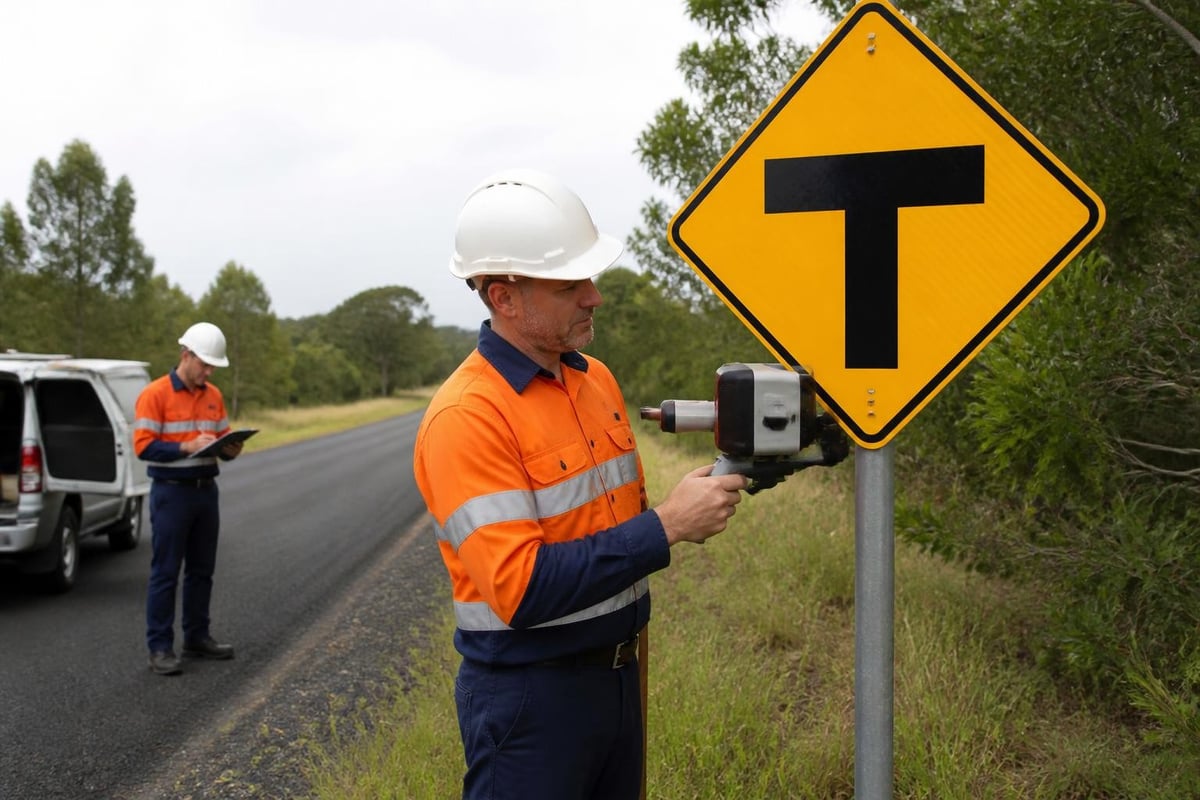
A t junction sign requires ongoing maintenance to sustain its safety function. Environmental exposure gradually degrades retroreflective properties, whilst physical damage from weather events or vehicle strikes can compromise sign integrity.
Regular inspection programmes should assess:
- Retroreflectivity levels using approved measurement devices
- Physical condition including bends, cracks, or delamination
- Mounting security and post stability
- Visibility from approach direction at various times of day
- Compliance with current regulatory standards
British Standard requirements suggest replacement when retroreflectivity falls below minimum thresholds, typically measured in candelas per lux per square metre (cd/lx/m²). Proactive replacement before complete failure maintains consistent safety standards and demonstrates due diligence in facility management.
Documentation and Legal Compliance
Maintaining comprehensive records of t junction sign installation, inspection, and maintenance activities provides essential documentation for compliance verification and liability management. These records should include installation dates, specification details, inspection findings, and any remedial actions taken.
Regulatory requirements evolve over time, and older signs may not meet current standards. Systematic audits identify non-compliant installations requiring upgrade or replacement. This becomes particularly important following changes to national standards or when facility operations modify traffic patterns necessitating revised signage.
T Junction Sign Variations and Special Circumstances
Standard t junction signs address the most common perpendicular intersection configuration, but variations exist for specific scenarios. Staggered junctions, where the perpendicular roads don't align directly opposite each other, may require modified symbols showing the offset arrangement.
Priority junction signs complement the basic t junction warning by indicating which road has priority. These become essential at junctions where the standard "give way" or "stop" rules might not be immediately apparent to approaching drivers.
Temporary Traffic Management Applications
Roadworks, events, and temporary access arrangements frequently create temporary junctions requiring appropriate signage. Temporary t junction signs must meet the same visibility and recognition standards as permanent installations, though they're typically mounted on portable stands rather than permanent posts.
The temporary nature doesn't diminish the safety requirement. In fact, temporary junctions may present higher risk because drivers aren't familiar with the changed traffic patterns. Enhanced warning measures, including advance warning signs and supplementary information plates, help mitigate this increased risk.
Psychological and Behavioural Impact on Driver Response
The effectiveness of a t junction sign extends beyond simple information provision. Research in traffic psychology demonstrates that warning signs trigger specific cognitive processes influencing driver behaviour patterns.
When drivers perceive a t junction sign, they initiate a mental checklist: assess current speed, evaluate braking distance required, scan for other traffic, and determine right-of-way priorities. The sign's presence activates heightened attention and more conservative decision-making compared to unsigned junctions.
Key behavioural responses include:
- Measurable speed reduction in approach zones
- Increased visual scanning of the intersection area
- Earlier brake application and more gradual deceleration
- Greater adherence to priority rules and right-of-way conventions
- Enhanced awareness of pedestrian crossing points
The consistent design and placement of t junction signs across different locations creates learned responses. Drivers develop automatic recognition patterns that function even when conscious attention is divided between multiple tasks. This automaticity proves particularly valuable during high-workload driving situations or when driver fatigue reduces cognitive capacity.
Integration with Broader Traffic Management Systems
A t junction sign rarely operates in isolation. Effective junction safety requires comprehensive planning that addresses all aspects of the intersection environment. The warning sign forms part of a hierarchical system including regulatory signs, road markings, lighting, and potentially traffic signals.
Strategic integration considers how drivers process multiple information sources simultaneously. Signs positioned too closely create information overload, whilst excessive spacing may separate related information that should be processed together. Traffic engineering principles guide optimal spacing between warning signs, regulatory signs, and the physical junction.
Advanced junctions may incorporate variable message signs that supplement static t junction warnings with real-time information about traffic conditions, temporary hazards, or alternative route options. These dynamic elements enhance rather than replace the fundamental warning function of the standard sign.
The relationship between vertical signage and horizontal road markings deserves particular attention. Give way markings, stop lines, and junction boxes should reinforce the same message communicated by the t junction sign. Consistency between vertical and horizontal communication creates redundancy that improves overall system reliability.
Understanding the proper specification, placement, and maintenance of t junction signs is fundamental to road safety management across public highways and private facilities alike. These warning signs serve as critical components in preventing collisions and guiding safe vehicle movement through perpendicular intersections. Whether you're managing a business park, industrial facility, or residential development, ensuring your junction signage meets current standards protects both your organisation and road users. SafetySignsForSale provides comprehensive traffic and safety signage solutions, including compliant t junction signs manufactured to exacting standards, helping you maintain safe environments across your facilities.