


Traffic Signal Systems: Design, Safety & Compliance
Traffic control systems form the backbone of modern road safety infrastructure, with the traffic signal serving as one of the most recognisable and essential components. These devices regulate vehicle and pedestrian movement at intersections, railway crossings, and other critical points in the transportation network. Understanding how traffic signals function, their design requirements, and their role in comprehensive safety systems enables organisations to better protect workers, visitors, and the general public across industrial sites, commercial properties, and public roadways. This guide explores the technical aspects, regulatory frameworks, and practical applications of traffic signal systems whilst connecting these principles to broader workplace safety initiatives.
Fundamental Components of Traffic Signal Systems
A traffic signal comprises several interconnected subsystems working in concert to manage traffic flow safely and efficiently. The signal head-containing red, yellow, and green indications-represents the most visible element, but sophisticated electronics, detection hardware, and communications infrastructure operate behind the scenes.
Signal Head Configuration and Standards
Modern signal heads must comply with precise specifications outlined in the Manual on Uniform Traffic Control Devices, which establishes federal standards for all traffic control devices. The standard configuration includes:
- Vertical arrangements with red on top, yellow in the middle, and green at the bottom
- Horizontal arrangements with red on the left, yellow in the centre, and green on the right
- Lens diameter typically 200mm or 300mm depending on application and visibility requirements
- Light-emitting diode (LED) technology replacing incandescent lamps for improved energy efficiency and longevity
Signal faces may include additional indications such as arrows for protected turning movements, pedestrian countdown displays, and bicycle-specific signals. The placement height, lateral position, and number of signal faces per approach follow detailed engineering guidelines to ensure adequate visibility from all approach lanes.
| Component | Standard Specification | Purpose |
|---|---|---|
| Red indication | Top position (vertical) or left position (horizontal) | Stop and remain stopped |
| Yellow indication | Middle position | Clearance interval warning |
| Green indication | Bottom position (vertical) or right position (horizontal) | Permitted movement |
| Arrow indications | Adjacent to or replacing circular indications | Protected or permissive turning movements |
Controller Hardware and Logic
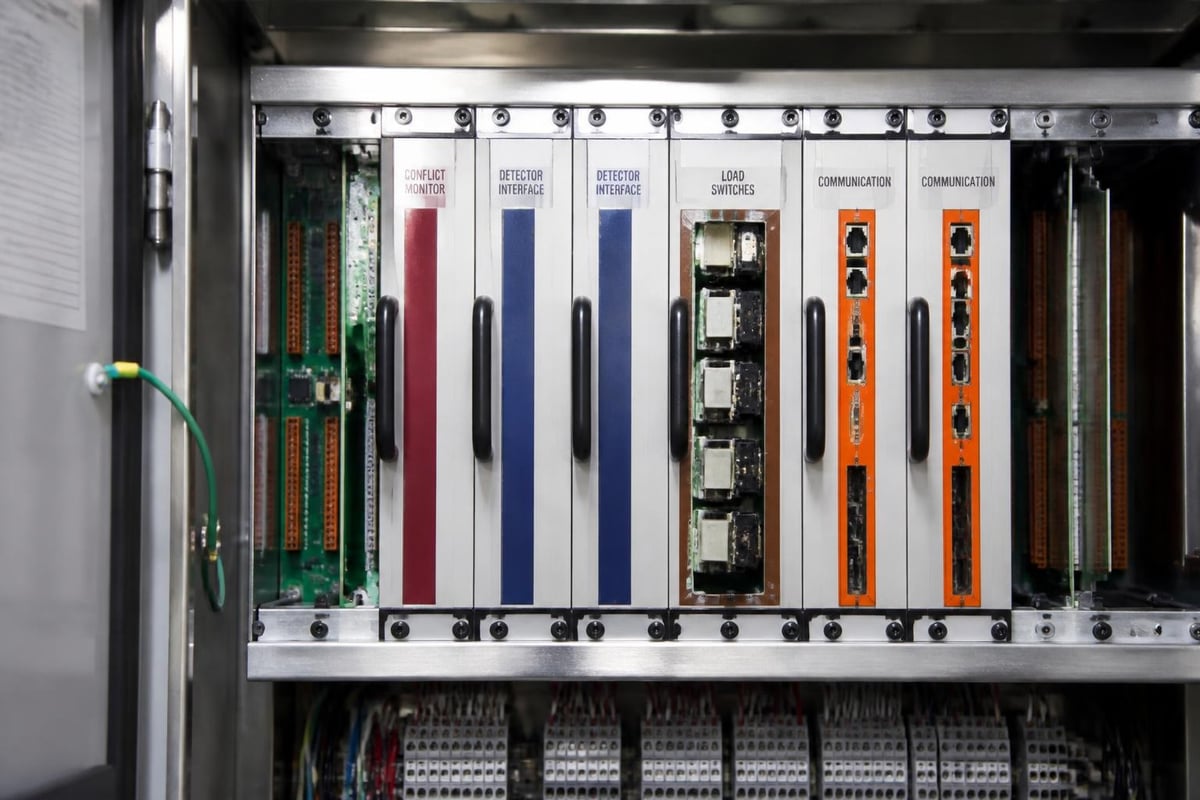
The traffic signal controller functions as the system's brain, executing timing plans and responding to vehicle and pedestrian actuation. Contemporary controllers utilise advanced microprocessors running sophisticated algorithms that adjust signal timing based on real-time traffic conditions. These systems incorporate multiple operational modes:
Fixed-time operation executes pre-programmed timing plans based on time of day and day of week. This approach suits locations with predictable traffic patterns where historical data demonstrates consistent demand profiles throughout the day.
Actuated operation responds to vehicle presence detected through loops, video cameras, or radar sensors. The controller extends green time when vehicles continue to arrive and transitions to the next phase when gaps occur in traffic flow.
Adaptive operation represents the most advanced approach, with controllers continuously monitoring traffic conditions across multiple intersections and adjusting timing parameters to optimise network performance. Research published in Transportation Research Part C demonstrates how modern adaptive systems combine pressure-based control with perimeter strategies to manage congested urban networks.
Engineering Standards and Warrant Analysis
Installing a traffic signal requires rigorous engineering analysis to determine whether this control type appropriately addresses the intersection's safety and operational needs. The FHWA Traffic Signal Program Handbook provides comprehensive guidance on signal warrant evaluation, design procedures, and ongoing operations.
Traffic Signal Warrants
Engineers must evaluate nine distinct warrants before recommending traffic signal installation:
- Eight-hour vehicular volume requiring specific vehicle counts on major and minor approaches
- Four-hour vehicular volume with higher thresholds over shorter periods
- Peak hour addressing specific high-demand periods
- Pedestrian volume focusing on pedestrian crossing needs
- School crossing protecting student movements
- Coordinated signal system maintaining progression along corridors
- Crash experience addressing demonstrated safety concerns
- Roadway network serving circulation needs
- Intersection near a grade crossing providing queue clearance
Meeting a single warrant does not automatically justify signal installation. Engineers must consider alternative treatments, conduct benefit-cost analyses, and evaluate potential negative impacts such as increased rear-end collisions or delay on low-volume approaches.
Design Considerations for Industrial and Commercial Sites
Private property owners operating industrial facilities, shopping centres, distribution warehouses, and office parks frequently encounter situations where traffic signals may benefit internal circulation. These installations must balance several factors:
- Integration with public roadway systems requiring coordination with local transportation authorities
- Emergency vehicle access ensuring fire apparatus and ambulances maintain unimpeded routes
- Pedestrian safety particularly in high-activity areas with workers moving between buildings
- Heavy vehicle movements accommodating lorries, forklifts, and specialised equipment
Sites requiring traffic signals for internal roadways should coordinate with suppliers of comprehensive safety signs to ensure consistent visual communication throughout the property. Regulatory signage, warning signs, and road signs complement traffic signal installations by reinforcing desired behaviours and highlighting specific hazards.
Signal Timing and Performance Measurement
Optimal signal timing balances competing objectives: minimising delay, reducing stops, improving safety, and supporting pedestrian access. The ITE Traffic Engineering Handbook serves as the profession's definitive reference for timing methodology and performance criteria.
Critical Timing Parameters
Several key parameters determine how a traffic signal operates:
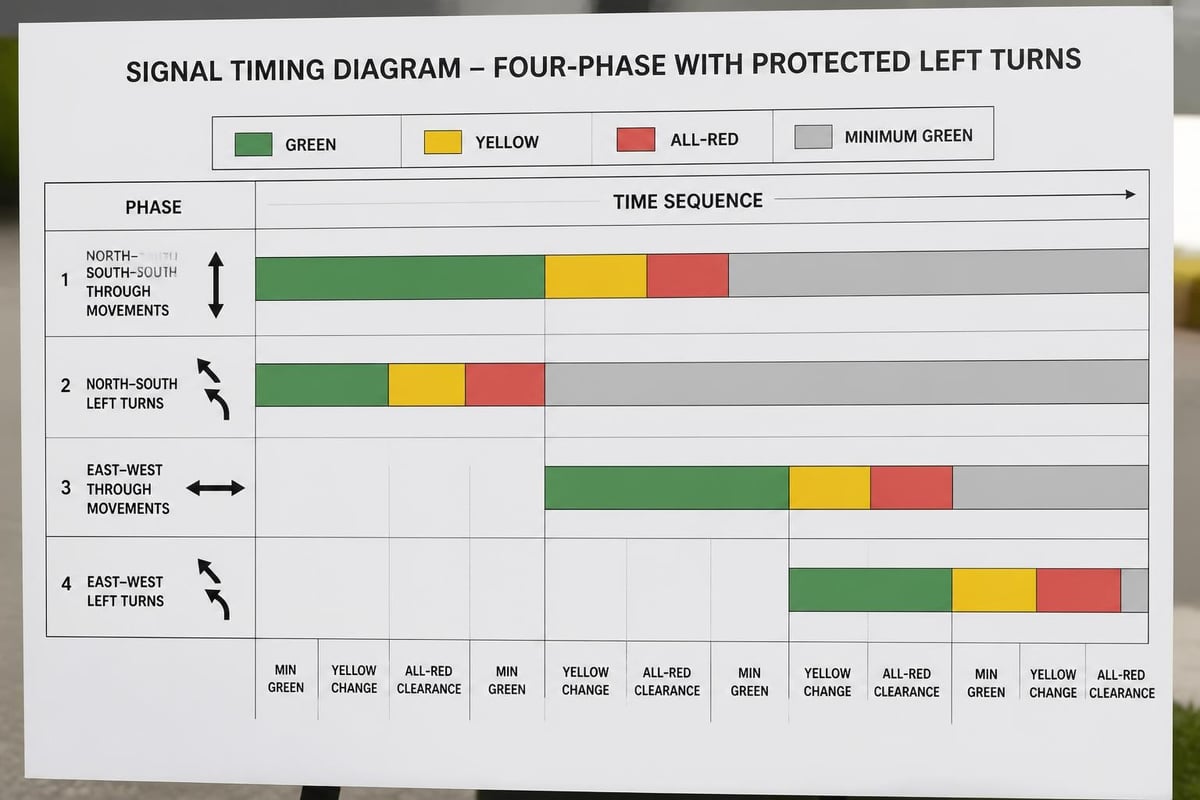
Cycle length represents the total time required to serve all phases and return to the beginning of the sequence. Longer cycles generally reduce delay but increase wait times for minor movements. Typical cycle lengths range from 60 to 150 seconds depending on intersection geometry and traffic volumes.
Green time allocation distributes available green time among competing movements based on traffic demand. Engineers use volume-to-capacity ratios, critical lane analysis, and optimisation algorithms to determine appropriate splits.
Change intervals include yellow time and all-red clearance time. Yellow duration depends on approach speed and driver reaction characteristics, whilst all-red time ensures the intersection clears before conflicting movements receive green. These intervals directly impact safety, with research on red-light running demonstrating the importance of adequate clearance timing.
Automated Traffic Signal Performance Measures
Modern controllers and detection systems generate vast quantities of data enabling continuous performance monitoring. The National Academies synthesis on automated traffic signal performance measures documents how agencies use high-resolution controller data to identify operational deficiencies and prioritise improvements.
Common performance metrics include:
- Split failures (vehicles unable to clear during allocated green)
- Arrivals on red (vehicles stopping unnecessarily due to poor progression)
- Pedestrian delay (wait time exceeding reasonable thresholds)
- Communication failures (loss of connectivity in coordinated systems)
| Performance Metric | Target Threshold | Significance |
|---|---|---|
| Split failure rate | <5% of cycles | Indicates inadequate capacity or poor timing |
| Arrivals on green | >60% of vehicles | Demonstrates good progression quality |
| Average pedestrian delay | <30 seconds | Ensures reasonable pedestrian service |
| Communication uptime | >99% | Maintains coordination effectiveness |
Safety Considerations and Countermeasures
Whilst traffic signals generally improve safety compared to uncontrolled intersections with similar traffic volumes, they introduce specific crash patterns requiring attention. Understanding these patterns enables more effective countermeasure selection and comprehensive safety planning.
Common Crash Types at Signalised Intersections
Right-angle collisions typically decrease following signal installation as the device establishes clear right-of-way assignment. However, rear-end crashes often increase as following vehicles fail to anticipate leading vehicle deceleration. Additional crash patterns include:
Red-light running violations causing severe right-angle impacts. These crashes carry high injury severity due to impact speeds and vulnerable side-impact zones. Countermeasures include increased yellow time, all-red clearance, red-light cameras, and advance warning systems.
Left-turn crashes occurring when drivers misjudge gaps during permissive operation or violate protected-only restrictions. Protected-only left-turn phasing eliminates these conflicts but increases delay and cycle length.
Pedestrian crashes resulting from inadequate crossing time, poor visibility, or drivers failing to yield during permitted turns. Leading pedestrian intervals, enhanced crosswalk markings, and pedestrian countdown displays improve safety.
Integration with Comprehensive Safety Systems
Traffic signal effectiveness increases when integrated into broader safety management programmes. Industrial facilities, commercial complexes, and institutional campuses benefit from coordinated approaches combining:
- Traffic signals at primary access points and internal intersections
- Warning signs alerting drivers to signal presence, especially at unexpected locations
- Mandatory signs reinforcing required actions and movement restrictions
- Pavement markings delineating lanes, stop bars, and crosswalks
- Lighting ensuring adequate visibility during darkness and adverse weather
Communications and Connected Vehicle Technology
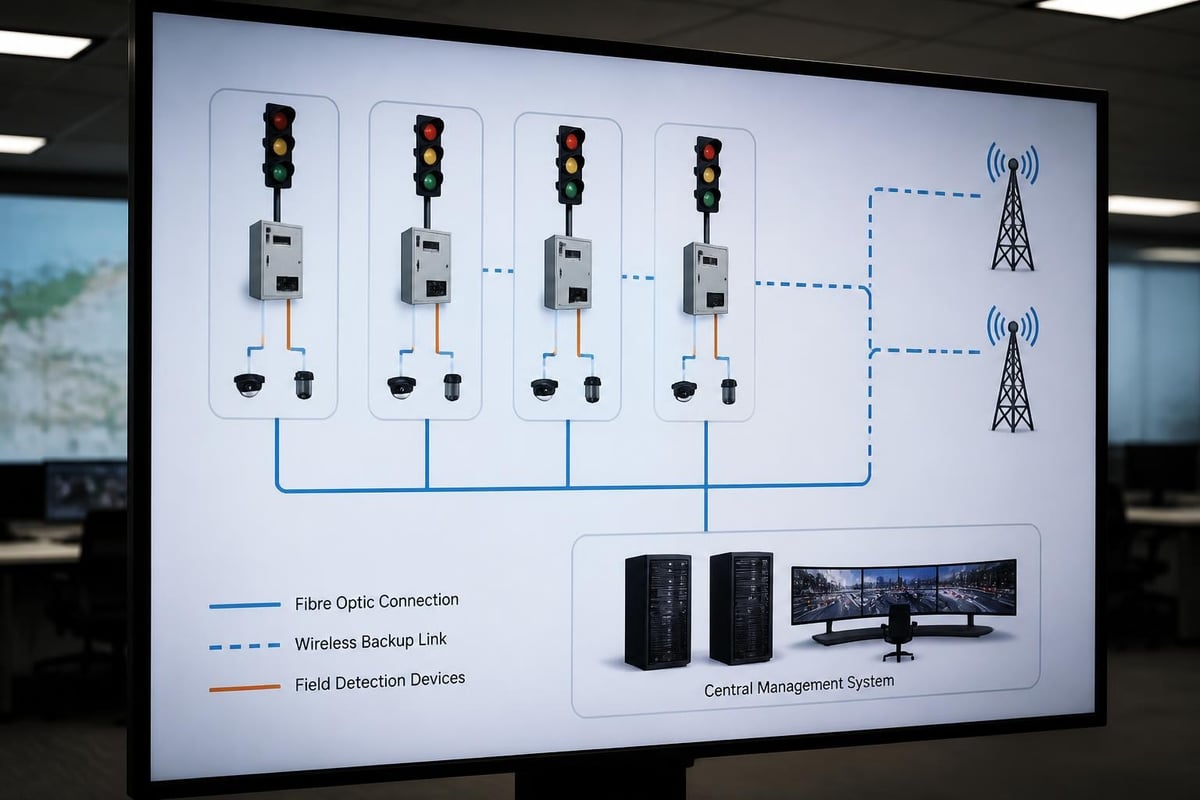
Modern traffic signal systems increasingly incorporate sophisticated communications infrastructure enabling remote monitoring, adaptive control, and connected vehicle applications. The NTCIP standards define protocols for exchanging data between field controllers and central management systems.
Communications Infrastructure Options
Agencies and private operators deploy various communications technologies depending on budget constraints, geographic factors, and performance requirements:
Fibre optic cables provide highest bandwidth and reliability, supporting video transmission, high-resolution data exchange, and future expansion. Initial installation costs are substantial but operating expenses remain low.
Wireless systems including cellular, licensed radio, and dedicated short-range communications offer flexibility and lower installation costs. Performance varies with signal strength, interference, and service provider reliability.
Hybrid approaches combining fibre backbone networks with wireless connections to isolated signals or recently added intersections balance cost and performance.
Connected Vehicle Applications
Emerging connected vehicle technology enables direct communication between traffic signals and equipped vehicles. Signal Phase and Timing (SPaT) messages broadcast current signal status and predicted phase changes, allowing vehicles to optimise speed for progression or warn drivers of impending red indications.
Vehicle-to-Infrastructure (V2I) applications extend beyond basic information sharing to enable:
- Priority requests from emergency vehicles, transit buses, and freight trucks
- Pedestrian safety warnings for vulnerable road users
- Curve speed warnings and queue alerts
- Green Light Optimal Speed Advisory (GLOSA) reducing fuel consumption and emissions
Maintenance and Operations Best Practices
Reliable traffic signal operation requires systematic maintenance programmes addressing both preventive servicing and responsive repairs. The Transportation Research Board's collection of NCHRP reports provides valuable guidance on asset management and maintenance strategies.
Preventive Maintenance Schedules
Regular inspection and servicing prevent failures that compromise safety and create liability exposure:
- Monthly inspections verifying proper operation, checking for damaged components, and cleaning lenses
- Quarterly timing reviews confirming timing plans match current conditions and seasonal variations
- Annual comprehensive assessments testing all subsystems, verifying detector accuracy, and updating firmware
- Three-to-five-year component replacement addressing wear items before failure occurs
Organisations operating private traffic signals should establish maintenance agreements with qualified contractors or develop in-house capabilities. Documentation systems tracking inspection results, repairs, and timing changes prove invaluable for troubleshooting and demonstrating due diligence.
Common Operational Issues
Several recurring problems affect traffic signal performance:
| Issue | Symptoms | Resolution |
|---|---|---|
| Controller failure | Dark signals or flashing operation | Replace controller or repair power supply |
| Detection system malfunction | Phases skipping or excessive delay | Recalibrate or replace detectors |
| Communication loss | Loss of coordination or remote monitoring | Repair communications infrastructure |
| Conflict monitor activation | Signal enters flashing mode | Investigate and clear conflict condition |
Many jurisdictions require traffic signals to operate in flashing mode (red for major street, yellow for minor street) when malfunctions occur. This fail-safe operation maintains basic safety whilst signalling obvious problems requiring immediate attention.
Regulatory Compliance and Documentation
Traffic signal installations must comply with multiple regulatory frameworks depending on jurisdiction and location. State transportation departments typically adopt the federal MUTCD with state-specific supplements. For example, the Florida DOT Traffic Engineering Manual demonstrates how agencies customise national standards to address local conditions and priorities.
Essential Documentation Requirements
Comprehensive documentation supports proper operation, maintenance, and legal defence:
As-built drawings showing signal head locations, conduit routing, detector placements, and controller cabinet specifications enable efficient troubleshooting and future modifications.
Timing sheets documenting all timing parameters for each timing plan with effective dates and modification rationale support performance evaluation and historical analysis.
Warrant analysis reports justifying initial installation decisions demonstrate engineering due diligence and provide baseline conditions for future evaluation.
Maintenance logs recording all inspections, repairs, complaints, and operational changes establish accountability and identify recurring problems.
Coordination with Workplace Safety Programmes
Organisations integrating traffic signals into comprehensive safety management systems should ensure alignment with other safety initiatives. Sites requiring fire-fighting signs, mandatory signs, and PPE protocols benefit from unified visual communication standards and coordinated training programmes.
Traffic signal timing should consider emergency vehicle movements, evacuation routes, and hazardous material transport requirements. Coordinating these operational aspects with fire safety systems, first aid facilities, and emergency response plans creates more resilient and safer operations.
Advanced Control Strategies and Future Developments
Traffic signal technology continues evolving rapidly with artificial intelligence, machine learning, and big data analytics transforming traditional control approaches. These advances enable more responsive, efficient, and sustainable traffic management whilst introducing new implementation challenges.
Adaptive Signal Control Technology
Adaptive systems represent the current state-of-the-art, continuously adjusting timing parameters based on real-time traffic measurements. Unlike traditional actuated control responding to immediate vehicle presence, adaptive systems anticipate traffic patterns and coordinate responses across multiple intersections.
Benefits include:
- Reduced delay and stops through improved progression
- Better response to non-recurring congestion from incidents or special events
- Enhanced pedestrian and bicycle accommodation
- Lower emissions and fuel consumption from reduced idling
Implementation requires substantial investment in detection infrastructure, communications systems, and ongoing technical support. Agencies must carefully evaluate whether expected benefits justify these costs compared to optimised conventional timing.
Artificial Intelligence Applications
Emerging AI applications learn traffic patterns from historical data and make sophisticated predictions about future conditions. Deep learning algorithms identify complex relationships between weather, special events, day of week, and traffic demand that exceed traditional modelling capabilities.
Neural networks trained on thousands of signal cycles can:
- Predict optimal timing adjustments before congestion develops
- Identify anomalous patterns indicating incidents or detector failures
- Recommend maintenance priorities based on performance degradation trends
- Simulate proposed timing changes with higher accuracy than traditional models
These capabilities remain primarily in research and pilot deployment stages but demonstrate significant promise for future operational systems.
Traffic signal systems represent critical infrastructure supporting safe and efficient movement throughout modern transportation networks and private facility operations. Proper design, installation, maintenance, and integration with comprehensive safety programmes maximise their effectiveness whilst minimising operational risks. Whether managing public roadways or private industrial sites, organisations committed to safety excellence recognise that traffic signals function best as part of coordinated visual communication systems. For businesses seeking to enhance safety across all operations, SafetySignsForSale provides comprehensive solutions spanning regulatory signage, warning systems, fire safety equipment, PPE, and first aid supplies-delivering the integrated approach modern safety management demands.