


Pedestrian Crossing Signal: Standards & Safety
The pedestrian crossing signal remains one of the most critical safety devices in modern traffic infrastructure, serving millions of people daily as they navigate busy streets and intersections. From the familiar "Walk" and "Don't Walk" indicators to advanced accessible pedestrian systems with audible tones and tactile features, these devices have evolved significantly to meet diverse user needs and regulatory standards. Understanding the specifications, installation requirements, and accessibility features of pedestrian crossing signals is essential for facilities managers, safety officers, municipal planners, and businesses responsible for traffic control devices.
Understanding Pedestrian Crossing Signal Standards
A pedestrian crossing signal is a traffic control device specifically designed to inform pedestrians when it is safe to cross a roadway at signalized intersections. These signals operate in coordination with vehicular traffic signals to create safe crossing windows whilst maintaining efficient traffic flow.
The Official Manual on Uniform Traffic Control Devices (MUTCD) establishes comprehensive standards for pedestrian signal indications across the United States. The latest edition provides detailed specifications regarding:
- Signal face design and symbology
- Minimum pedestrian clearance intervals
- Pushbutton placement and operational characteristics
- Countdown pedestrian signal timing
- Accessible pedestrian signal integration
Core Components of Modern Systems
Today's pedestrian crossing signal systems typically incorporate several integrated components working in synchronization. The primary signal heads display either word messages ("WALK"/"DON'T WALK") or the internationally recognized symbols of a walking person and an upraised hand.
Standard signal displays include:
- Walking person (steady): Pedestrians may begin crossing
- Flashing upraised hand: Do not start crossing; finish crossing if already in the roadway
- Steady upraised hand: Do not enter the crosswalk
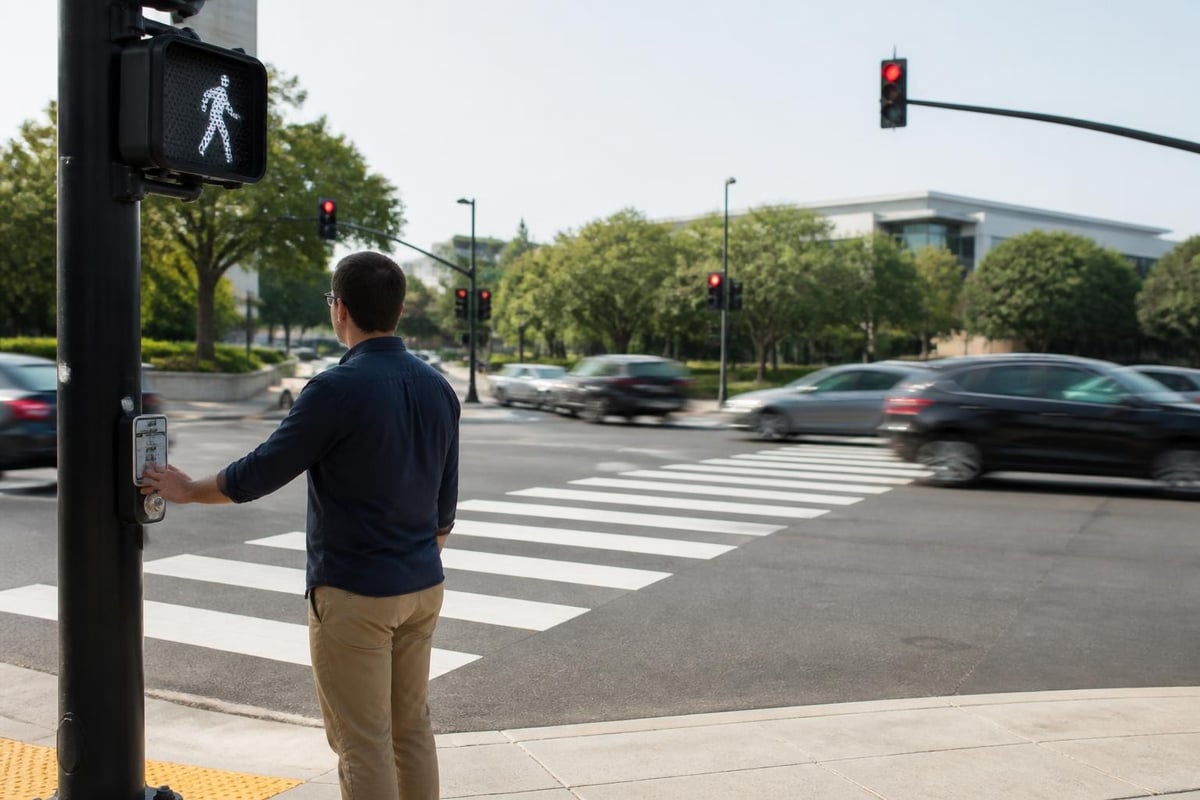
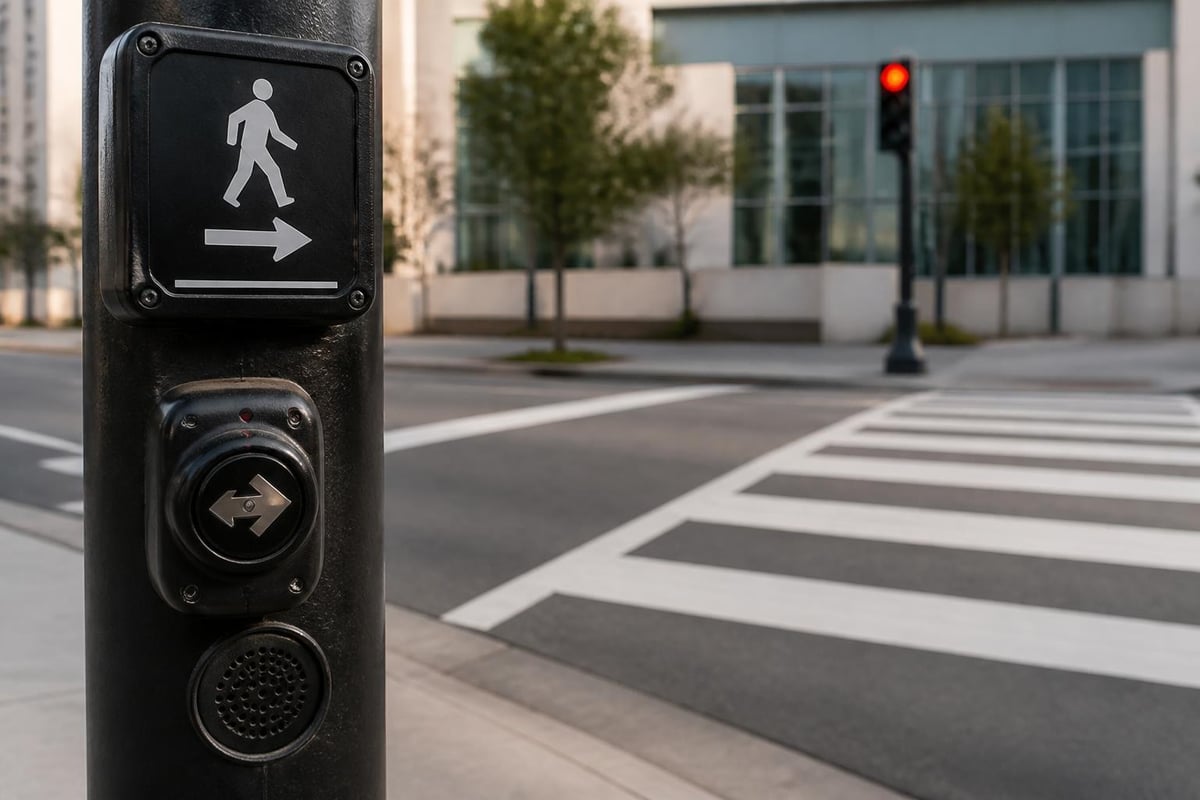
Pedestrian pushbuttons serve as the interface between users and the traffic control system, allowing pedestrians to register their presence and request crossing time. Modern pushbuttons often feature locator tones, tactile arrows, and vibrotactile surfaces to accommodate users with visual impairments.
Accessible Pedestrian Signal Requirements
Accessibility has become a paramount consideration in pedestrian crossing signal design and implementation. The Public Rights-of-Way Accessibility Guidelines (PROWAG) mandate specific features to ensure pedestrians with disabilities can safely navigate crossing facilities.
Accessible Pedestrian Signals (APS) provide non-visual and tactile information to communicate the same information conveyed by visual pedestrian signal indications. These systems are particularly crucial for individuals with vision loss who cannot see the standard signal displays.
Key Accessibility Features
| Feature | Purpose | Standard Requirement |
|---|---|---|
| Audible Walk Indication | Communicates WALK phase | Distinct tone or speech message |
| Locator Tone | Helps users locate pushbutton | Quiet repeating sound |
| Vibrotactile Surface | Tactile feedback during WALK | Arrow vibrates during crossing phase |
| Speech Messages | Provides intersection information | Optional but recommended |
| Volume Adjustment | Adapts to ambient noise | Automatic adjustment capability |
The NCHRP Guidelines for Accessible Pedestrian Signals provide evidence-based recommendations for functional requirements and proper installation practices. These guidelines emphasize the importance of proper placement, with pushbuttons positioned within reach ranges specified by accessibility standards and located to clearly indicate which crossing they control.
Common Installation Challenges
Research from the U.S. Access Board on APS installation identifies frequent problems that compromise accessibility effectiveness:
- Incorrect pushbutton placement: Buttons placed too far from the crossing or at confusing locations
- Inadequate volume settings: Audible tones too quiet or excessively loud
- Poor message clarity: Unclear speech messages or conflicting information
- Insufficient tactile features: Missing or poorly maintained vibrotactile arrows
- Lack of maintenance: Broken speakers, non-functioning locator tones, or damaged tactile surfaces
A pedestrian crossing signal system that fails to incorporate proper accessibility features excludes significant portions of the population from independent mobility. Facilities managers must ensure regular maintenance and testing of all accessibility components.
Safety Benefits and Effectiveness
The implementation of properly designed pedestrian crossing signal systems delivers measurable safety benefits. According to the Insurance Institute for Highway Safety research on pedestrian crossings, signalized crossings with well-designed pedestrian facilities significantly reduce pedestrian-vehicle conflicts.
Documented safety improvements include:
- Reduced pedestrian-vehicle collision rates at treated intersections
- Decreased illegal crossing behavior when adequate crossing time is provided
- Enhanced compliance with traffic signals by both pedestrians and motorists
- Improved safety for vulnerable road users including children and elderly pedestrians
Global Best Practices
The World Health Organization's pedestrian safety manual emphasizes that pedestrian crossing signal deployment must be part of a comprehensive approach to pedestrian safety. Effective implementation requires consideration of:
Engineering factors:
- Appropriate signal timing based on crossing distance and pedestrian walking speeds
- Clear sight lines between signals and approaching pedestrians
- Adequate illumination for nighttime visibility
- Complementary road design features such as curb extensions and refuge islands
Operational factors:
- Regular timing reviews to ensure adequate crossing intervals
- Coordination with adjacent signals to minimize pedestrian delays
- Seasonal adjustments for changing daylight conditions
- Emergency vehicle preemption protocols that safely clear pedestrians
Installation and Maintenance Considerations
Proper installation of a pedestrian crossing signal requires careful attention to multiple technical and practical factors. The positioning, mounting height, signal visibility, and system integration all contribute to overall effectiveness.
Installation Best Practices
Pushbutton placement represents one of the most critical installation decisions. The Pedestrian and Bicycle Information Center guidance recommends specific placement criteria:
- Position buttons within 1.5 to 3 metres of the crosswalk edge
- Install at appropriate heights (900mm to 1200mm from the ground surface)
- Ensure clear space around the pushbutton for wheelchair users
- Orient tactile arrows to point in the direction of travel across the street
Signal heads must be positioned to maximize visibility whilst avoiding visual clutter or confusion. At complex intersections with multiple pedestrian crossings, each crossing requires clearly identifiable signal indications that cannot be mistaken for signals controlling other movements.
Ongoing Maintenance Requirements
A pedestrian crossing signal system requires regular maintenance to ensure continued safe operation. Maintenance schedules should include:
Monthly inspections:
- Visual check of all signal lenses and housing
- Verification of pushbutton operation
- Testing of locator tones and vibrotactile features
- Cleaning of lenses and pushbutton surfaces
Quarterly maintenance:
- Audible tone volume verification under various ambient conditions
- Speech message clarity assessment
- Timing verification for all pedestrian phases
- Electrical connection inspection
Annual comprehensive review:
- Complete system functional testing
- Timing analysis and adjustment as needed
- Wear and damage assessment
- Compliance verification with current standards
Documentation of all maintenance activities creates an essential record for liability protection and helps identify recurring issues requiring corrective action.
Timing and Phasing Strategies
The effectiveness of any pedestrian crossing signal depends heavily on appropriate timing parameters. Signal timing must balance pedestrian safety needs with traffic efficiency requirements, a challenge that requires careful engineering analysis.
Calculating Pedestrian Clearance Time
Pedestrian clearance intervals must provide sufficient time for pedestrians who entered the crosswalk during the WALK indication to safely complete their crossing. The standard calculation considers:
| Factor | Typical Value | Adjustment Considerations |
|---|---|---|
| Pedestrian walking speed | 1.0 to 1.2 m/s | Slower speeds near schools, hospitals, senior facilities |
| Start-up time | 3 seconds | Additional time before pedestrian enters roadway |
| Crossing distance | Actual curb-to-curb width | Include median widths, refuge islands |
| Buffer time | 1-2 seconds | Safety margin for slower individuals |
Modern pedestrian crossing signal systems increasingly incorporate countdown displays showing the remaining time available for crossing. These countdown timers help pedestrians make informed decisions about whether to begin crossing or wait for the next cycle.
Special Phasing Configurations
Different intersection geometries and traffic patterns may require specialized pedestrian signal phasing:
- Exclusive pedestrian phase: All vehicular traffic stops whilst pedestrians cross in all directions (also called pedestrian scramble)
- Leading pedestrian interval: Pedestrians receive a WALK signal several seconds before parallel vehicles get a green signal
- Rest in walk: Pedestrian signals default to WALK when activated, rather than requiring a pushbutton press
- Pedestrian recall: System automatically calls a pedestrian phase every cycle without requiring pushbutton activation
Each configuration offers specific advantages for particular site conditions, traffic volumes, and pedestrian safety needs.

Regulatory Compliance and Liability Considerations
Organizations responsible for pedestrian crossing signal installation and maintenance face significant regulatory obligations and potential liability exposure. Compliance with established standards protects both pedestrians and the implementing agency.
Key Regulatory Frameworks
Multiple regulatory authorities establish requirements for pedestrian crossing signal systems:
Federal standards govern basic operational characteristics, signal indications, and accessibility features. The MUTCD provides the baseline requirements applicable across the United States, though states may adopt more stringent provisions.
Accessibility regulations under the Americans with Disabilities Act and PROWAG mandate specific APS features and installation practices. Non-compliance can result in enforcement actions and civil rights complaints.
State and local codes often supplement federal requirements with additional specifications tailored to regional conditions or particular safety concerns.
Documentation and Record-Keeping
Maintaining comprehensive records of pedestrian crossing signal installations, maintenance, and modifications serves multiple important purposes:
- Demonstrates due diligence in safety management
- Supports defence against liability claims
- Tracks system performance and identifies improvement needs
- Facilitates planning for system upgrades and replacements
- Ensures continuity during staff transitions
Essential documentation includes installation plans, timing studies, maintenance logs, complaint records, incident reports, and modification histories.
Technology Advancements and Future Trends
Pedestrian crossing signal technology continues to evolve, incorporating new capabilities that enhance safety, accessibility, and operational efficiency. Several emerging trends are reshaping how these critical safety devices function.
Smart Signal Technologies
Connected and intelligent pedestrian crossing signal systems can adapt to real-time conditions:
- Automatic pedestrian detection using video analytics or thermal sensors
- Dynamic timing adjustments based on observed pedestrian volumes
- Integration with traffic management centres for coordinated network operation
- Remote monitoring and diagnostics to identify maintenance needs proactively
Enhanced Accessibility Features
Next-generation accessible pedestrian signals incorporate advanced features beyond basic compliance requirements:
Smartphone integration allows users with visual impairments to receive personalized crossing information and navigation assistance through dedicated apps. These systems can provide detailed intersection geometry information and customize audible features to individual preferences.
Improved tactile communication systems provide richer information through varied vibration patterns, potentially indicating crossing distance, time remaining, or approaching vehicles.
Multi-language speech messages accommodate diverse communities and international visitors, enhancing usability across broader populations.
Sustainability Considerations
Modern pedestrian crossing signal installations increasingly emphasize energy efficiency and environmental responsibility:
- LED signal displays reducing power consumption by up to 90% compared to incandescent lamps
- Solar-powered systems for locations where electrical service is unavailable or impractical
- Wireless communication reducing infrastructure costs and environmental disruption
- Extended-life components minimizing replacement frequency and waste generation
Selection Criteria for Different Applications
Choosing the appropriate pedestrian crossing signal configuration requires analysis of specific site conditions, user populations, and operational requirements. No single solution suits all locations.
Intersection Complexity Assessment
Simple two-way intersections with clear geometries and moderate pedestrian volumes may require only basic signal heads and pushbuttons. Standard timing calculations suffice, and accessibility features can follow straightforward placement guidelines.
Complex multi-leg intersections demand more sophisticated approaches. Multiple crossing locations, turning movements, and varied signal phases require careful signal placement to avoid confusion. APS installations must clearly indicate which crossing each pushbutton controls through proper placement and tactile arrows.
User Population Considerations
The anticipated user population significantly influences appropriate pedestrian crossing signal specifications:
| User Group | Key Considerations | Recommended Features |
|---|---|---|
| Schools | Child pedestrians, adult supervision | Extended crossing times, high-visibility signals |
| Hospitals/Medical | Mobility-impaired users, wheelchair users | Full APS, extended clearance, accessible pushbuttons |
| Senior facilities | Slower walking speeds, vision/hearing loss | APS with speech, longer clearance, rest-in-walk |
| Transit stations | High volumes, time-sensitive users | Shorter cycle lengths, countdown displays |
| Commercial areas | Diverse users, high volumes | Full accessibility, clear sight lines, adequate capacity |
Environmental Factors
Site-specific environmental conditions affect both equipment selection and installation specifications:
High-noise environments require APS with higher maximum volume capabilities and potentially different audible tones that better penetrate ambient noise. Industrial areas, locations near highways, or sites with construction activity present particular challenges.
Extreme weather locations need ruggedized equipment rated for temperature extremes, moisture protection, and resistance to ice formation. Coastal installations require corrosion-resistant materials and sealed electrical connections.
Lighting conditions influence signal visibility requirements. Locations with significant backlighting from the sun at certain times of day may require higher-intensity signal displays or modified placement angles.
Integration with Broader Safety Infrastructure
A pedestrian crossing signal functions most effectively when integrated within a comprehensive safety infrastructure system. Isolated signal installations, whilst beneficial, achieve maximum effectiveness through coordination with complementary safety measures.
Complementary Safety Elements
Advance warning signage alerts approaching motorists to the presence of the pedestrian crossing signal ahead, particularly important on higher-speed approaches where drivers need additional notice to prepare to stop.
Pavement markings including crosswalk striping, stop bars, and directional arrows reinforce the regulatory requirements and guide both pedestrians and motorists to appropriate positions.
Illumination ensures visibility during darkness and poor weather conditions. Dedicated crossing illumination should meet minimum horizontal illuminance levels specified in design standards.
Physical infrastructure such as curb ramps, detectable warning surfaces, and pedestrian refuge islands works in concert with the pedestrian crossing signal to create a complete accessible crossing facility.
Safety Sign Coordination
Effective pedestrian safety requires coordination between traffic control devices and static safety signage. Warning signs, regulatory signs, and informational signs all contribute to creating a predictable and safe crossing environment.
Organizations responsible for pedestrian facilities should ensure consistent messaging between dynamic signals and static signs, maintaining visual and informational coherence throughout the crossing area. This coordination extends to construction zones where temporary pedestrian crossing signal installations may be necessary during roadwork activities.
Understanding pedestrian crossing signal standards, accessibility requirements, and proper installation practices ensures safer crossing facilities for all road users whilst maintaining regulatory compliance. Whether you're managing a commercial facility, industrial site, or public infrastructure, SafetySignsForSale provides the comprehensive range of safety signs, traffic control products, and complementary safety equipment needed to create effective pedestrian safety systems throughout your organization.