


Road and Safety Signs: Complete Guide for 2026
Road and safety signs form the backbone of visual communication systems that protect lives across highways, facilities, construction zones, and public spaces. Understanding the different categories, regulatory frameworks, and proper implementation of these critical warning devices ensures compliance whilst reducing accidents and liability. This comprehensive guide explores the essential elements of effective signage systems, from international standards to practical placement strategies that work in 2026's evolving safety landscape.
Understanding Road and Safety Signs Categories
Road and safety signs serve distinct yet complementary purposes within comprehensive protection systems. Road signs primarily govern traffic movement, warn of hazards ahead, and provide navigational information to motorists. Safety signs, meanwhile, communicate workplace hazards, emergency procedures, and mandatory precautions within facilities and controlled environments.
The Vienna Convention on Road Signs and Signals established international harmonization for traffic control devices, creating recognizable shapes and symbols across signatory nations. This standardization enables drivers to navigate unfamiliar territories safely, whilst safety signs follow region-specific standards like ANSI Z535 in the United States or ISO 7010 globally.
Regulatory Road Signs
Regulatory signs communicate laws and regulations that drivers must obey. These include:
- Stop signs: Octagonal red signs requiring complete vehicle cessation
- Yield signs: Triangular signs indicating right-of-way priorities
- Speed limit signs: Rectangular signs displaying maximum permitted velocities
- No entry signs: Circular signs with red borders prohibiting access
- One-way signs: Rectangular directional indicators
Compliance with regulatory road and safety signs carries legal weight, with violations typically resulting in fines or penalties. The Federal Highway Administration's MUTCD provides comprehensive specifications for design, colour, size, and placement of these devices throughout the United States.
Warning and Hazard Signs
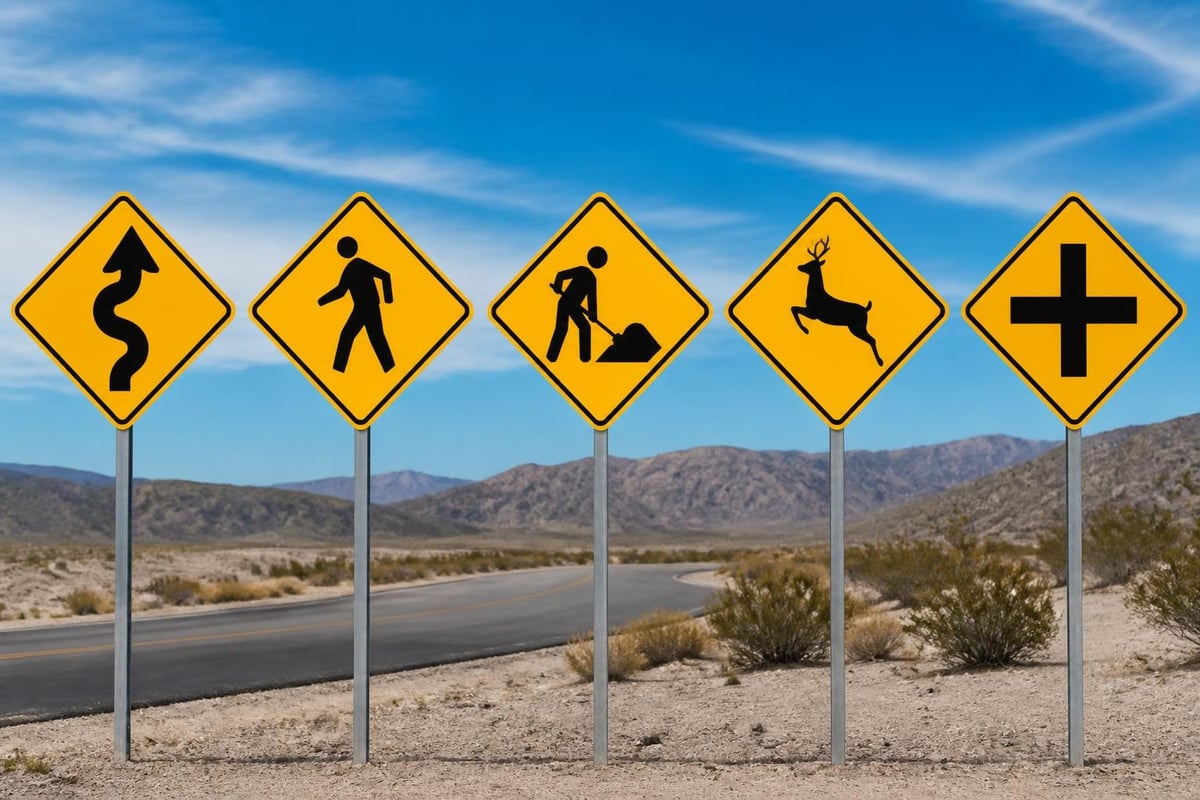
Warning signs alert road users to potential dangers ahead, allowing time for appropriate response. Standard warning signs feature diamond shapes with black symbols on yellow backgrounds, creating high visibility even in challenging conditions.
| Warning Type | Symbol | Typical Placement | Response Required |
|---|---|---|---|
| Sharp curve | Curved arrow | 150-300m before curve | Reduce speed |
| Pedestrian crossing | Walking figure | 30-60m before crossing | Prepare to yield |
| Road works | Worker with shovel | At work zone boundary | Reduce speed, merge |
| School zone | Children crossing | 100-200m before school | Significant speed reduction |
The WHO's Pedestrian Safety Manual emphasizes proper warning sign placement as crucial for reducing pedestrian fatalities, particularly in urban environments where multiple road users interact.
Facility and Workplace Safety Signs
Workplace safety signs communicate hazards, prohibitions, mandatory actions, and emergency information within industrial, commercial, and public facilities. These road and safety signs follow different standards than traffic devices, focusing on stationary hazards and procedural compliance.
Hierarchy of Safety Sign Types
Safety signs employ a colour-coded hierarchy system recognized internationally:
Prohibition signs feature circular shapes with red borders and diagonal slashes, indicating forbidden actions. Common examples include "No Smoking," "No Unauthorised Access," and "Do Not Touch."
Warning signs utilize triangular shapes with yellow backgrounds and black borders. These alert personnel to hazards like electrical danger, chemical exposure, or overhead loads.
Mandatory signs display circular blue backgrounds with white pictograms, commanding specific actions such as wearing PPE, following directional flows, or maintaining hygiene protocols.
Emergency and safe condition signs feature green backgrounds indicating escape routes, first aid stations, assembly points, and emergency equipment locations.
The ANSI Z535 standards provide detailed specifications for American facility safety signs, whilst ISO 7010 offers international harmonization for pictogram design and meaning.
Design Principles for Maximum Effectiveness
Effective road and safety signs share fundamental design characteristics ensuring rapid comprehension across literacy levels, lighting conditions, and viewing distances. Poor design compromises safety regardless of placement or maintenance.
Legibility and Visibility Factors
Research from the Sign Research Foundation demonstrates that legibility depends on multiple interrelated variables:
- Letter height: Minimum 25mm per metre of viewing distance
- Contrast ratio: Minimum 70% between background and message
- Font selection: Sans-serif typefaces with stroke-width ratios between 1:5 and 1:8
- Colour combinations: High-contrast pairings like black-on-yellow or white-on-red
- Surface finish: Non-reflective materials for general use, retroreflective for night visibility
Viewing angle also affects sign effectiveness. Road and safety signs should maintain readability within 30 degrees off-axis from the primary approach vector. This consideration proves especially important at intersections where drivers approach from multiple directions.

Symbol Versus Text Communication
Pictographic symbols communicate faster than text across language barriers, making them invaluable for international facilities and diverse workforces. However, symbol recognition requires either intuitive design or prior training.
| Communication Method | Advantages | Limitations | Best Applications |
|---|---|---|---|
| Text only | Precise, detailed information | Language-dependent, slower recognition | Supplementary information, procedures |
| Symbol only | Universal, rapid recognition | May require training, limited detail | Immediate hazards, directions |
| Symbol + text | Combines speed with clarity | Requires more space | General safety warnings, emergency information |
| Colour coding | Instant categorization | Cultural variations, accessibility issues | Hazard hierarchy, zoning |
Modern road and safety signs increasingly adopt hybrid approaches, pairing internationally recognized symbols with text reinforcement for maximum clarity.
Strategic Placement and Installation
Even perfectly designed signs fail when poorly positioned. Strategic placement considers viewing distance, decision time, environmental factors, and potential obstructions.
Placement Guidelines for Road Signs
The MUTCD establishes specific placement criteria based on road classification, speed limits, and sign function. Key principles include:
- Advance warning distance: Warning signs appear sufficiently ahead of hazards to permit safe response
- Clear zone compliance: Signs positioned outside traffic areas or protected by appropriate barriers
- Height standards: Minimum 2.1 metres clearance in urban areas, 1.5 metres in rural settings
- Lateral offset: Minimum 600mm from edge of shoulder to sign face
- Sight distance: Unobstructed visibility for distances matching posted speeds
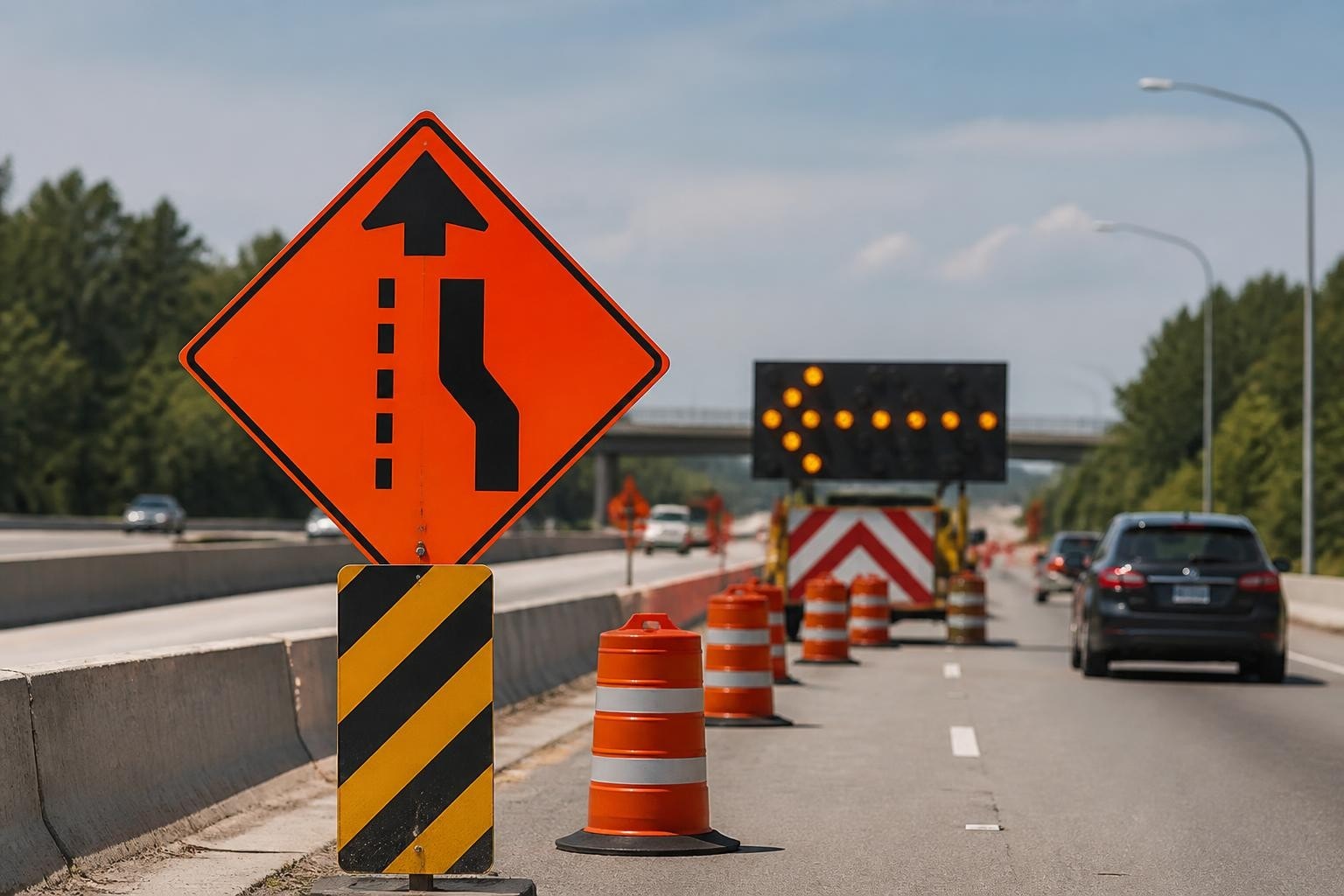
Road work zones require enhanced signage density and often mandate additional devices like arrow boards, channelizers, and temporary barriers to guide traffic safely through altered conditions.
Facility Safety Sign Positioning
Workplace road and safety signs demand different placement strategies focused on hazard proximity and employee sightlines. The Sign Research Foundation's on-premise signage research provides evidence-based guidance for optimal positioning.
Hazard warning signs should mount at eye level (1.4-1.7 metres) directly adjacent to or above the hazard source. Chemical storage areas, electrical panels, and machinery require multiple signs visible from all approach directions.
Emergency information signs must remain visible during power failures and smoke conditions. Exit signs, evacuation maps, and assembly point markers require photoluminescent materials or battery-backed illumination.
Mandatory instruction signs position at decision points before workers encounter situations requiring protective equipment or specific procedures. This advance placement permits compliance before exposure occurs.
Material Selection and Durability
Environmental conditions, vandalism potential, and expected service life dictate appropriate materials for road and safety signs. Outdoor installations face ultraviolet degradation, temperature extremes, moisture, and physical impacts that indoor signs never encounter.
Common Sign Materials
Aluminium sheeting dominates outdoor applications due to corrosion resistance, light weight, and excellent durability. Diamond-grade retroreflective sheeting bonded to aluminium substrates ensures night visibility for road signs whilst maintaining structural integrity through decades of service.
Rigid plastics including polycarbonate and acrylic offer impact resistance and weather protection suitable for both indoor and protected outdoor applications. These materials accept various printing methods and mounting systems.
Flexible materials like vinyl and polyester serve temporary applications, vehicle graphics, and indoor wayfinding where rigidity proves unnecessary. Removable adhesive systems permit updates without surface damage.
Photoluminescent materials absorb ambient light and emit visible glow during darkness or power failures. Emergency exit signs and evacuation route markers increasingly specify these self-luminous materials.
| Material | Typical Lifespan | Best Applications | Weather Resistance |
|---|---|---|---|
| Aluminium + retroreflective | 10-15 years | Road signs, parking | Excellent |
| Polycarbonate | 7-10 years | Facility safety, vandalism-prone areas | Very good |
| Rigid PVC | 5-7 years | Indoor safety, temporary outdoor | Good |
| Vinyl adhesive | 3-5 years | Indoor wayfinding, temporary warnings | Fair |
Maintenance and Compliance Auditing
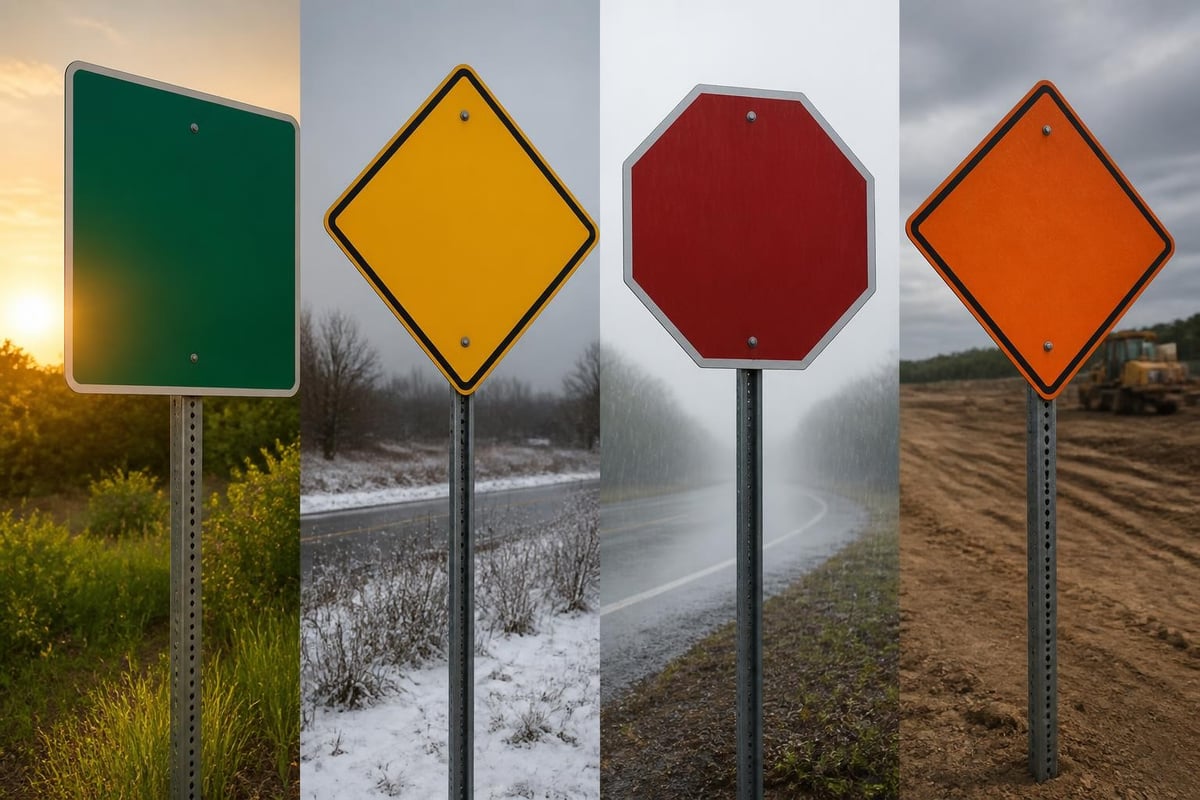
Road and safety signs deteriorate through environmental exposure, physical damage, and simple aging. Regular maintenance programmes ensure continued effectiveness whilst demonstrating due diligence during liability investigations.
Inspection Protocols
Systematic inspection identifies issues before signs fail completely. Monthly visual surveys should document:
- Visibility obstructions: Vegetation growth, parked vehicles, new construction
- Physical damage: Dents, holes, graffiti, bullet strikes
- Retroreflectivity degradation: Fading, delamination, reduced night visibility
- Mounting system integrity: Loose bolts, corroded posts, unstable foundations
- Message relevance: Outdated information, changed conditions, obsolete warnings
Annual detailed assessments employ retroreflectivity meters measuring light return values. Signs falling below minimum standards require immediate replacement regardless of visual appearance.
Compliance Documentation
Comprehensive records demonstrate regulatory compliance and support liability defence. Essential documentation includes:
- Initial installation specifications and placement rationale
- Manufacturer certifications and material test reports
- Inspection logs with photographic evidence
- Maintenance actions and replacement schedules
- Incident reports linking sign conditions to accidents
Digital asset management systems increasingly replace paper records, enabling GPS-tagged photographs, automated inspection reminders, and trend analysis identifying problem locations or materials.
Emerging Technologies and Future Trends
Road and safety signs continue evolving through technological advancement and data-driven design refinement. Several trends shape signage systems entering 2026 and beyond.
Dynamic and Intelligent Signage
Variable message signs adapt to changing conditions, displaying speed limits adjusting to weather, congestion warnings based on real-time traffic, and emergency notifications during incidents. Solar-powered LED displays provide bright visibility without electrical infrastructure.
Connected vehicle systems may eventually supplement or replace certain road and safety signs through direct digital communication, though physical signs remain essential for pedestrians, cyclists, and non-connected vehicles.
Enhanced Materials and Production
Advancements in retroreflective technology improve night visibility whilst reducing maintenance frequency. New prismatic designs return more light to drivers whilst resisting degradation from moisture and temperature cycling.
Digital printing capabilities enable economic small-batch custom signs, supporting facility-specific hazard communication without expensive screen setup costs. Print-on-demand systems reduce inventory requirements whilst ensuring current information.
Data-Driven Placement Optimization
Advanced modelling incorporating vehicle speeds, approach angles, roadway geometry, and human factors research identifies optimal sign placement with greater precision than traditional methods. Simulation tools test proposed configurations before installation, reducing trial-and-error experimentation.
Integration with Comprehensive Safety Systems
Road and safety signs function most effectively as components within broader protection strategies rather than standalone solutions. Complementary measures multiply effectiveness through layered defences.
Physical Infrastructure Integration
Proper sign systems coordinate with roadway design, traffic signals, pavement markings, and barrier systems. Warning signs anticipate geometric features like sharp curves requiring guard rails. Work zone signs coordinate with concrete barriers, attenuators, and lane closures.
Facility safety signs integrate with engineering controls, administrative procedures, and PPE requirements. Confined space entry signs remind workers of atmospheric testing, ventilation, and buddy system requirements before access.
Training and Education Programmes
Signs communicate effectively only when viewers understand symbol meanings and respond appropriately. Workplace safety orientations should specifically address facility signage systems, explaining colour coding, symbol meanings, and expected responses.
Driver education emphasizes sign recognition, though studies show many licensed drivers cannot correctly identify common regulatory and warning signs. Refresher training proves valuable, particularly when traveling to regions with different signage conventions.
Road and safety signs ultimately serve as visual reminders reinforcing knowledge gained through comprehensive training rather than teaching complex concepts independently.
Effective road and safety signs require careful attention to standards, design principles, placement strategies, and ongoing maintenance to protect lives across diverse environments. Whether managing highway infrastructure, industrial facilities, or commercial properties, implementing robust signage systems demonstrates commitment to safety whilst ensuring regulatory compliance. SafetySignsForSale provides the extensive range of compliant road and safety signs, mounting hardware, and related safety equipment necessary to build comprehensive protection systems tailored to your specific requirements.